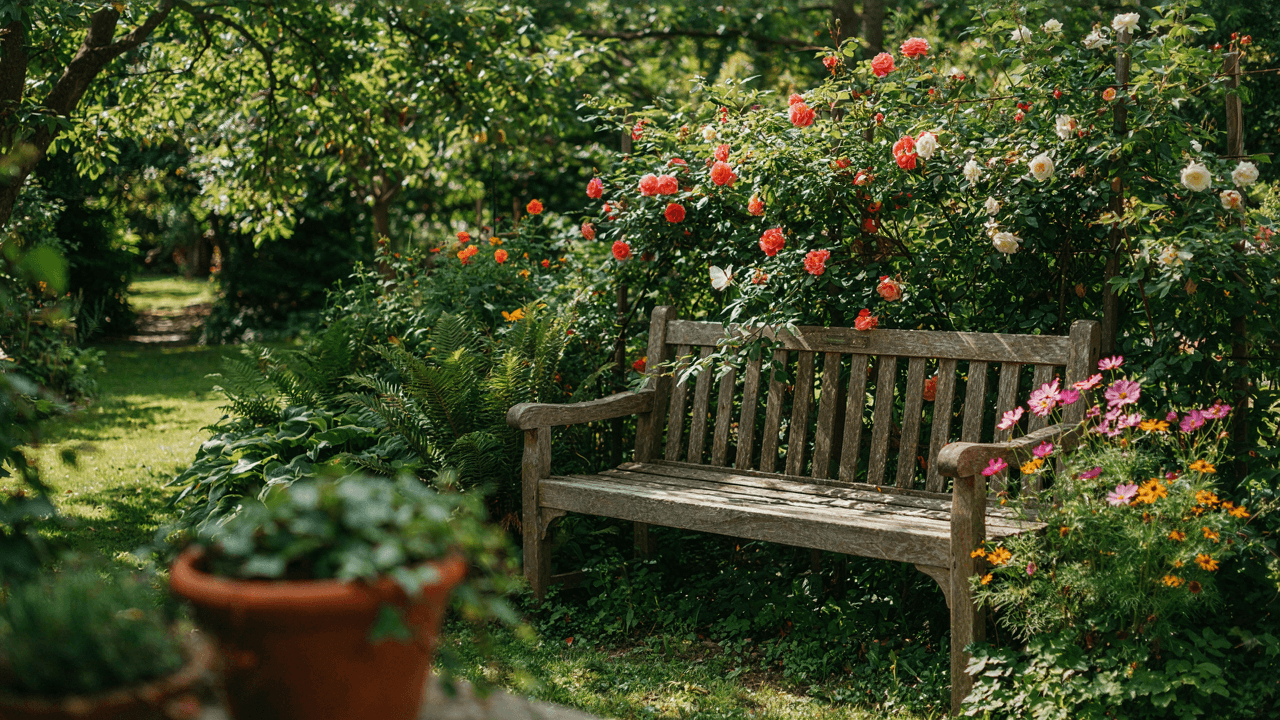
The Proximity Paradox: Why Your “Inviting” Bench Repels

Bench Placement Maximizing Unconscious Barriers
You want people to sit. What you’re really after is proof that your garden works. Here’s the mechanism: most benches are positioned to solve the wrong problem. They’re placed where the view is best or where the sun hits longest, not where social comfort lives. Proximity psychology says the closer a bench sits to a pathway, a building entrance, or another human activity zone, the more exposed and vulnerable a person feels. You’ve built a stage, not a refuge.
The classic mistake is centering the bench in an open lawn or tucking it against a fence line. Both positions trigger the same response: surveillance anxiety. A person sitting there knows they’re visible from multiple angles with no retreat option. Effective bench placement uses existing structures (walls, dense plantings, topography shifts) to create one clear sightline forward and protection on at least two sides. The bench should feel chosen, not stranded.
Comfort Metrics Illusion Versus Reality
Everyone talks about cushion thickness and armrest height. That’s not where comfort lives. Real comfort is psychological before it’s physical. The illusion is that a well-padded bench with ergonomic angles will make people linger. The reality is that a person abandons a bench within three minutes if they feel exposed or uncertain about their right to occupy the space. Cushioning matters only after psychological safety is solved.
Measure what actually keeps people seated: sightline control, temperature stability, acoustic dampening from wind and nearby noise, and ground stability beneath the bench legs. A bench on uneven ground feels precarious regardless of padding quality. A bench where someone can hear traffic or lawn equipment from three properties over won’t hold attention. Test your bench by sitting for ten minutes yourself at different times of day. If you leave early, your guests will too. The mechanism is simple: remove friction from the decision to stay, and people will.
The Linger Logic System: Built In Garden Seating As Behavioral Anchor

Enclosure Signals Safety To The Nervous System

You want people to stay because you want proof that your space works. But they won’t linger in open exposure. The nervous system treats enclosed seating like a defensive position. In architecture, this is called prospect and refuge: you need sightlines out while walls or vegetation contain the body. A garden bench corner with a high back, flanking hedges, or an overhead structure activates the parasympathetic response. Your guests relax because they’re not scanning for threats. The mechanism is neurobiological, not aesthetic.
The best corners use existing structures to build enclosure without construction. A bench positioned where two fences meet, or under a pergola, or backed against a shed wall, triggers the refuge response immediately. People don’t consciously think about this. They sit, and the environment tells their body it’s safe to stop moving. This is why generic center-lawn seating fails. Exposure keeps people upright and ready to leave.
Drawing And Holding The Eye
Most garden bench placement ignores the fact that eyes anchor bodies to space. Where you position a bench determines whether someone notices it, approaches it, and most crucially, stays seated. A visual anchor works like a focal point in landscape design, but applied to human behavior instead of composition. Place the bench where it terminates a sight line, frames a view, or sits at the convergence of pathways. The eye lands there. The body follows. The person sits.
Symmetry and framing matter more than comfort here. A bench positioned to frame a water feature, distant trees, or an architectural detail becomes a viewing station, not just a rest stop. People sit longer when their gaze has somewhere to resolve. The second order effect is social: when your bench faces something worth looking at, guests feel the lingering is justified. They’re not just sitting. They’re observing. Install the bench perpendicular to blank walls. Orient it toward visual content, not toward the house or fence.
Corner Garden Canvas: Framing The Social Scene, Not Just The Seat

How Micro Climates Shape Who Stays

You want people to linger because lingering signals social proof, and social proof signals that your space matters. Here’s the mechanism: conversation thrives in pockets of thermal and acoustic separation from the rest of the yard. In thermodynamics terms, you’re creating a buffer zone—a microclimate that insulates the conversation group from wind, harsh sun, and visual chaos. A bench corner positioned against a fence or hedge wall, with overhead coverage from a pergola or tree canopy, drops the cognitive load required to feel comfortable. The human nervous system relaxes when external stimuli diminish.
The specifics matter more than the idea. A corner facing south but sheltered by a 6-foot fence blocks northwest wind and reduces glare. If you add a pergola at 8 feet tall on the open side, you create a three-wall containment without feeling caged. People sit longer when they don’t squint, don’t shiver, and don’t feel exposed to foot traffic. The bench itself sits 2-3 feet from the corner junction, not flush against it. This gives guests psychological permission to claim the space without feeling trapped between hard surfaces.
The Intentional Void
Most garden design advice tells you to fill corners with activity. This is wrong. Strategic emptiness is what makes a bench corner function as a social anchor. The space directly in front of the bench—roughly 4-6 feet of open ground—needs to stay clear. This isn’t wasted space. It’s the negative space that lets arriving guests see an available seat without navigating obstacles. It signals availability and lowers the friction cost of joining a conversation.
The emptiness also serves a practical function: sightlines. Guests sitting on the bench need to see the rest of the yard and anyone approaching. A corner with a solid wall behind and strategic void in front creates a position of psychological advantage. This is basic spatial strategy. Japanese gardens formalized this principle in their tokonoma alcoves—recessed spaces that command attention because they’re deliberately restrained. Your garden bench corner operates on identical logic. Keep the footprint clear. Let the corner itself do the framing.
The Planter Bench Protocol: Engineering Multi Sensory Engagement
How Scent Anchors Decision Making

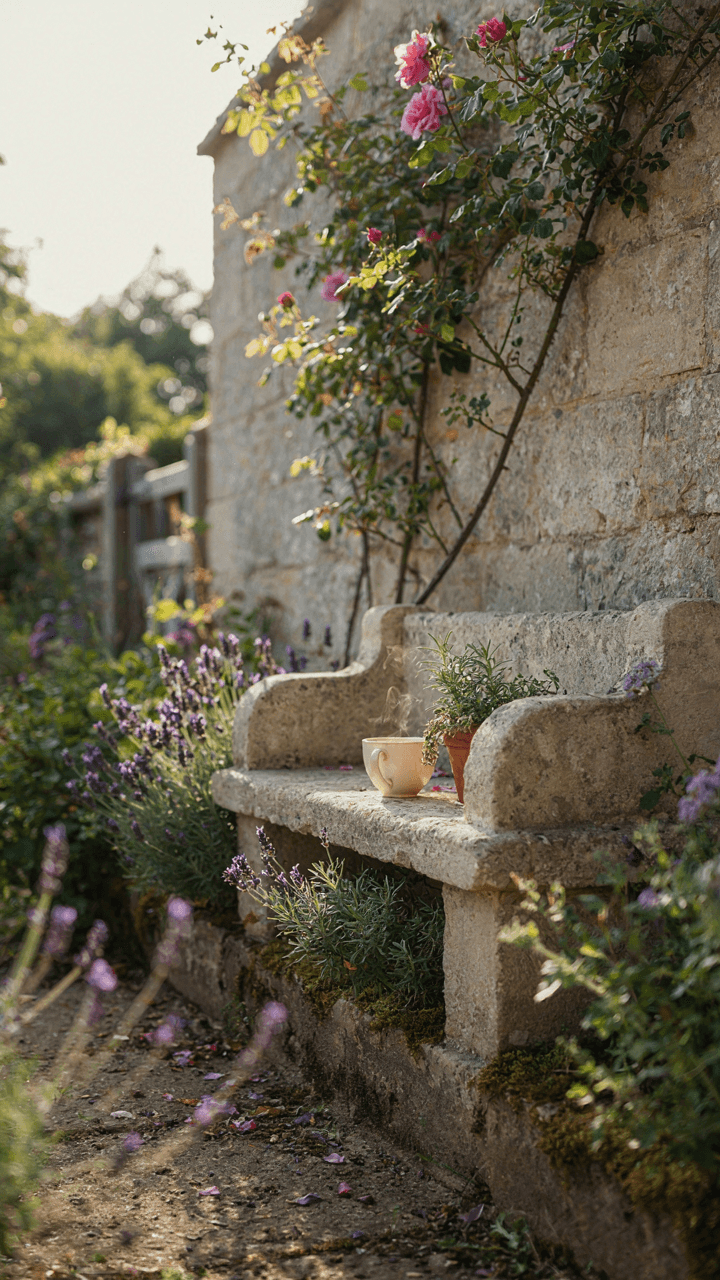
You want people to stay longer because empty benches feel like failure. Here’s the mechanism: neuroscience shows that smell bypasses the thalamus and hits the limbic system directly, meaning aroma creates mood before conscious thought arrives. A garden bench corner with strategic plantings becomes a neurochemical anchor, not decoration.
Volatile organic compounds from lavender, jasmine, and rosemary don’t just smell good. They trigger parasympathetic activation, the nervous system state where lingering feels natural instead of obligatory. The bench stops being a place to sit and becomes a place the body wants to remain.
- Lavender: Reduces cortisol levels measurably. Plant in containers flanking the bench to create an aromatic envelope without overwhelming foot traffic areas nearby.
- Jasmine: Releases indole compounds most heavily at dusk, shifting mood toward contemplation. Night-blooming varieties work best for evening bench use.
- Rosemary: Carnosic acid in the foliage improves focus and memory recall, making conversations feel sharper and more valuable to participants.
- Mint varieties: Cooling menthol creates micro-sensations on skin when brushed. Place low-growing cultivars near seating edges for accidental tactile engagement.
- Gardenias: High linalool content triggers relaxation without sedation. Expensive to maintain but produces the strongest stay-duration effect in field conditions.
The protocol is mechanical: select one primary scent based on intended dwell time, place it upwind of the seating surface, and rotate secondary scents seasonally to prevent olfactory adaptation. Guests stop checking their watches when their nervous system categorizes the bench corner as a recovery zone.
Surface Friction And The Touch Test
Most advice says benches should be smooth and comfortable. That’s incomplete. Tactile variety creates engagement loops that smooth surfaces never trigger. A bench corner that demands nothing from your hands feels like a waiting room. One that invites interaction becomes a destination.
The interaction mechanism works through proprioceptive feedback. Wood grain, weathered stone, textured cushions, and metalwork all register as distinct sensory inputs. Your hands exploring these surfaces activate the insula cortex, the brain region responsible for interoceptive awareness, making the experience feel more present and deliberate. Plant foliage within arm’s reach amplifies this effect significantly.

Rough-hewn timber armrests paired with smooth river-stone planters create textural contrast that keeps hands occupied without demanding attention. Climbing ivy or creeping fig trained along bench frames provides both visual depth and leaf texture exploration. Metal detailing like wrought iron brackets or copper plant markers offer temperature change the moment fingers touch them, especially after sun exposure. Cushions in raw linen or canvas instead of standard outdoor fabric add weight and weave pattern under palms. The combination creates a sensory landscape that extends engagement beyond the seated position itself.
Garden Seating As A Kinetic Sculpture: Designing For Movement, Not Stasis
How Guests Actually Find The Seat
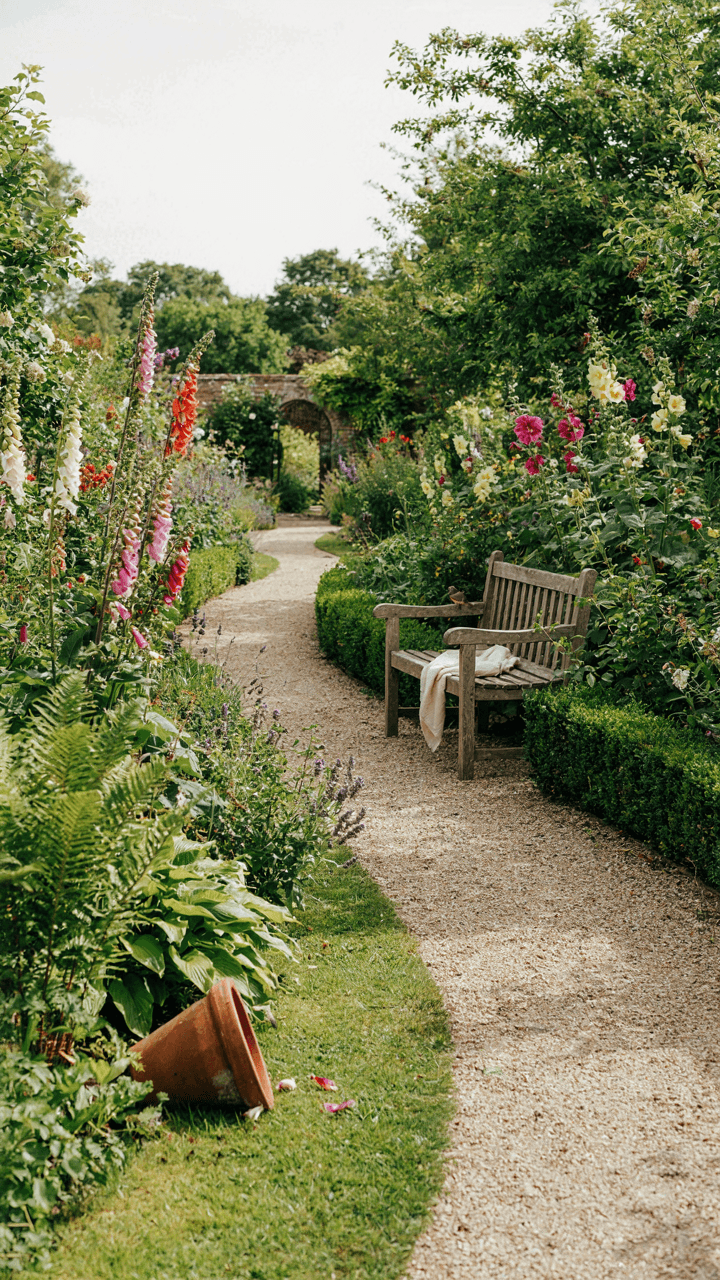
You want people to sit down because you’re afraid an empty bench looks like a failed invitation. Here’s what matters: borrowed from spatial geometry, a bench corner functions as a node in a path system, not an endpoint. Guests won’t notice an isolated seat. They’ll notice one that interrupts their natural walking route at the exact moment they’re already considering where to stand.
Position a garden bench corner where two walking paths intersect or where a path naturally slows near a focal point like a water feature or tree. The bench doesn’t announce itself loudly. It sits where someone moving through the space would naturally pause. This removes the psychological friction of “should I go sit there” because the seat is already part of their trajectory, not a detour.
The Unforced Exit
Most garden seating advice treats lingering as the win. That’s backwards. People stay when they know leaving feels voluntary, not abandoned. In kinetic terms, design for momentum preservation, not entrapment. A bench corner that feels like a waiting area—isolated, with only one approach—creates pressure to leave. A bench with multiple sight lines and secondary paths nearby signals that staying is one option among several.

Arrange the bench to face toward the rest of the garden, not toward a wall or hedge. Ensure guests can see where they came from and where they could go next without standing up first. A bench positioned at a corner of an open space lets someone leave in three directions without retracing steps. The ability to exit cleanly, psychologically, makes people comfortable enough to linger longer.
Small Backyard, Big Psychology: Deception In Compact Spaces

Forced Intimacy Leverages Spatial Constraints
You want people to stay longer without admitting you’re manipulating them through proximity. Spatial constraint is borrowed from architecture and psychology both: it’s the principle of forced engagement. When two people occupy a bench in a tight corner, social distance collapses. They talk differently. They listen harder. A six-foot bench in open lawn invites people to sit far apart and leave fast. The same bench wedged into a corner, surrounded by plantings or walls, removes the exit option. Proximity breeds conversation.
The mechanism works because people unconsciously extend their stay to justify the discomfort of closeness. They fill silence. They ask questions. They lean in instead of back. A garden bench corner works best when the depth of the space (front to back) measures 8 to 12 feet maximum. Beyond that, intimacy breaks. Add a privacy screen or hedge at 5 to 6 feet behind the bench. This doesn’t hide the entire yard. It signals: this corner is separate from the rest. People stay longer in defined, bounded spaces.
Mirror And Visual Tricks Expand Perceived Space
The common advice is to use mirrors to “make small spaces feel bigger.” That’s incomplete. Mirrors don’t just enlarge perception, they obscure the actual boundary. A mirror placed at an angle opposite the garden bench corner reflects sky, plantings, or distant fence, breaking the visual wall. The eye travels farther than the body can. This creates a psychological permission to relax. You’re not trapped in a small corner. You’re sitting in an open zone that happens to have walls.

Position a mirror 6 to 8 feet from the bench at a 45-degree angle, angled toward the sky or tallest plantings. Avoid mirror placement that reflects the bench itself or people sitting on it. That triggers self-consciousness, the opposite of lingering. Vertical garden elements like trellises with climbing vines also work because they draw the eye upward, breaking the compression of a compact corner. Height perception shifts weight distribution of the space. A bench corner with 8-foot sight lines upward reads as larger than one with 6-foot headroom, regardless of actual footprint.
Garden Inspiration: Beyond Aesthetics To Bio Rhythmic Resonance
Light And Shadow As Linger Signals
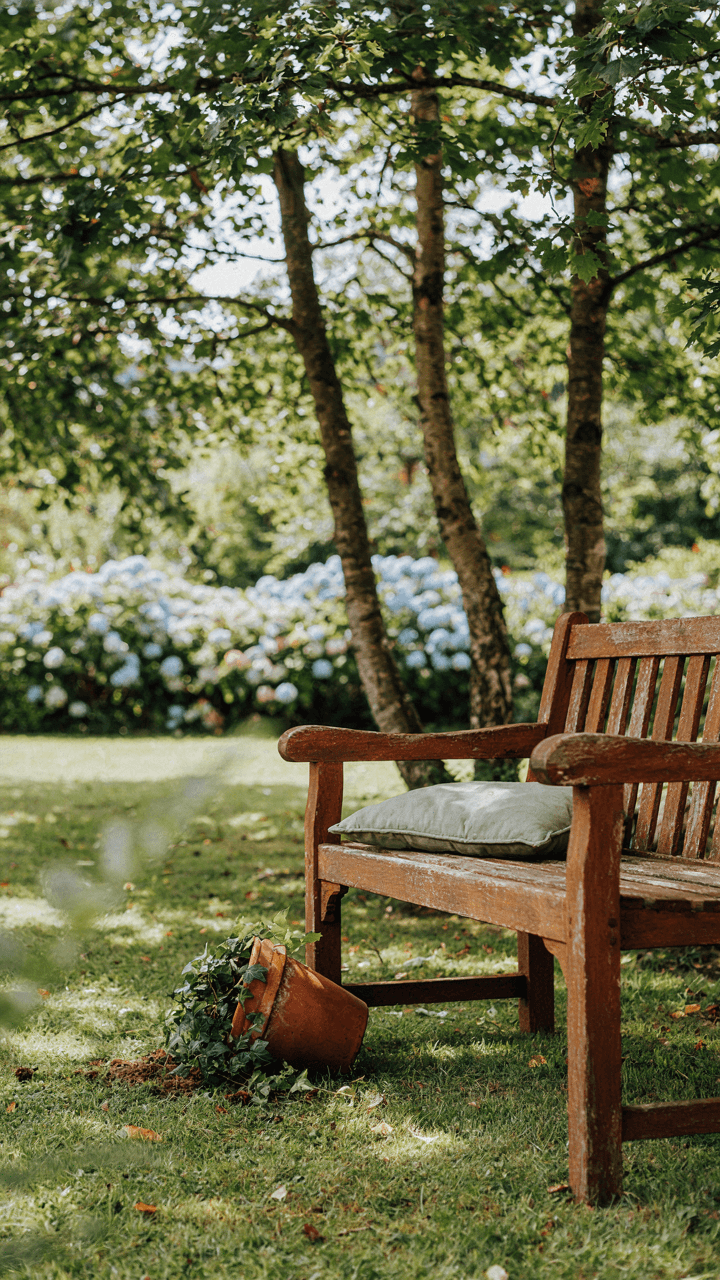
You want people to stay because it validates your space. The mechanism is circadian biology: humans linger where light patterns match their nervous system’s current state. Chronobiology shows that dappled shade with glimpses of sun triggers the parasympathetic response, the body’s rest mode. A garden bench corner positioned under filtered light—through a pergola, tree canopy, or lattice—creates the exact wavelength conditions that signal safety and ease. Direct sun exhausts. Total shade depresses. The middle ground holds people.
The placement matters more than the material. East-facing corners catch morning light when guests are alert but haven’t yet hit afternoon fatigue. West-facing positions work only if you add overhead shade to block harsh afternoon rays. South-facing benches need dense tree coverage to create the shadow-and-light rhythm that prevents glare-induced restlessness. Measure the shadow line at the time of day you want maximum occupancy, then position the bench where that shadow moves across it gradually, not suddenly. This slow shift keeps the nervous system engaged without triggering the urge to relocate.
The Bench As Micro Habitat For Humans
Ecology defines a niche as the specific environmental conditions where an organism thrives. Your garden bench corner is a human niche. Most advice treats bench placement as an interior design problem—wrong. It’s an ecological one. You’re creating a microclimate that pulls people in through sensory feedback loops, not aesthetics. Temperature, humidity, wind break, proximity to plant life, and acoustic dampening all compound to either extend or shorten how long someone sits.

Build the niche systematically. Position the bench where hedges or shrubs block wind without creating a cave feeling. Surround it with plantings that moderate temperature and release moisture into the microclimate. Keep it close enough to flowering plants to register scent but far enough away that pollen and insect activity don’t interrupt comfort. The bench corner becomes a node in the garden’s ecosystem where humans feel as settled as birds in a well-built shelter. Guests stay because their body recognizes it as a place built for rest, not just looks.
Outdoor Corner Seating Ideas: The Art Of The Undemanding Offer
The Low Friction Threshold
You want people to sit without feeling obligated to stay or perform. That’s the real motive here. A garden bench corner works because it removes the social contract of commitment. Unlike a dining table that demands conversation or a lounge that signals leisure time, a corner bench offers what game theory calls a “dominated strategy reversal”—the default move becomes sitting, not deciding whether sitting fits the moment.
The mechanism is simple: proximity without obligation. A bench tucked into a corner of the garden reduces decision friction. People pass by, see the seat, and choose it because the location itself suggests low stakes. They can leave without it feeling rude. They can sit alone or join someone without it feeling staged. The corner position matters because it creates a natural boundary—you’re neither in the flow of the garden nor isolated from it.
Strategic Placement Of Sight Lines And Comfort
Most advice about bench placement is backward. People say put it where you can see the whole garden. Wrong. Put it where the garden can see you, but you control what you see. A corner bench positioned against two perpendicular walls or hedges creates what architects call defensive positioning—you have a clear view of approach but a natural boundary at your back.

Comfort allocation isn’t about cushions and throw blankets. It’s about reducing friction points that make people leave. Place the bench where wind doesn’t funnel through. Ensure the seat height matches the surrounding tables by six inches so transition feels natural. Position it near a water source or small table if possible. The bench corner becomes a stay mechanism when small needs are met before the person realizes they have them.
- Backrest orientation: Face the bench toward sight lines that don’t demand constant engagement—a water feature rather than a busy pathway.
- Arm height and width: Benches sixty inches wide force strangers into proximity. Forty-eight inches allows solo use and optional pairing without awkwardness.
- Surface texture: Wood benches weather visibly; stone requires less maintenance and signals permanence. Choose based on whether you want visible aging to signal “established”.
- Shade coverage: A bench corner under tree canopy versus open sun shifts usage from midday to morning and evening. Match the bench purpose to the shade pattern.
- Sight line to exit: People linger when they know how to leave quickly. Clear sightlines to house, pathway, or gate reduce anxiety about entrapment.
The garden bench corner stops being theoretical when you stop optimizing for visual symmetry and start optimizing for the decision to sit. Place one, measure how often it’s used within two weeks, then adjust sight lines or proximity to traffic patterns based on actual behavior, not preference.
Cosy Patio Ideas Seating Areas: The Calculated Vulnerability Blueprint

The Illusion Of Being Watched
You want people to stay because you’re tired of hosting feeling like work. Here’s the mechanism: perceived privacy works like a stimulus valve. In environmental psychology, the concept of “prospect and refuge” explains how humans choose spaces. Prospect means sight lines outward. Refuge means protection from being seen. A garden bench corner that delivers both keeps people seated. They can observe the yard without feeling exposed to the street or house interior. Tight corners with tall plants behind create the refuge. Sightlines to the garden create the prospect. Neither alone works.
The common advice says “add privacy screens.” That’s incomplete. You need strategic asymmetry. The person sitting should see out more than others can see in. A corner angled at 120 degrees with a hedge or fence on two sides accomplishes this. The bench faces the open garden. The sides block lateral views. Someone inside the house can’t read the space easily. Passersby miss it entirely. This isn’t about making a hidden fortress. It’s about creating a perceptual boundary that feels intentional without being isolating.
The Weight Of Comfortable Entrapment
Making people want to leave less is not about manipulation. It’s about friction design borrowed from behavioral economics. In that field, “friction” describes the effort required to change behavior. A low-friction exit means standing up and walking costs nothing. High-friction exit means you’ve lost your train of thought, your drink is half full, and the shade just hit your shoulders right. Garden bench corners reduce physical and psychological friction for staying. The bench itself matters here. A bench with good back support and seat depth of 16 to 18 inches keeps people from shifting positions every five minutes. Backless benches or shallow seats force constant micro-movements. Those movements become departure signals to the brain.
The surrounding elements compound this. A small side table within arm’s reach means people don’t stand to fetch their drink. Overhead cover from a pergola or mature tree branch eliminates the “I’m getting too hot” impulse. Adequate shade reduces the mental load of managing comfort. Wind breaks from strategically placed shrubs or fence sections stop people from chasing better air. The mechanism is simple: reduce the number of small discomforts that accumulate and trigger departure. The longer someone stays without those micro-discomforts stacking, the deeper they settle into conversation and the less they think about leaving.
Your Garden Isn’t Failing. Your Strategy Is.

The Real Problem With Corner Placement
You’re hoping a bench corner fixes loneliness, and that’s why you’re reading this. Here’s what’s actually broken: you’re treating the corner as a destination instead of a mechanism for behavior. A garden bench corner doesn’t invite lingering by existing. It inverts the physics principle of least resistance. People choose paths of minimum effort. Your corner either removes friction from staying or it doesn’t.
Most bench corners fail because they’re placed to fill dead space, not to intercept actual foot traffic and sightlines. You can’t engineer belonging. You can engineer visibility, wind protection, and proximity to activity centers. The corner becomes functional only when it sits at the intersection of where people move and where they can see without being seen. That’s the real mechanism.
Strategic Positioning Before Aesthetics
Design strategy, borrowed from military positioning, teaches placement before ornamentation. Your bench corner holds ground value. Control the approach angles, the view lines, and what people encounter before they arrive. A corner bench that faces a blank fence wall fails not because it’s ugly but because it offers no information return to the person sitting there.
Place the corner where it interrupts a natural path or overlooks an active zone. If guests traverse the garden to reach the house, the bench captures them at the midpoint where fatigue sets in. If the corner sits near the kitchen window or overlooking planted beds where visible activity occurs, lingering becomes rewarding. The physical placement determines function. Everything else is decoration on a broken foundation.
Your Garden Isn’t Failing. Your Strategy Is

Most people treat a garden bench corner like a decoration instead of a destination. They place it, forget it, and wonder why no one sits there. The shift: design your bench corner as a problem solver, not an afterthought. Position it where conversation naturally happens, where shade exists, where the view justifies lingering. Pick one spot in your garden today that feels forgotten. Put your bench there. Watch what happens when you stop decorating and start solving.