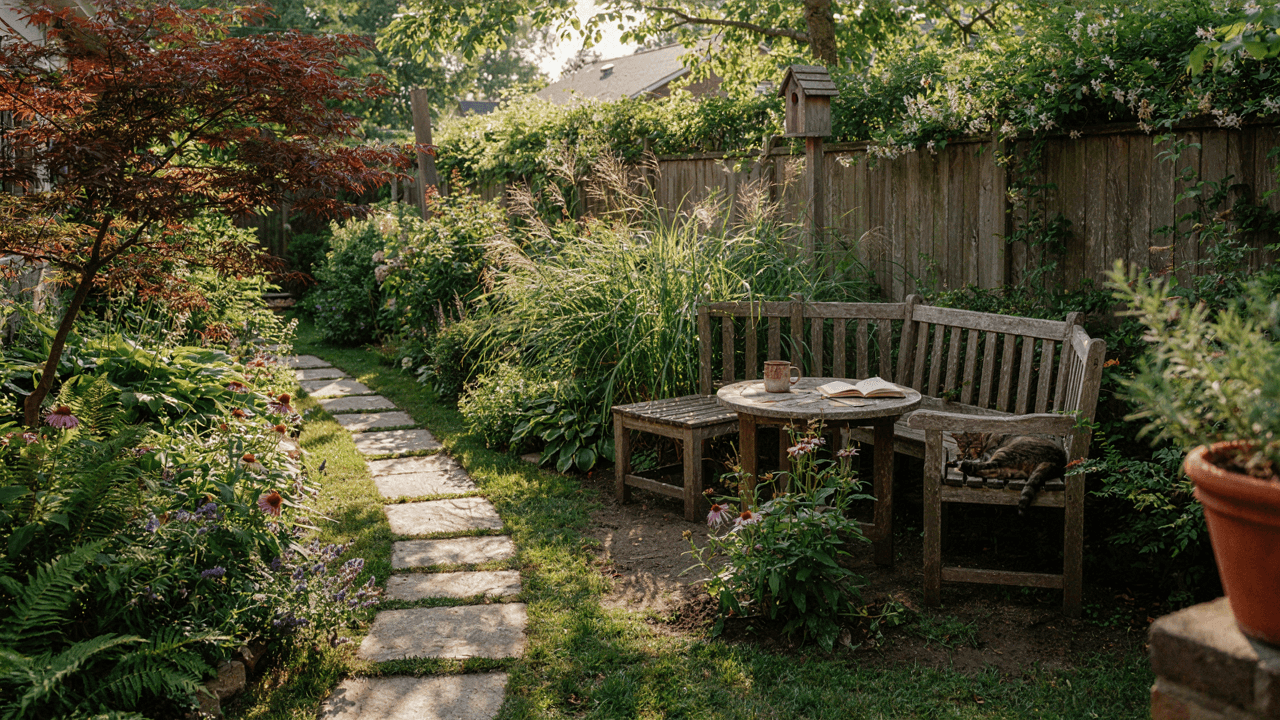
The De Clutter Protocol: Engineering Your Backyard Sanctuary

Remove What Your Eye Can’t Ignore
You want a backyard sanctuary because you’re tired of feeling fractured in your own space. Visual noise taxes your cognitive load before you even sit down. Borrowing from signal-to-noise theory in communications, your backyard’s signal is the experience you’re trying to have, and everything else is interference. Most people think decluttering means hauling away obvious junk. They miss that a cluttered backyard isn’t cluttered because of too many things. It’s cluttered because things have no visual hierarchy or containment.
- Broken or non-functional items: Anything damaged, unused, or awaiting repair sends a subconscious message of incompleteness. Remove it entirely rather than storing it visibly.
- Unfinished projects or materials: Stacks of wood, half-installed trellises, or scattered tools fragment attention. Complete or relocate them completely out of sight.
- Mismatched or orphaned furniture: A single chair that belongs to no set, a table without context. These create visual discord that contradicts sanctuary logic.
- Visible utility clutter: Hoses draped on fences, tool buckets scattered, extension cords lying exposed. Store these in closed containers or dedicated zones outside the primary view.
- Overgrown or dead vegetation: Dead branches, weeds between pavers, and overgrown shrubs read as neglect. They’re not natural, they’re visual evidence of abandonment.
The protocol: walk your backyard from the vantage point where you’ll spend the most time. Document everything your eye catches that doesn’t belong to your sanctuary narrative. Then remove or hide each item before you add anything new. This single move solves seventy percent of backyard problems.
Define Sanctuary By Absence
A sanctuary isn’t defined by what you add. It’s defined by what you remove permission for. Most people confuse a sanctuary with a garden or entertainment space, then wonder why adding more features still feels chaotic. The real definition is negative: a backyard sanctuary is a space where nothing competes for your attention. Your job isn’t to fill it. Your job is to enforce boundaries against intrusion.
This means saying no to random lawn ornaments, accepting that not every corner needs a purpose, and resisting the urge to optimize every square foot. A true sanctuary has empty space. Empty space feels wrong to the acquisition-focused mind, which is exactly why it works. The absence of options reduces decision fatigue. The absence of clutter reduces mental load. Create zones by what you exclude, not by what you include.
Biomimicry’s Blueprint: Beyond The Generic Backyard Garden

Design For Natural Flow

You want this to feel effortless because you’re tired of fighting nature. Here’s the mechanism: biomimicry borrows from systems theory, the field that studies how energy and resources move through networks. In your yard, flow means water, sunlight, and wildlife moving along the paths of least resistance, not the paths you imposed on a grid.
Most backyard advice treats design as decoration. You place plants in rows, add a fire pit, call it done. The real move is mapping how water actually wants to travel after rain, where shade naturally pools, and which edges attract insects and birds. This becomes your design skeleton. You’re not creating flow. You’re revealing it and removing obstacles.
Forest Layers Build Microclimates
The forest doesn’t have a flat floor because that’s inefficient. Ecology teaches us about vertical stratification: the canopy, understory, shrub layer, and forest floor each operate as a distinct thermal and moisture zone. Your yard has one climate now. Layering creates four.
A backyard sanctuary needs height variation to trap heat, slow wind, and hold moisture where you want it. Plant tall trees first (overstory), then shorter trees below them (understory), then shrubs, then ground cover. Each layer casts shade on the one below, creating cooler zones in summer. Each layer also catches and funnels rainwater differently, turning a soggy spot into a dry one or vice versa. The mechanism is simple: density changes temperature and water retention. Stack your plants by height, measure soil moisture at each level monthly, and adjust species placement based on what actually survives where.
The Myth Of Lush Green: Cultivating True Vitality In Your Landscape

Plants That Survive Without You

You want a yard that looks intentional without the weekly maintenance debt. The real mechanism here comes from ecology: you’re building a closed-loop system instead of a dependent one. Native plants aren’t trendy—they’re local species adapted to your region’s rainfall, soil composition, and temperature swings over millennia. Import the wrong plants and you’re fighting against physics every season.
- Nitrogen-fixing natives: Plants like locust or clover pull nitrogen from air into soil, reducing fertilizer dependency and building soil structure over time.
- Deep-rooted perennials: Species with roots extending 6+ feet tap into water tables shallow plants miss, surviving drought without irrigation intervention.
- Insect-native relationships: Local plants host insects that predators depend on, creating a food chain that self-regulates pests without chemicals.
- Seasonal bloom stacking: Native species evolved to flower at different times, extending visual interest year-round while supporting pollinators continuously.
- Soil-building understory: Ground covers and low shrubs native to your zone accumulate leaf matter that feeds microbes, improving drainage and nutrient cycling.
The payoff isn’t aesthetic. It’s operational. Your landscape becomes a living system that handles its own fertility, pest control, and water distribution. You stop managing it and start observing it. That shift from input-heavy to input-light is the actual sanctuary.
Water Systems, Not Water Schedules
Most people treat water like a utility they turn on when grass gets brown. Wrong frame. Think about hydrology—the study of water movement in landscapes. You’re designing capture and distribution, not buying time between sprinkler cycles.
Rain doesn’t fall uniformly. It runs off, pools, or soaks depending on soil structure and slope. Water harvesting systems (swales, rain gardens, mulched basins) intercept runoff at the point it falls, holding it long enough for infiltration instead of letting it drain to the street. One inch of rain on a 1,000-square-foot roof yields 600 gallons. Most yards waste that. A backyard sanctuary collects it.
The mechanism is retention time. Water sitting in soil longer means deeper root access and better moisture availability during dry periods. Mulch holds moisture at the surface. Swales slow water movement, increasing infiltration time. Amended soil (organic matter, compost) holds more water in pores than compacted dirt. These aren’t luxury add-ons—they’re infrastructure.

Skip the constant watering schedule. Install one rain barrel or a small swale system, apply 3-4 inches of mulch around plantings, and amend your soil with 1-2 inches of compost before planting. Water deeply once or twice a week during establishment (usually the first year), then let native plants and your water-capture system take over. Your maintenance drops to seasonal adjustments.
Strategic Placement: Defining Your Outdoor Seating Microcosm

Where You Sit Determines What You See
You want your backyard to feel intentional so visitors think you’re the kind of person who has their life together. The real mechanism is simpler: placement controls sight lines, and sight lines control whether your nervous system relaxes or stays alert. Borrowing from landscape architecture’s concept of “prospect and refuge,” you need sightlines that let you observe without being exposed. Position seating to face inward toward plantings or water features, not toward the neighbor’s fence or street. This isn’t decoration. It’s neurobiology.
Placement also determines whether the space functions as a sanctuary or a waiting room. A seat tucked against the house, facing the yard, creates containment. A seat in the middle of open lawn creates vulnerability. The best placement uses existing structures, trees, or planted screens as a natural frame. You’re not hiding. You’re defining a perimeter that your brain recognizes as bounded territory. Most people put seating wherever there’s a flat spot. That’s why most backyards feel generic.
Materials That Ground The Body
Cheap outdoor furniture is cheap because it signals transience. Your body knows the difference between sitting on plastic and sitting on wood or stone. Material choice has nothing to do with luxury and everything to do with thermal mass and tactile feedback. Wood retains heat, moderates temperature, and gives feedback through its surface. Stone does the same. Synthetic materials don’t. When your skin contacts a material that responds to climate and time, your nervous system registers stability instead of artificiality.

The surfaces your body touches become the foundation of sanctuary feeling. Use teak, cedar, or composite wood that weathers visibly. Use stone or concrete for ground planes. Avoid plastic lounge chairs unless they’re high-end outdoor-specific pieces with structural integrity. Material deterioration is part of the mechanism, not a failure. A weathered wood seat looks lived-in. A weathered plastic chair looks abandoned. Place seating on a hard surface like flagstone or poured concrete to create a defined sitting zone that’s distinct from the grass or mulch around it.
The Indian Courtyard Garden Law: Enclosed Focus, Not Open Exposure

Walls As Sound And Sight Buffers
You want people to think your yard is bigger and more impressive than it actually is. The real mechanism here borrows from acoustic engineering: sound waves and sightlines behave the same way. They travel in straight lines until they hit a barrier. A barrier doesn’t need to be tall to work—it needs to be positioned to interrupt the path between the noise source and your ear, or between the outside world and your eye.
Traditional Indian courtyards worked because walls created defined boundaries that stopped external chaos from entering. A six-foot fence or hedgerow placed strategically blocks street noise, neighbor views, and wind patterns effectively. The placement matters more than height. A wall perpendicular to the noise source stops more sound than a wall parallel to it. Position walls to intercept the direct line of sight from adjacent properties and streets into your sanctuary space.
Central Focus, Internal Gaze
A sanctuary fails the moment your eye searches outward instead of inward. The courtyard model solved this through what landscape architects call internal focal points—a fountain, a specimen tree, a seating area—positioned to anchor attention inside the perimeter. Your yard should train the visitor’s gaze inward, not invite it to wander beyond the boundary.

Place a single strong focal point near the center or slightly offset from center, then arrange seating and paths to orient toward it rather than the perimeter. This creates what designers call “prospect-refuge” dynamics: people feel observed from a safe vantage point rather than exposed. The mechanism is simple. You control where eyes land through object placement. End the visual journey inside the walls, not at them.
Backyard Landscaping Designs: Function Dictates Form, Not Trends
Zone Your Yard By Use, Not Aesthetics
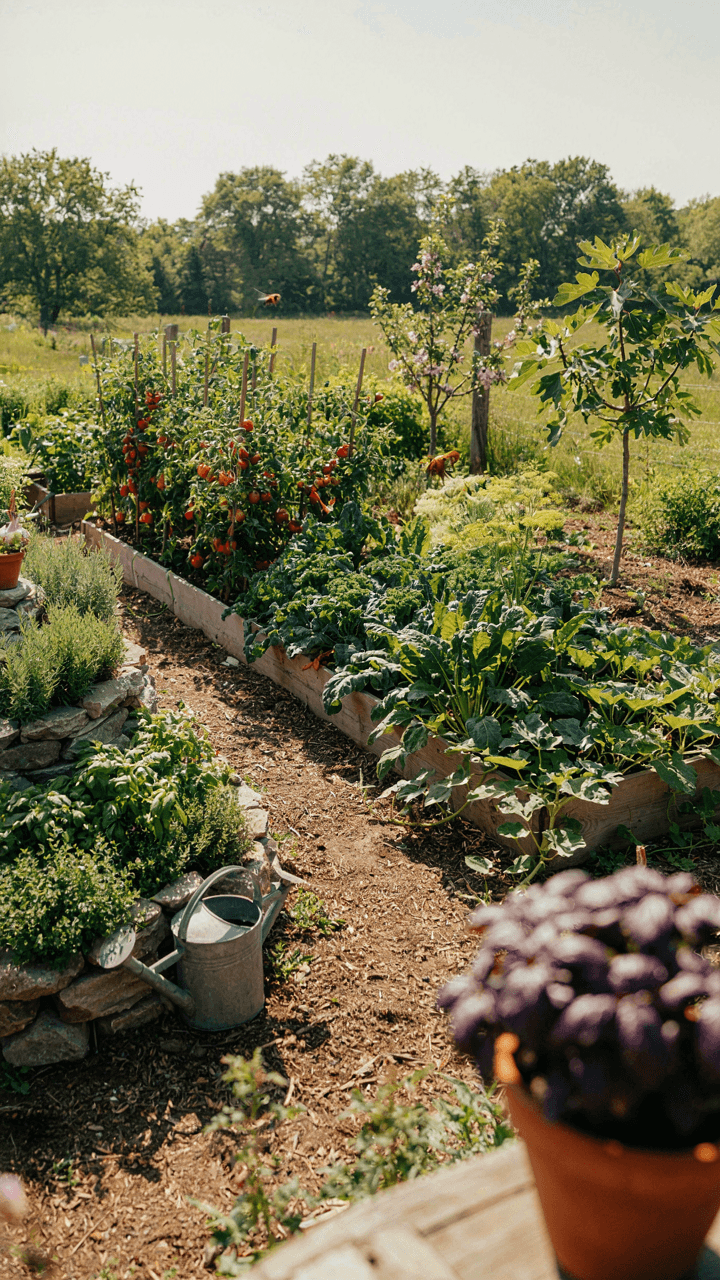
You want your backyard to look intentional so people think you have your life together. Here’s the mechanism: permaculture zones work because they eliminate wasted movement and duplicate resources. Permaculture borrows from ecology, which teaches that systems efficiency depends on proximity. Zone 0 sits nearest your house—herbs, daily harvest plants, high-maintenance specimens. Zone 1 extends further out for occasional-use plants. Zone 2 and beyond hold plants that need minimal intervention.
The mistake most people make is treating zones as rings on a map rather than workflow layers. Your zones should reflect actual foot traffic, water access, and maintenance frequency. If you visit your garden twice weekly, don’t plant shade-tolerant perennials that need weekly deadheading in Zone 2. Instead, place high-touch plants in Zone 0 where you already walk. Map your current movement patterns first—where you naturally stand, where you pause, which edges you ignore. Then build your design around that reality, not around what looks balanced.
Pathways Shape How You Actually Use The Space
Pathways aren’t decoration. They’re navigational architecture that determines which parts of your yard get used and which become dead zones. A path is a permission structure: it tells your body where to go. Without clear routes, people cluster in safe, obvious areas—near the door, along existing hardscape. The spaces that feel remote or unmapped stay empty and maintenance-heavy.

Design pathways to connect functional zones in the order you’d naturally visit them. Morning coffee on the patio to herb garden to seating area—that’s your primary circuit. Secondary paths should connect to quieter zones without forcing detours. Use materials that match your climate durability: gravel compacts under foot traffic and drains fast in wet regions. Stone or mulch work in drier climates. The width matters too—a three-foot path signals you can linger; eighteen inches says pass through. Your pathways should make the sanctuary usable, not just visible.
Cultivating Intentional Quiet: The Noise Abatement System For Your Backyard Sanctuary
Sound Barriers That Actually Work
You want this section because silence signals wealth and control—neighbors can’t afford peace, so you’re buying it. Here’s the mechanism: sound travels in waves that bounce off hard surfaces and get absorbed by soft, dense materials. Think of acoustic engineering’s principle of impedance mismatch—the harder it is for a sound wave to pass through a material, the more energy it loses. Dense plants, water features, and strategic barriers create layers that disrupt sound’s path before it reaches your ear.
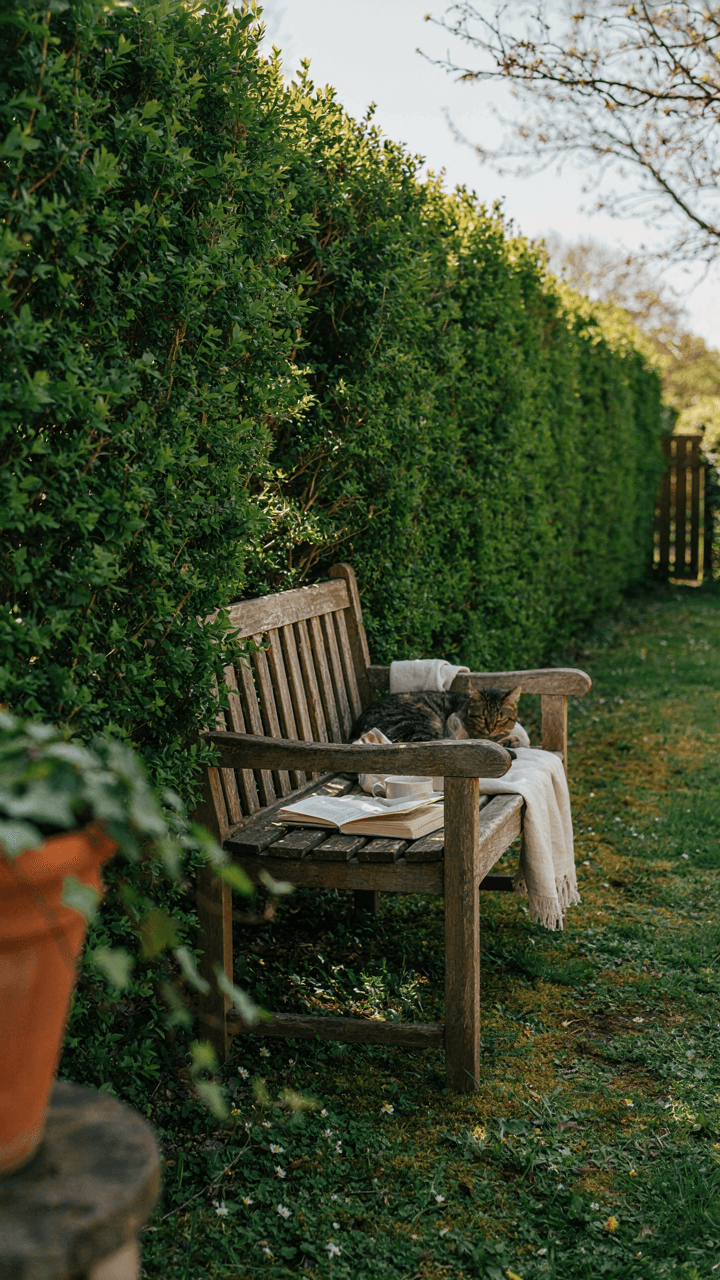
Hedges and shrubs planted in staggered rows outperform solid fences because they absorb rather than reflect. A fence bounces noise back like a drum; a 6-foot hedge of arborvitae or privet actually dampens it. Water features—small recirculating fountains or ponds—mask unwanted sound with consistent ambient noise while absorbing some incoming noise through water’s surface tension. The combination compounds the effect. Install barriers closest to the noise source, not your seating area. This intercepts sound before it travels across your entire yard.
Wildlife As Acoustic Camouflage
Birds and insects create biological noise that masks traffic, neighbors, and human activity. This isn’t mystical—it’s signal masking from information theory. Your brain prioritizes novel sounds over constant background noise. Consistent birdsong trains your nervous system to tune out intrusion. Native plants attract species that vocalize during your peak relaxation hours. Flowering shrubs draw songbirds. Dense groundcover supports insects. The result is an acoustic environment your mind categorizes as “natural and safe” instead of “exposed to the world.”

Plant for year-round presence, not seasonal bursts. Berry-producing species like serviceberry and dogwood retain wildlife through winter. Native grasses attract grasshoppers and crickets. Water sources—even a shallow basin refreshed daily—concentrate bird activity in your sanctuary. The mechanism works because consistent biological sound creates what acoustic designers call a “masking profile” that your auditory system learns to filter. You stop hearing the interstate; you hear cardinals instead. This shift happens unconsciously within two to three weeks of exposure.
Your Yard, Your Escape: Rejecting The Outdoor Living Room Myth And Seating Area
What Solitude Actually Requires
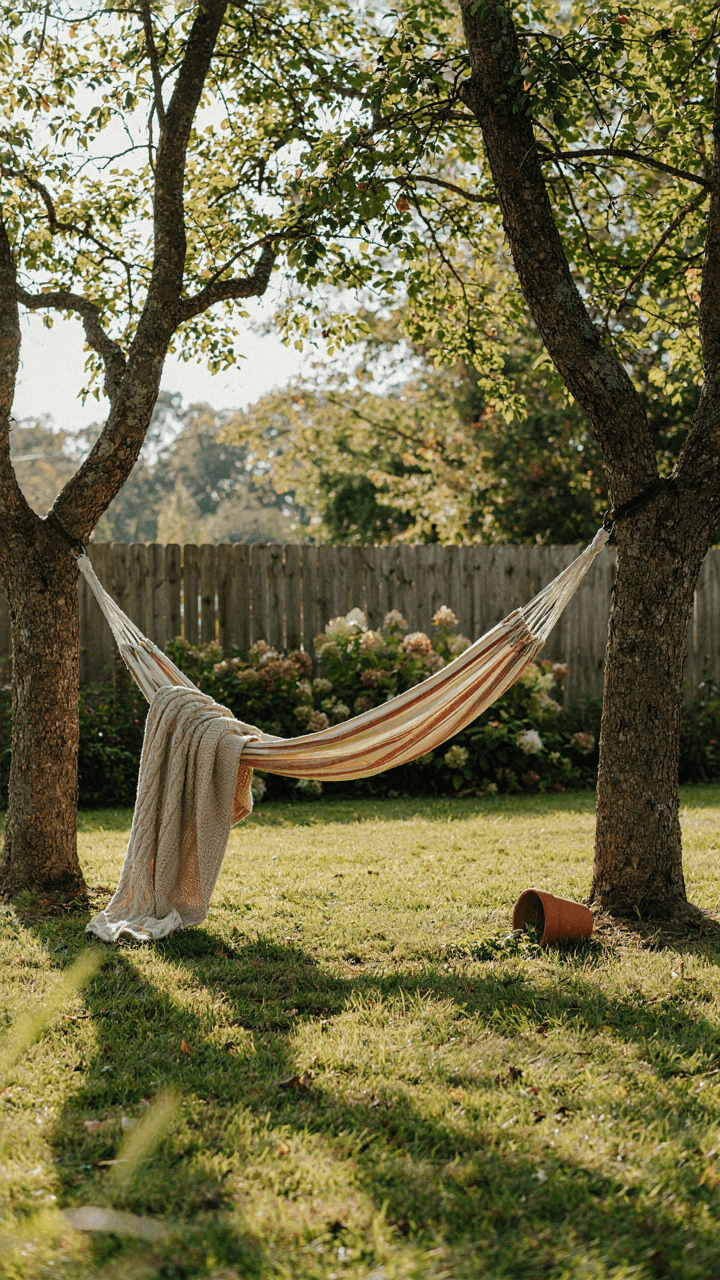
You want your yard to prove you have your life together. That’s the real motive. But a backyard sanctuary operates on the inverse principle of scarcity, borrowed from economics: constraint creates value. Most people design for entertainment potential instead of personal withdrawal. They build for the hypothetical guest who never arrives. The mechanism that actually works is negative space—what you deliberately exclude matters more than what you include. A sanctuary demands boundaries, not an open gathering zone.
Define solitude by asking what pulls you away from it. Is it visual noise from neighbors? Sound from the street? Other people’s schedules interrupting yours? Your parameters aren’t aesthetic choices. They’re functional requirements. A single enclosed seating area facing one direction solves for focus. A fire pit surrounded by multiple vantage points creates obligation to socialize. The distinction between sanctuary and entertaining space collapses when you try to do both.
Letting Disorder Become Design
The outdoor living room myth sells the fantasy of permanent polish. Your yard doesn’t need to look finished. Finished yards demand maintenance rituals that drain the very peace you’re building toward. Ecology moves in ecological succession, not renovation schedules. Plants grow unevenly. Mulch settles. Paths shift. This is where most people fail: they see deviation as failure instead of evolution.

Imperfection accelerates belonging. A moss-covered stone retains moisture and attracts insects that feed birds that create sound and movement. Unmulched areas let volunteer plants establish themselves, creating density without effort. Weathered wood ages into character instead of degradation. Your job isn’t preservation but direction: decide which growths stay and which you remove. Let the yard become a record of seasonal change rather than a static asset. This reduces labor by 70 percent while deepening the sanctuary effect through authentic development.
The True Barrier Isn’t Your Yard’s Size Or Budget, It’s Your Addiction To External Validation

You’re waiting for permission. Waiting for the perfect plan, the perfect season, the perfect Instagram aesthetic to justify starting. Your backyard sanctuary doesn’t need your approval first. It needs you to stop performing and start building. Today, pick one corner of your yard and change it. Plant something, move a rock, hang a light. Stop planning the perfect sanctuary and create an imperfect one instead. The difference between people with backyards and people with backyard sanctuaries is just one: they started before they were ready.