
The Falsity Of More Space

Why Conventional Kitchens Fail In RVs
You want more counter space because you’re convinced that’s what separates you from cooking disaster. It’s not. Conventional kitchens fail in RVs because they apply land-based design to a constraint problem. A house kitchen optimizes for workflow across distance. An RV kitchen optimizes for density under gravity. These are opposite requirements. The moment you try to replicate a home kitchen’s layout in 40 square feet, you’ve already lost. You’re fighting physics instead of working with it.
RV manufacturers copy residential kitchens because it’s fast and familiar. They don’t because it works. They place appliances where a builder would place them in a house, then shrink everything proportionally. This creates dead zones, awkward reaches, and counter edges that trap you against the stove. The real problem isn’t the amount of space. It’s that conventional design wastes half the space you have through poor positioning and unused vertical real estate.
Bigger Isn’t Better, It’s Worse
The myth that bigger RV kitchens solve cooking problems is lazy thinking. A larger counter doesn’t make you cook faster or better. It makes you move more. More distance between prep, cooking, and storage means more wasted motion, more bumping into cabinets, and more spills in tight quarters. You’re trading efficiency for the illusion of breathing room.
The mechanism is simple: constraint breeds optimization. When space is limited, you stop arranging things for comfort and start arranging them for speed and accuracy. You think vertically instead of horizontally. You use magnetic strips instead of drawers. You stack instead of spread. When you have more space, you default to the habits you learned in a house, which don’t transfer to moving vehicles. Smaller counters force you to use the laws of kitchen design instead of fighting them.
The Command Center Protocol For RV Kitchens

Zones Over Square Footage

You want counter space because you’re afraid cooking in an RV will expose your lack of planning. The real mechanism is this: task separation beats surface area. Cooking, prep, plating, and cleanup each demand different zones. A two-foot counter divided into four functional areas outperforms a four-foot counter treated as one dumping ground. RV kitchens force this constraint. You stop wasting motion between where you chop, where you cook, and where you plate.
Establish a prep zone on one side of your stove, a plating zone on the opposite end, and a cleanup station near your sink. This mirrors assembly line logic from manufacturing. Each zone gets its own small tools and ingredients. You never cross zones mid-task. When zones are unclear, you create the bottleneck yourself—reaching across the stove, moving items twice, losing counter space to items that shouldn’t be there.
Flow Beats Size Every Time
Most people think they need bigger counters. Wrong. They need a sequence that removes decision-making. The common advice to “use vertical storage” misses the point. Vertical storage holds things. Workflow optimization moves things through a system. Start with your cooking sequence: what do you grab first, second, third? Then position storage and zones to match that sequence exactly, not your cabinet layout.
The constraint forces clarity. In a house kitchen, bad workflow hides because space absorbs inefficiency. In an RV, bad workflow becomes obvious because you run out of counter immediately. Organize your zones so prep flows into cooking flows into plating flows into cleanup. Store ingredients near prep zones. Keep cooking tools within arm’s reach of the stove. Position the plating zone where hot food won’t cross traffic patterns. This discipline costs nothing and recovers more functional space than adding shelves.
Gravity And Leverage: Physics For Your Camper Kitchen

Stack What You Don’t Use Daily

You want to feel like you have more space without actually moving your RV, so you’re looking for permission to ignore the counter. Physics gives it to you. In mechanics, leverage is the mechanical advantage gained by using a lever. In your galley, vertical storage is your lever. Everything you use weekly or less moves up. Everything daily stays at elbow height.
The common advice says to use every inch. That’s incomplete. You’re not optimizing for inches, you’re optimizing for access friction. Wall-mounted magnetic strips, overhead cabinets, and hooks above windows hold your least-touched items. Your coffee maker and cutting board stay put. This single decision cuts your reaching and shuffling in half.
Put The Heavy Stuff Lower Than You Think
Counter placement isn’t about prettiness, it’s about work. The principle of mechanical advantage says that moving weight requires less effort when the load sits closer to your body’s center of gravity. In an RV, this means your heaviest, most-used tools go at waist height or below, not on open shelves at eye level where they create visual clutter and physical strain.
Canned goods, cast iron, and water bottles belong in under-counter cabinets or drawers, not stacked visibly. Your knife block, utensils, and small appliances occupy the sweet zone between your hips and shoulders. This setup cuts prep time because you reach naturally instead of adjusting your stance. Place your cutting board directly above your lowest drawer so you pull, place, and work without repositioning.
The Deceptive Allure Of Multi Purpose Gadgets
When Everything Does Nothing Well

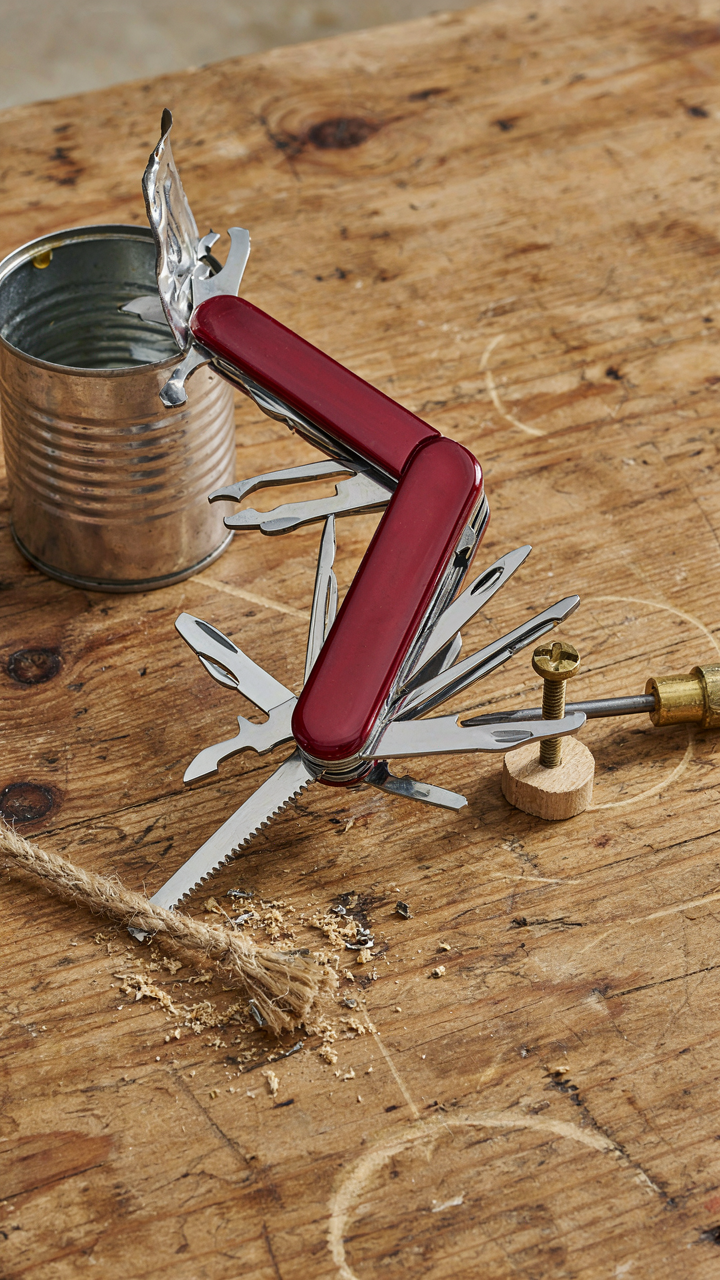
You want to believe one tool solves multiple problems because it signals you’re efficient and resourceful. The mechanism is simple: a gadget designed to do three things does all three at 60% capacity. Kitchen science confirms this. Compression, heat distribution, and ergonomic leverage don’t scale linearly across functions. A chopping board that folds into a colander that becomes a steamer rack performs each task worse than a single-purpose tool. RV counter space rewards specialization, not compromise.
The RV kitchen operates under severe constraint. Every item competes for cubic inches. Manufacturers exploit this by packaging mediocrity as convenience. You end up storing a tool you use once weekly because it theoretically saves space, when you’d actually free more room by keeping one excellent cutting board and one excellent colander. Multi-purpose gadgets occupy mental shelf space too, creating decision friction every time you cook. The math doesn’t work. Space saved by consolidation gets consumed by the tool’s inefficiency forcing you to use supplementary single-purpose items anyway.
The Real Tax Of Kitchen Clutter
Clutter operates like cognitive load in systems design. Every item in your RV kitchen drawer increases retrieval time and decision complexity. Adding a multi-function gadget doesn’t reduce clutter, it reorganizes it. You still have your knife, your vegetable peeler, your cutting surface. Now you add a tool that does all three poorly, and you use the original tools anyway because they work. You’ve subtracted nothing and added friction.
The counter space problem in an RV isn’t solved by tools that do more. It’s solved by tools that do one thing so well you never need backup options. This means owning a single sharp knife instead of a knife plus a peeler plus a multi-tool. It means one mixing bowl instead of nesting bowls in three sizes. Store only what you use weekly. During trip planning, identify your actual cooking pattern first. Then buy tools that match that pattern exactly. This eliminates the gadget temptation at the source.
RV Organization: Eliminating The Culinary Redundancy

The Duplicate Purge
You keep extras because you’re afraid of running out, but fear is expensive in 200 square feet. The mechanism at work here is what economists call the sunk cost fallacy applied to physical space: you hold onto duplicate items because you already own them, not because you’ll use them. An RV forces a hard constraint that a house never does. You cannot ignore the trade-off.
Start by cataloging every single kitchen tool you own. Pull everything from cabinets, drawers, and hidden corners. Lay it out. You’ll spot duplicates immediately: two can openers, three spatulas, multiple measuring cup sets. Most RV owners carry these because they came from a kitchen where storage was infinite. In an RV, each duplicate item steals counter space or cabinet real estate from something you actually cook with. The math is brutal and non-negotiable.
One Tool, One Role
Multitasking doesn’t work for people and it doesn’t work for kitchen tools. A colander that doubles as a strainer works for neither function completely. The design compromise kills both utility. Pick one tool per task and commit to it entirely, which means one cutting board, one chef’s knife, one mixing bowl set that covers your actual cooking range.
The constraint forces better decision-making. When you can only keep what serves a single, clear purpose, you stop rationalizing. You choose the best version of that tool and leave the rest behind. This is when your counter stays open. This is when you actually cook instead of spend ten minutes finding space to prep. The protocol: for each cooking task you do weekly, assign one and only one tool to it.
Small RV, Big Impact: Countertop Materials That Matter

Surfaces That Don’t Betray You Under Pressure

You care about this because a destroyed countertop feels like a personal failure in a space where you can’t escape it. The real mechanism is heat transfer and material degradation. RV counters fail not from use but from thermal shock and moisture infiltration. Laminate delaminates when water sits underneath. Particle board swells. The material you choose determines how many seasons before your counter becomes unusable.
Butcher block and granite look premium but trap water in RVs where ventilation stays poor. Solid surface materials like Corian resist this because they’re non-porous and bond at a molecular level rather than layered construction. Stainless steel transfers heat too fast and shows every fingerprint, creating psychological friction every time you cook. The counterintuitive pick: marine-grade vinyl composite or commercial laminate rated for moisture environments. These materials were designed for boats, not kitchens, which means they handle the exact condition your RV throws at them.
Reclaim Workspace By Engineering Surfaces Smarter
The common advice says to keep counters clear. That’s incomplete. You should design surfaces that work as storage while remaining accessible. In architecture, negative space refers to empty area that defines form. In RV counters, you’re doing the inverse: you’re adding form that doesn’t consume usable surface. Thin cutting boards that nest vertically in a gap between appliances. Magnetic strips on the side of a cabinet edge that hold metal containers. Folding or pull-out surfaces that mount under existing cabinets add 8 to 12 inches of workspace without taking permanent counter real estate.
Material choice drives this. Lightweight composites support accessories without bracket reinforcement. Recessed edges and beveled corners prevent items from catching and tipping during travel. Install a countertop that has a 1-inch raised lip on the backsplash side. This converts the back 3 inches of counter into containment space for cooking debris and prevents items from sliding during acceleration or braking.
RV Storage Hacks: The Illusion Of Permanent Solutions
Collapsible Systems Beat Bolted Installations

You want to feel like you’ve solved the problem forever. That feeling is the trap. The real mechanism here is optionality—borrowed from systems thinking, where a closed system loses adaptive capacity the moment you commit. Your RV layout isn’t permanent. Your cooking needs shift. Your body ages. Temporary storage keeps you in control instead of locked into yesterday’s decision.
Collapsible containers, nesting bowls, and hanging racks solve the actual problem: you need access to counter space unpredictably, not constant storage. The moment you bolt something down, you’ve surrendered flexibility for the illusion of organization.
- Collapsible silicone bowls: Stack to nearly flat, expand when needed, hold from prep to storage without transferring food between containers.
- Hanging spice racks with magnetic backing: Mount on metal strips above counters, remove entirely when you need the wall space for something else.
- Nesting measuring cup sets: Take up one slot when stacked, eliminate six individual spots cluttering your drawers.
- Tension rods under cabinets: Hold spray bottles, cloths, or small hanging organizers, remove in seconds without drilling new holes.
- Vacuum storage bags for dry goods: Compress pasta, rice, flour to half their volume, stack flat above cabinets, retrieve only when needed.
These systems let you expand or collapse your storage footprint based on what you’re actually cooking that week. Fixed installations assume your cooking never changes. It does.
Why Fixed Storage Locks You Into Failure
Everyone installs permanent shelving or drawer dividers thinking they’re upgrading. They’re actually reducing your ability to adapt. Most RV owners discover this six months in when their cooking pattern shifts and now they’re stuck with a cabinet designed for someone else’s kitchen.
Fixed storage optimizes for one scenario. Real cooking happens across dozens of scenarios. When your lifestyle changes, your storage becomes an obstacle you’re forced to work around. You lose counter space, not gain it, because you’re maintaining a system that doesn’t match your actual use. The mechanic is simple: build storage flexibility into your flow, not rigidity into your walls.

The Unseen Weight Of Aspiration: Small Camper Kitchen Ideas

Your Kitchen Fantasy Versus The Box You Live In
You want a full kitchen because you’re afraid cooking in an RV means eating worse, and worse eating signals failure. The mechanism is simple: you’re projecting a pre-RV life onto a fundamentally different space. A full-size stove, counter depth, cabinet volume—none of that exists here, and no hack makes it exist. You either cook differently or you don’t cook at all.
The gap between what you imagined and what fits is the real problem. Most people buy an RV, then spend months trying to recreate their apartment kitchen in 24 square feet. They cram appliances, fight for counter space, and end up cooking less because everything feels wrong. Accept the constraint first. Then work with it.
Stop Fighting Physics, Start Using It
Industrial designers call this principle “constraint-driven innovation”—you solve harder problems faster when you eliminate options. Your RV counter space hack isn’t about finding more surface area; it’s about eliminating the need for it. A single sharp knife and a cutting board that sits flush over a burner replaces half your prep station. A nesting bowl set replaces stacked storage. You’re not working around your kitchen. You’re redesigning your process.
The cooking style that works is the one that minimizes active counter real estate. Sheet pan meals, one-pot cooking, mise en place done directly into the pan—these aren’t inferior to sprawling prep work. They’re efficient. Once you shift from “I need space to cook” to “I need a method that doesn’t need space,” your counter becomes functional instead of frustrating. Keep your most-used tool within arm’s reach of your cooking surface. Everything else stays stowed.

Your Real Obstacle Isn’t Space; It’s Your Attachment To Excess

Every counter hack fails the moment you stop asking why you own seven kitchen gadgets you use twice a year. RV living forces a choice most people avoid: what actually matters? Pull three items from your kitchen today. Not tomorrow. Today. Throw them out or sell them. You’ll feel lighter, and your counter will prove it. Constraints don’t limit you; they reveal what you actually need.