The Myth Of More: Why Buying More Storage Is Losing You Space
The Organizer Trap
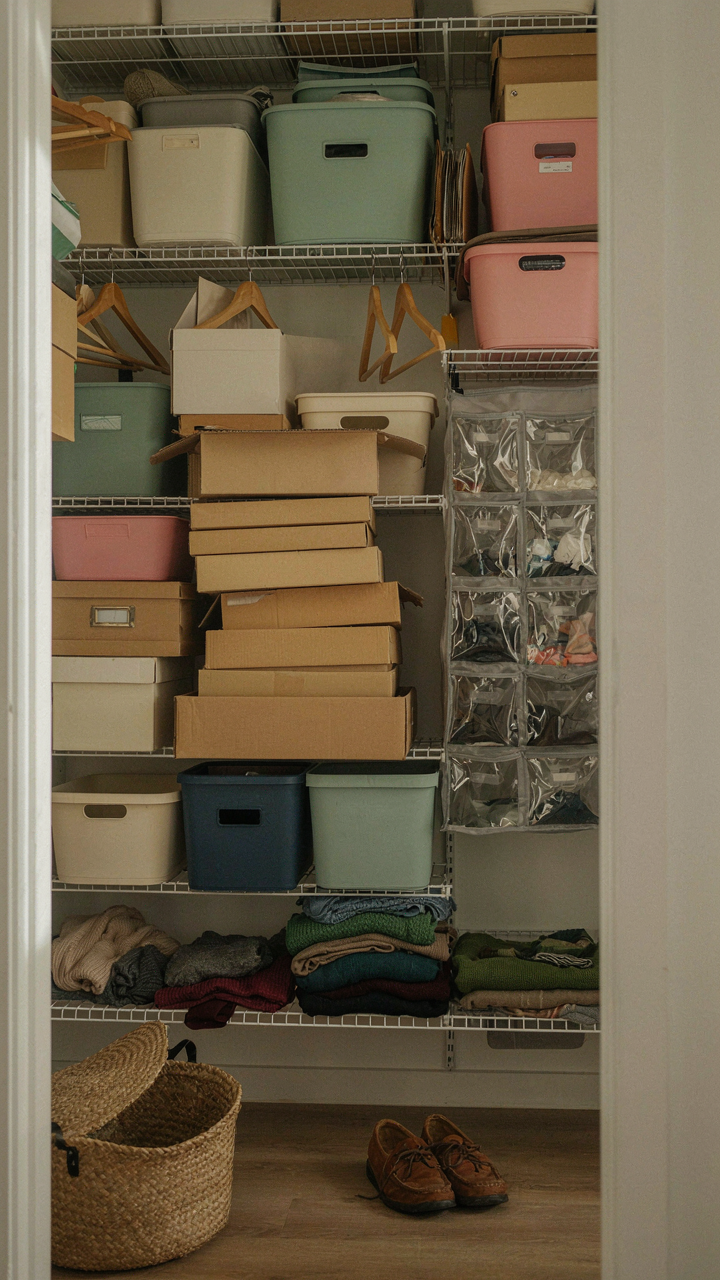
You think you need better systems because admitting you have too much stuff feels like failure. The real mechanism is displacement: every organizer you buy takes up floor or wall real estate before it holds anything. An RV bathroom cabinet measures roughly 24 by 18 inches. A hanging organizer claims 4 inches of depth. You’ve surrendered 8 percent of your usable volume to the container itself, not the contents.
Most people buy storage solutions backward. They keep their items, then hunt for containers. In RV design, this reverses the space equation. You don’t optimize storage by adding more organizers. You optimize it by eliminating what doesn’t fit into your existing footprint first. The organizer industry profits from your refusal to make that choice.
What Each Addition Actually Costs
Think of RV bathroom storage like naval logistics: every cubic inch of supply chain overhead reduces deployment capacity. A shelf divider sounds neutral. It isn’t. In a 30-inch-wide under-sink cabinet, a divider system takes 1 inch of depth and eats 2-3 inches of vertical space for installation hardware. You’ve compressed usable volume by roughly 6 percent before storing a single item.
Calculate true space cost by measuring the organizer’s footprint, adding installation clearance, then dividing your remaining volume by your original volume. Most organizers reduce effective capacity by 10 to 20 percent. The bathroom in your RV operates on margins this thin. Before you purchase another drawer insert or magnetic strip, identify what you’ll remove from the space to make room for it.
The RV Bathroom Inventory Protocol: What You Actually Need

Track What You Actually Use

You want to believe you need everything you own. That’s the real reason this matters. But RV bathroom space doesn’t care about your psychology. Economics calls this “inventory turnover”—how fast you move stock. In RV bathrooms, turnover is your enemy. Every item sitting unused is dead weight stealing inches. Run a one-month audit. Document what you touch daily, weekly, and never. Mark each bottle, container, and tool. Be honest about frequency, not intention.
After thirty days, you’ll see the pattern. Most people discover they use eight to twelve core items regularly. The rest occupy prime real estate for contingencies that rarely materialize. This data becomes your baseline. Don’t trust memory. Memory tells you that travel-size deodorant matters. Data tells you what actually happens. Track in a simple notebook or phone notes. The format doesn’t matter. The honesty does.
Strip Down To Actual Rotation
Most advice here is wrong. You don’t need backup supplies in an RV bathroom. You need a supply chain. The difference matters. Backups create false security and waste space. A supply chain means you use something, it depletes, you replace it. This cycle works in tight quarters because nothing accumulates. One toothbrush, not three. One deodorant in rotation, not five. One set of medications and supplements you actually take daily.
“Redundancy is not preparation in a space-constrained system.” Identify the items you genuinely used during your audit month. For each one, ask: if this ran out tomorrow, could I replace it at a reasonable RV stop or town? If yes, you keep one. If no, you keep one plus a reasonable backup. Reasonable means travel-sized or smaller. Anything else goes. Pull everything out of your bathroom. Physically remove items that didn’t get touched. This is the protocol that actually creates space.
Vertical Dominance: Unlocking Hidden RV Bathroom Real Estate

Adhesive Hooks: Maximum Utility, Minimal Footprint

You’re hoping vertical storage will somehow make your RV bathroom feel less cramped without admitting you bought an RV that’s too small. Here’s the mechanism: adhesive hooks exploit the one dimension RV bathrooms have in abundance—height—by converting wasted wall space into load-bearing real estate. Unlike permanent installations, adhesive hooks require zero drilling, zero structural compromise, and zero landlord approval anxiety for rental rigs.
The real constraint isn’t the hooks themselves. It’s substrate preparation. RV bathroom walls are typically fiberglass or laminate over plywood, and moisture is the enemy. Clean the wall with rubbing alcohol, let it dry completely, then apply hooks rated for 3 to 5 pounds each. Cheap adhesive fails not because it’s weak but because installers skip the surface prep step. Towels, loofahs, and small bottles hang safely from quality 3M Command strips designed for bathroom environments. Replace strips every 12 to 18 months, depending on humidity and weight load.
Over Door Caddies And Shower Organization That Work
Everyone buys over-door organizers expecting them to solve everything. They don’t. They solve one problem: they occupy dead space behind a door that would otherwise sit there unused. The specificity matters. A caddy with shallow pockets works. A caddy with deep pockets that blocks the door from closing does not.
- Tension rods across the shower surround: Mount horizontal rods between shower walls at multiple heights to hang spray bottles, washcloths, and loofahs without adhesive or drilling.
- Magnetic strips on metal surfaces: RV shower surrounds sometimes have metal framing. Magnetic strips hold metal grooming tools, nail clippers, and tweezers without taking up shelf space.
- Vacuum seal bags for off-season items: Store heavy cotton towels, spare toiletries, and seasonal items in compressed bags on upper shelves, freeing functional bathroom space.
- Corner suction cup caddies: These fit into shower corners and don’t interfere with water flow or door operation. Suction cups fail if the wall texture is rough, so test before committing.
- Hanging organizers on cabinet doors: Mount slim fabric organizers on the inside of cabinet doors to store medications, first aid supplies, and cleaning products vertically rather than horizontally.
The installation sequence matters. Install tension rods first, as they’re load-bearing and dictate what else fits. Mount suction cup caddies second, testing for seal strength immediately. Add adhesive hooks last, using remaining wall space strategically. This order prevents conflicts and lets you adjust placement based on what actually works in your rig’s specific dimensions and moisture patterns.
The Multi Functional Mandate: Every Item Earns Its Keep

One Bar Handles What Three Products Do

You want to believe your RV bathroom can accommodate the same product lineup as your home. It can’t, and pretending otherwise wastes the only real asset you have: space. Borrowed from economics, RV bathrooms operate under scarcity pricing—each cubic inch costs something. A solid soap bar that cleans skin, shaves, and removes makeup occupies one slot instead of three. That’s not minimalism. That’s math.
Solid soap bars concentrate function into density. A standard bar replaces liquid body wash, shaving cream, and makeup remover without performance loss. Solid deodorant works the same way. Toothpaste tablets eliminate the liquid container entirely. The mechanism is straightforward: remove the water weight and packaging redundancy, and one item does the work of several. Store the bar in a magnetic container mounted inside the cabinet door to keep it accessible and dry between uses.
Tools That Stack Functions Eliminate Shelves
Most RV bathrooms advice tells you to buy special organizers. Wrong. You need tools that perform multiple operations so fewer items occupy your space. A combination nail file and cuticle pusher reduces two tools to one. A mirror with built in magnification and demisting capability handles grooming and visibility without requiring separate fixtures. A small squeegee removes excess water from surfaces and serves as a shower caddy edge.
The real win is tool consolidation on walls rather than shelves. Mount a tension rod inside the cabinet to hang wet items instead of stacking them. Use adhesive hooks rated for moisture to hang a spray bottle of multipurpose cleaner that works on mirrors, fixtures, and surfaces. This protocol works because it moves items vertical instead of horizontal, which is the constraint in RV bathrooms. Every tool you mount to a wall is space you reclaim in a cabinet.
The “Zero Crevice” Strategy For Small RV Bathroom Storage Ideas

Under Sink Custom Inserts Transform Dead Space

You want your bathroom to feel intentional, not like you’re making do. Most RV owners ignore the under-sink cavity entirely because the plumbing takes up obvious space, but that’s where the mechanism lives: vertical real estate you’re already paying for sits empty because nobody measured it. Custom inserts work because they force you to declare what goes where instead of letting items drift into chaos.
Start by removing everything under the sink and measuring the actual usable depth, width, and height around your p-trap. The p-trap consumes roughly 6 to 8 inches of depth on most RVs. Use a thin plywood insert or a modular drawer system that sits flat against the back wall and sides, leaving the trap zone untouched. This turns wasted corner angles into tiered storage for toiletries, cleaning supplies, and medications that need to stay dry and accessible.
Seal Gaps Before Items Vanish Into Them
The real problem isn’t storage scarcity; it’s that RVs move. Every pothole, turn, and brake sends loose items into crevices between the sink cabinet and wall, or into gaps around plumbing runs. You don’t notice until something valuable disappears or you hit a smell you can’t locate. Seal these gaps with adhesive-backed foam weather stripping or thin rubber wedges that fit snugly but remain removable.
Identify every gap wider than a half-inch around your sink base, cabinet edges, and counter seams. Fill horizontal gaps first since gravity works against you there. Small items migrate downward in an RV faster than on land. Use flexible foam rather than rigid caulk so you can access plumbing if needed without destroying your storage system. Check seals monthly during your first three months of use, then quarterly after that.
Psychology Of Scarcity: How To Conquer Your Fear Of Lacking

The Real Cost Of Keeping Things

You’re afraid of running out because running out feels like failure. Economics calls this opportunity cost: the value of what you give up by choosing one thing over another. In your RV bathroom, every item you keep is space you’re not using for something that actually matters. A half-empty bottle of shampoo takes up the same shelf real estate as a full one. The cost of keeping it isn’t the bottle itself—it’s the cubic inches you’ve surrendered.
Most storage advice tells you to “declutter” or “be intentional.” That’s useless. What you need is a brutal calculation: for every item, ask what you lose by keeping it versus what you lose by replacing it if you run out. If a bottle of deodorant costs four dollars and replacing it mid-trip costs you dignity and a gas station detour, the replacement cost is higher than the item’s footprint. Keep it. If you have three half-used bottles of lotion from different trips, the replacement cost is near zero—toss them. This framework stops the emotional hoarding dead.
Batch And Refill To Starve Scarcity
Refilling containers is not a trendy organizing hack—it’s the only way to separate actual need from packaging waste. The mechanism works because packaging is designed to feel full and important. A gallon jug of shampoo looks legitimate. A 2-ounce travel bottle of the same shampoo feels precious and rare, even though it costs more per ounce.
Buy concentrates or large formats once per season and fill small containers as you need them. This collapses the psychological trick that packaging plays on your fear. You see the gallon jug at home before your trip and know you have supply. Your RV bathroom holds only what you’ll use in two weeks. The scarcity signal your brain sends—that clutching feeling when you see a half-empty bottle—disappears because you’ve engineered actual abundance into your supply chain instead of storing it where it takes up space.
RV Bathroom Organization: Magnetic Fields & Suction Cups Reconsidered

Industrial Strength Magnets For Metal Surfaces

You want a solution that looks intentional and costs almost nothing. That’s the real driver here. Magnets work because they exploit a basic physics principle: ferromagnetism. In RV storage terms, ferromagnetism is your ability to anchor items without drilling, adhesive, or hardware that fails under vibration. Most RV owners dismiss magnets as toys because they’ve only tried weak refrigerator-grade ones.
Industrial neodymium magnets hold 10 to 15 pounds per square inch on clean steel. RV bathroom cabinets, medication holders, and tool racks often have metal frames or backing panels. The mechanism is simple: you mount the magnet to the item, attach it to the metal surface, and vibration becomes irrelevant. Magnets don’t loosen over time like adhesive does. Placement matters though. Mount them low on vertical surfaces where the load hangs downward, not horizontally where shear force fights the magnetic pull.
When And Where Suction Cups Actually Hold Up
Suction cups fail predictably, and the common advice to “just get stronger ones” misses the actual problem. Suction cups work through negative pressure, not adhesion. On smooth, non-porous surfaces with consistent contact, they hold. On textured, curved, or slightly dusty surfaces, air leaks into the seal and pressure equalizes. Your RV bathroom has fiberglass walls that feel smooth but aren’t. Even a light film of moisture, soap residue, or dust breaks the seal.
Use suction cups only on flat fiberglass or acrylic surfaces that you’ve cleaned with rubbing alcohol first. They work best for lightweight items under five pounds in low-vibration zones like mirrors or shelves above the toilet. Install them level to the ground. Any angle causes the seal to creep. Replace them every eighteen to twenty-four months because the rubber degradates and loses elasticity. Test the hold before storing anything valuable on the shelf.
The Mobile Minimalism Method For Rv Bathroom
Decant Everything: Liquids, Powders, Pills

You want to feel organized without actually cutting back. That’s the real reason this section matters to you. But here’s the mechanism: RV bathrooms fail because they store containers, not contents. The packaging takes up 60-70% of the volume while holding 10% of the actual product. Decanting transfers only what you use into smaller vessels.
Shampoo bottles, toothpaste tubes, and pill bottles are designed for retail shelves, not cubic feet of floor space. Buy small 2-3 ounce pump bottles, dropper containers, and stackable jars from medical or travel supply vendors. Label everything with waterproof tape. This single move reclaims more space than any organizational system because you’re removing the waste, not hiding it.
Flat Pack And Collapsibles: The Ultimate Space Savers
The common advice here is dead wrong: people tell you to buy collapsible storage bins as if they save space. They don’t. They compress when empty but still occupy shelf depth. What actually works is eliminating the need for rigid containers entirely through flat-pack thinking, borrowed from industrial supply chains where density equals survival.
Use adhesive-backed wall pouches instead of under-sink cabinets. Hang shoe organizers on the back of the bathroom door for rolled towels and grooming tools. Buy collapsible dish racks and drying mats that fold to 2 inches thick. Store hair tools in vacuum-seal bags. The mechanism is vertical displacement: move everything off horizontal surfaces and into the walls and doors. Your floor becomes functional instead of cluttered.
Beyond The Mirror: Neglected RV Bathroom Storage Solutions

The Door Back Is Real Estate You’re Wasting

You want to feel like you’ve maximized your space without admitting you haven’t looked at what’s literally behind you. The mechanism is simple: cabinet door interiors have depth that remains unused in most RVs because manufacturers default to empty. A standard RV bathroom cabinet door sits 1.5 to 2.5 inches deep before hitting the sink or wall. That’s workable space if you treat it like inventory, not decoration.
Adhesive organizers, thin shelving, and magnetic strips exploit this zone without blocking door closure. Toiletries, medications, and small tools mount flat against the interior surface. The constraint forces you to store only what fits the shallow profile, which means your actual necessities become visible and accessible. Install organizers before the door swings open and hits anything behind it.
Secret Storage Points Most People Miss
Everyone talks about over-the-toilet racks and under-sink baskets, but those solutions fill fast and become obvious clutter. The real density gains come from spaces that don’t advertise themselves as storage. Look for the gap between your toilet tank and the wall, the dead space above your shower caddy, the cavity inside your medicine cabinet’s frame, or the hollow sections of your RV’s sidewalls if they’re accessible through the bathroom area.
- Toilet tank backs: Install a slim organizer behind the toilet using adhesive strips or a tension rod to hang small bags of medications and supplies.
- Mirror frame edges: Thin magnetic strips or self-adhesive hooks on the frame’s sides hold razors, tweezers, and small tools without visible mounting.
- Ceiling corners: Corner shelves mounted in bathroom corners use vertical space that never registers as “full” until you stack items there.
- Shower surround crevices: The gap between shower walls and cabinetry fits slim vertical organizers or tension rods for towels and bathing supplies.
- False cabinet bottoms: Remove a cabinet’s bottom panel, install a thin plywood shelf 3 inches up, and stack flat items like towels or paper goods below it.
The payoff is access without visual clutter. False bottoms and hidden compartments work because they move frequently accessed items into a defined zone while keeping the cabinet’s functional surface clear for daily use. Measure twice, mount once, and never store anything in these spaces that needs daily rotation.
The Reimagined Camper Bathroom: Design Principles For True Efficiency

The Storage Hierarchy You Actually Need
You want to feel in control of your space. The real mechanism is that most RV dwellers store what they own, not what they use. You’re wasting cubic inches on backup supplies and duplicates you’ll never touch. The fix is brutal: inventory only items you access within a 48-hour cycle, then assign them zones based on reach frequency, not category.
Daily-use items live at eye level and arm’s reach from where you stand. Weekly items go one shelf up or down. Everything else either leaves the RV or gets mounted outside in wet lockers. This isn’t organization theory, it’s triage. You compress your bathroom from 40 square feet to maybe 8 that actually matter, and suddenly storage problems disappear because you’ve eliminated the problem at the source.
Task Zones Over Catchall Drawers
Military logistics calls this “spatial clustering,” and it applies directly to RV bathroom storage: group tools and supplies by the specific action they serve, not by type. The common mistake is creating a “toiletries drawer.” That fails instantly because you open it daily for different reasons. Instead, you build zones: shower prep occupies one corner, grooming occupies another, medication lives in a third. Each zone stays compact and self-contained.
A shower zone holds exactly soap, shampoo, and a razor. Grooming gets a mirror-mounted organizer with hair tools and deodorant. Medicine takes a small cabinet door-mounted holder. You never hunt. You never double-stock because you see what you have at a glance. When you move from one task to the next, your supplies are already there, waiting. That’s efficiency—not spending mental energy finding things in a tight space.
The Clutter In Your Camper Bathroom Isn’t A Storage Problem, It’s A Decision Problem. Eliminate Ruthlessly

Stop buying organizers. You don’t have a storage crisis, you have an ownership crisis. Every bottle, container, and backup supply you keep is a decision you made to carry dead weight. Pull everything out. Touch each item. Ask one question: does this solve a real problem on the road or does it solve an imaginary one? Throw out the rest. Better rv bathroom storage starts when you stop storing things you don’t actually use. Your bathroom doesn’t need more space. It needs you to decide what matters.