
The Unspoken Cost Of A Cheap Box Truck Camper

What The Listing Price Doesn’t Show
You want to believe a ten-grand box truck is a steal because you’re afraid spending more money means you’re bad with decisions. Here’s the mechanism: used box trucks operate in a market where sellers only disclose what they’re legally required to. Everything else is your problem the moment you take possession.
The engine, transmission, and frame condition determine whether your conversion becomes a mobile home or a rolling repair bill. A cheap truck often masks deferred maintenance through cosmetic fixes—fresh paint, new upholstery, clean interior. Sellers know buyers shop with their eyes first. The real assessment requires a pre-purchase inspection from a diesel or heavy-duty mechanic who charges 150 to 300 dollars and actually gets under the vehicle.
When Systems Fail Between Uses
Common advice says budget five to ten percent of purchase price annually for maintenance. That’s incomplete. Box trucks sit idle for weeks or months, and dormancy creates specific failure modes that regular vehicles don’t experience.
Fuel systems gum up. Batteries lose charge and corrode terminals. Coolant degrades in stagnant radiators. Seals dry out on doors and windows, letting water into frame cavities where rust accelerates. You discover these problems when you try to start the truck for a trip. Prevention requires a pre-season protocol: fluid flushes, battery charging, seal inspection, and a cold engine start test at minimum two weeks before travel.
Box Truck Conversion Layout: Optimizing For Reality, Not Instagram

Function Over Aesthetics: Designing For Daily Grind

You want your layout to look like a design magazine spread because you’re buying status through the conversion, not solving for how you’ll actually live in 200 square feet. The mechanism is simple: aesthetics consume space that function needs. A wood accent wall looks great in photos and wastes three inches of usable depth. A recessed lighting rig photographs well and costs time you won’t recoup. Strip the conversion to what you touch, use, and depend on daily.
The bed, kitchen, and storage solve 85 percent of your problems. Everything else is decoration posing as necessity. Prioritize this order: sleeping platform, stove and sink, refrigeration, water systems, then climate control. Only after these systems work without compromise should you consider finishes. Your layout succeeds when you can cook a meal, shower, and sleep without moving the same item twice. Test this ruthlessly before permanent installation.
Maximizing Utility Per Square Foot
Economics calls this “density of return on invested capital.” In a box truck, it means stacking function vertically and eliminating dead zones where nothing serves two purposes. A bed frame that creates storage underneath isn’t clever design—it’s the only rational choice. A dinette that folds into wall space when not in use isn’t trendy, it’s mandatory. The common advice says “use vertical space,” which is lazy. The real mechanism is eliminating single-use zones.
Map out activity zones: sleeping, cooking, working, storage. Each zone must occupy the smallest footprint possible while remaining usable. A galley kitchen takes up less floor space than a separate counter. A murphy bed claims vertical real estate instead of claiming the entire floor during sleep hours. Measure twice, design once. Build your layout on cardboard templates at full scale before cutting into your truck. This single protocol prevents the 90 percent of conversions that waste 40 pounds of material on poor spatial decisions.
The “Truck House” Fallacy: It’s Still A Truck

Noise, Vibration, And The Comfort Ceiling

You want to believe the interior will feel like home. It won’t, because you’re fighting physics on a platform designed to move cargo, not people. The real mechanism: a box truck’s frame transmits every road imperfection directly into your living space. Diesel engines produce low-frequency vibration that no insulation fully dampens. Highway noise enters through thin aluminum walls, the cab firewall, and the gap between driver area and living quarters where most conversions cut corners.
Standard RV insulation (foam board, mineral wool) handles temperature but barely touches vibration. Engine vibration resonates at 600 to 2000 Hz depending on RPM. To actually reduce it, you need mass decoupling: isolating the living floor from the frame using rubber or elastomer mounts rated for vehicle use. Most converters skip this and add foam instead, which muffles nothing. The living space will rattle differently than a purpose-built RV because the truck’s structure wasn’t engineered for it. Accept this first, then budget materials accordingly.
Weight Distribution And How It Changes Everything
Vehicles are load-bearing systems. Adding 3,000 to 5,000 pounds of living space, water, and gear to a chassis rated for cargo changes how the truck responds to steering input and braking. The engineering term is “center of gravity shift,” which directly affects rollover risk, tire wear, and brake fade. Most box truck conversions place weight high and rearward, compressing the rear suspension and lifting the front end slightly.
This isn’t a minor comfort issue. It affects stopping distance, especially on highway descents. A loaded conversion needs suspension upgrades: air springs or heavier-duty coil packs to handle the new baseline load. Tire pressure must increase to handle the weight, which changes ride quality again. The steering becomes heavier, responsiveness decreases, and the truck understeers in corners more than stock. Before cutting into aluminum, calculate your full loaded weight and compare it to the truck’s GVWR and axle ratings. That number determines whether you need suspension work before you even build the box.
Box Truck Conversion Interiors: Durability Trumps Trendy

Materials That Last Against Constant Motion

You want your interior to look like a magazine photo without admitting you’re terrified of it falling apart the moment you hit a pothole. Here’s the mechanism: a box truck isn’t a stationary home. It’s a vibrating metal box that moves. Everything inside experiences constant low-level shock and movement that stationary structures never do. This isn’t about aesthetics. This is about what survives repeated stress cycles without degrading.
Plywood and MDF are the default choices because they’re cheap and familiar, but they fail predictably in mobile environments. Plywood delaminates when exposed to humidity swings and vibration. MDF absorbs moisture and swells irreversibly. Marine-grade plywood costs more but uses exterior adhesives that resist moisture penetration. Aluminum composite panels don’t absorb water, don’t rot, and handle vibration without fatigue. They cost more upfront but they don’t require replacement mid-conversion. The real cost calculation isn’t material price per sheet. It’s whether you’re rebuilding interiors every two years or never touching them again.
Assembly Integrity Prevents Everything Else
Structural engineering principles apply directly to box truck campers: load distribution, stress concentration, and fastener failure are your three failure modes. Most conversions use standard wood screws or nails. These work until they don’t. Vibration causes fasteners to back out progressively. One screw loosens, load transfers to its neighbors, those fail faster, and suddenly your bed frame or cabinet is moving independently of the wall. You don’t notice until something breaks or crashes into your face at 2 AM on a rough road.
Use stainless steel bolts with lock washers and nylon-insert lock nuts on all structural connections. Screw every joint, don’t nail anything. Pre-drill everything to prevent wood splitting, which creates stress concentration points that crack under vibration. Seal screw holes with polyurethane caulk after fastening to prevent water infiltration and reduce vibration transmission through the fastener itself. Test your assembly by driving over rough terrain before declaring it done. If fasteners are backing out, your assembly integrity failed before the build was complete.
The “Box Van Conversion” Myth Of Easy Customization

What The Chassis Actually Dictates

You want to believe customization is infinitely flexible because that fantasy lets you skip the hard planning phase. It isn’t. The chassis constrains everything downstream, and most people don’t grasp this until they’ve already committed money and time.
Box trucks come in three weight classes: light-duty (10,000-14,000 lbs GVWR), medium (14,000-26,000 lbs), and heavy-duty diesel models. Each class dictates payload capacity, axle strength, suspension travel, and brake system architecture. A P700 Ford step van has 4,000 lbs usable payload. A Freightliner MT-45 diesel has 10,000-plus. Put 6,000 lbs of water, propane, batteries, and structure into a P700 and you exceed GVWR, which voids insurance and creates genuine legal liability. The frame geometry, wheelbase, and axle placement are fixed. You can’t relocate the fuel tank or add external structure that changes the center of gravity without recalculating load distribution. This isn’t customizable. It’s fixed physics.
Systems integration—electrical, plumbing, HVAC, propane—must route through existing wall cavities, around wheel wells, and within the frame rails. You don’t get to route a gray water line wherever you want. It must drain at the lowest point, slope correctly to avoid pooling, and clear the rear axle and suspension components. Install lithium batteries without considering thermal management and cooling pathways, and you create a fire risk. The chassis doesn’t bend to your design. Your design has to conform to the chassis first, then optimize within those constraints.
Integration Complexity Exposes Poor Planning
Most conversion advice treats electrical, plumbing, and climate control as independent problems you solve separately then stack together. That approach creates cascading failures that surface months into the build when diagnosing becomes impossible.
Consider electrical load balancing during shore power connection and engine-off battery draw. A 100-amp alternator charges lithium batteries at 200 amps, which means the alternator can’t carry that load and your chassis electrical system simultaneously. You need an isolator or a DC-to-DC charger that limits input current. Skip this detail and you deplete the chassis battery while “charging” the house battery. Nobody teaches this because it requires understanding both systems as one integrated circuit, not two separate builds.

Plumbing creates similar integration traps. Freshwater tanks placed for weight distribution might sit where gray water drain lines need to pass underneath. Heater core coolant lines must not share the same gravity zone as propane appliance vents, or condensation seeps into propane regulators. Sewage backflow into the freshwater system happens when drain vents aren’t tall enough or properly routed. Each system depends on spatial routing, pressure dynamics, and gravity. Build each system independently and you create conflicts that require partial deconstruction to fix.
Climate control integration is where most builds fail silently. Insulation R-value, window condensation, ventilation CFM, and propane heater BTU output must work as a closed-loop system. A box truck with 40 square feet of window area, R-7 wall insulation, and a 16,000 BTU heater will develop mold inside four weeks during winter. The heater runs, but moisture has nowhere to exit fast enough. The fix isn’t better insulation or a bigger heater. The fix is installing a powered exhaust fan tied to a humidity sensor before you build the walls. You can’t retrofit this logic after framing is complete. Treat each system as dependent on the others from day one, or accept that your conversion will fail at system boundaries.
The Self Sufficiency Protocol For Your Box Truck Home Conversion

Power Systems: Energy Budget, Generation, Storage
You want to believe you’ll work less once you’re mobile. That’s backwards. What you actually want is to stop thinking about power management. The real mechanism here comes from thermodynamics: you’re running a closed system with finite inputs. Budget your energy like a military campaign budgets ammunition. You don’t fire because you have bullets. You fire because you calculated the outcome.
Start with honest consumption math. Every appliance, light, and device draws amps. A typical box truck camper runs 1500 to 3000 watts peak load. Most conversions use 200 to 400 amp-hour lithium battery banks paired with 3000 to 5000 watt inverters. Solar generation depends on panel placement and seasonal sun angle. A south facing roof with 400 to 600 watts of panels generates 1200 to 2400 watt hours daily in optimal conditions. Reality is half that in winter or cloudy regions.
Water Supply, Treatment, And Waste Management

The conventional wisdom says install big tanks and call yourself independent. Wrong move. Redundancy beats capacity every time. You need multiple supply paths, not one massive tank taking up floor space and weight. Potable water sits in your truck. Stagnant water grows bacteria. Fresh water works.
Most box truck builds carry 40 to 100 gallons of potable water. Greywater tanks hold 30 to 60 gallons for sink and shower drainage. Black water tanks for toilet waste run 20 to 30 gallons. Install a multi stage filtration system: sediment filter, carbon filter, UV sterilization. This keeps your stored water viable longer and catches contamination early. Empty greywater every three to five days depending on usage. Black water empties every week or sooner. The mechanism is simple: stagnant tanks become biohazards. Fresh water and regular dumps keep you healthy and your system functional.
Box Truck Conversion Ideas: Beyond The Pinterest Board

Solving Problems Nobody Talks About
You want conversion ideas that make you look smart online, but the real win is eliminating friction before it compounds into regret. The mechanism here is constraint-driven innovation: limitations force specificity, and specificity solves actual problems. Generic builds fail because they chase aesthetics instead of addressing the grinding daily irritants that nobody photographs.
Most conversions fail at the same three pressure points: moisture control in enclosed spaces, thermal regulation under direct sun, and storage access without sprawl. These aren’t design choices. They’re engineering problems with finite solutions. A build that looks clean but sweats condensation every morning isn’t innovative. It’s a money pit wearing a filter. The differentiation isn’t in the idea. It’s in naming the constraint and building backward from it.
Adaptive Layers For The Long Game

Systems thinking from architecture teaches us that buildings shift with demand. Apply the same logic to a box truck: design for change without redesigning the whole structure. Most conversions build as if the owner’s needs are frozen at day one. They’re not.
Your sleeping layout works at month three. By month eighteen, you need different power distribution, or you’ve added equipment, or your work pattern changed. Instead of bolting everything down permanently, stage the build in layers: structural frame first, electrical infrastructure second, then modular components that swap without touching the foundation. Magnetized panels, removable shelving, and quick-disconnect systems feel optional until you actually need them. Then they’re the difference between a functional space and a fixed mistake. Build your truck so tomorrow’s version of you can edit it without a reciprocating saw.
Your Box Truck RV As An “Ecosystem”: Biological Systems Thinking

Waste Becomes Fuel, Not A Problem
You want to believe your box truck camper is independent. It isn’t. The real mechanism is this: you’re building a closed loop where every output becomes an input, which means you stop hauling trash and start cycling resources. Biology calls this nutrient cycling. In your truck, it means your gray water feeds your garden, your compost becomes soil amendment, and your energy waste becomes thermal mass for passive heating.
Most camper guides treat waste as something to dump at a station. They’re wrong. Your actual constraint isn’t space—it’s the number of times you can operate before you must leave your location to discharge or resupply. Close the loops and you extend that window. Your shower water irrigates a planter box. Your composting toilet becomes the foundation of a small garden economy. Your propane heater’s exhaust moisture gets captured in your grey tank or absorbed by strategic towel placement. This isn’t environmental theater. It’s operational efficiency.
Redundancy Is Survival, Not Luxury

Resilience engineering teaches us that single points of failure kill systems. Your truck’s freshwater pump fails, you lose water pressure entirely. Your only propane heater dies, you lose heating. Military logistics solved this decades ago: build parallel systems that operate independently but share the same load when needed. You need two water sources minimum—a primary tank and a gravity-fed backup. Two heating methods—propane and electric. Two power generation pathways—solar and shore power capable.
The mechanism isn’t about comfort. It’s about operational continuity. When your primary freshwater system fails at mile 800 from civilization, your backup gravity system still delivers water. When your propane runs out in a cold snap, your portable electric heater keeps the interior above freezing. When solar production drops in winter, your battery bank’s depth doesn’t leave you stranded. Test each redundant system monthly. Document which takes over and how long switchover takes. This cycle prevents the moment when you discover your backup doesn’t actually work.
The Unromantic Reality Of “Mobile Living” In A Box Truck Camper

Where You’ll Actually Park And Why It Matters
You want to believe the lifestyle photos. That’s the real friction point—not the truck itself, but your resistance to admitting where box truck campers actually spend their time. The mechanism is simple: parking availability determines your route, not freedom. Most urban areas restrict overnight parking to commercial lots or private RV parks. Rural land requires permission or BLM designation. You’ll spend 30 percent of your planning energy solving this one variable, not exploring.
The logistics compound fast. RV parks charge nightly rates that undercut the cost advantage you imagined. Street parking in desirable areas isn’t actually available—cities enforce 72-hour limits or require residential permits. You end up rotating between the same three legal zones or committing to a stationary location, which defeats the stated purpose. This isn’t negotiable. Map your actual parking options before you build the truck.
The Cost Of Staying Sane Alone
Isolation in a box truck is not a philosophy problem—it’s an operational one. You experience it through depletion: social contact becomes logistically expensive, so you reduce it, which accelerates the psychological decline. The mechanism mirrors supply chain collapse: each removed touchpoint makes the next removal easier until the system fails.
- Hygiene and shower access: Most truck campers lack full shower infrastructure. You’ll visit gyms, RV parks, or truck stops weekly. This costs money and time, not freedom.
- Food sourcing and meal prep: Cooking in 80 square feet with limited counter space and water creates decision fatigue. Takeout becomes default, killing budget assumptions.
- Weather confinement: Winter rain or summer heat makes the truck uninhabitable for work. You’re stuck working from parking lots or cafes, negating the “mobile office” premise.
- Social scheduling complexity: Meeting friends requires coordinates, planning, and often staying stationary. Spontaneity vanishes. Relationships deteriorate from logistical friction alone.
- Mental load of uncertainty: No fixed address creates admin overhead: mail forwarding, vehicle registration across states, tax filing complications, insurance policy updates.
The decision to stay put or keep moving becomes a daily negotiation with yourself. After six months, most people choose one location anyway—or quit and go back. The loneliness isn’t romantic. It’s a design flaw you’ll pay to solve.
Beyond The Build: The True Cost Of A Box Truck Conversion
The Maintenance Trap Nobody Admits
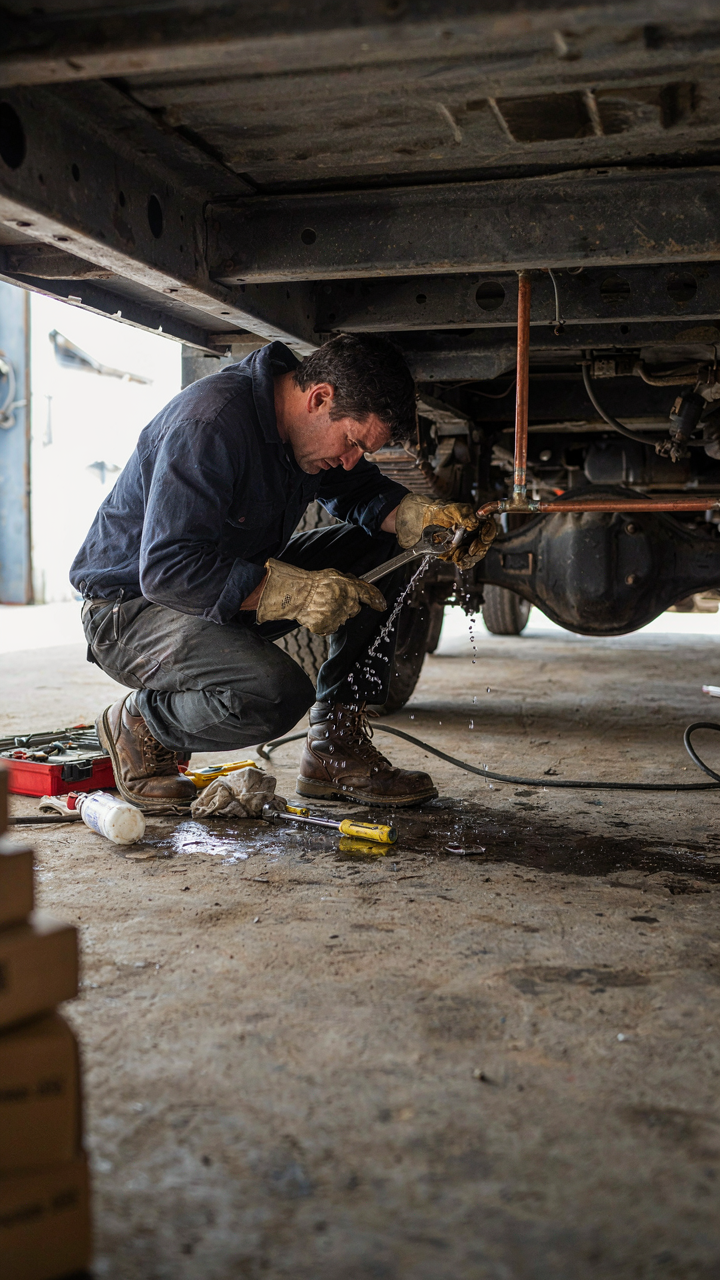
You’re attracted to this section because you want permission to believe maintenance won’t be a problem. It will be. Box truck conversions operate on thermodynamic principles identical to industrial equipment: every sealed system accumulates entropy. Neglect compounds exponentially, not linearly. A roof seal that leaks for three months doesn’t cost twice as much to fix as one that leaks for six weeks. It costs five times as much because water infiltration spreads into insulation, plywood, and electrical.
Routine maintenance on a box truck camper follows a seasonal schedule most builders ignore until failure forces it. Caulk joints annually. Inspect all penetrations where vents, pipes, or wiring exit the shell. Check propane connections before cold months. Reseal roof seams every two to three years depending on climate and UV exposure. These aren’t optional refinements. They’re the difference between a vehicle that appreciates in livability and one that depreciates into a money pit you’re trapped inside during a breakdown.
What You’re Actually Trading Away
Economics calls this opportunity cost. While you’re parked somewhere fixing a refrigerator compressor or replacing rotted plywood, you’re not working, creating, or moving toward what actually matters to you. Most people romanticize the mobile lifestyle without calculating what they surrender to maintain it. A standard lease or mortgage comes with a landlord’s responsibility to handle structural issues. A box truck is yours entirely. You own every problem.
The compounding effect matters here. Time spent sourcing parts, waiting for shipments, and performing repairs adds up to weeks per year for most full-time converters. That’s not freedom. That’s trading a stable income stream for irregular crises that demand immediate attention. If your primary income depends on presence, availability, or consistent bandwidth, a box truck conversion doesn’t liberate you from constraints. It multiplies them. Document this clearly before committing: what percentage of your monthly revenue can you afford to lose to unexpected vehicle downtime?
The Real Obstacle Isn’t The Build; It’s Your Fantasy Of Effortless Freedom

You’ll romanticize the box truck camper conversion until you’re holding a wrench. The build forces you to confront what you actually want versus what Instagram sold you. Stop researching layouts and interior designs. Today, spend two hours sitting in a box truck or cargo van without the fantasy filter. Feel the tight space. Notice the noise. Imagine three months of it. Your box truck camper conversion only works if you’re running toward something, not away from something.