
The Minimalism Manifesto: Beyond Van Storage Hacks

What Actually Belongs In Your Van
You want to believe you’re organized. That’s the real reason you’re reading this. Organization feels like control. But control starts with brutal honesty about what you actually use. Most van dwellers carry items for hypothetical scenarios that never arrive. The mechanism is simple: your brain treats ownership as optionality. You keep something because you might need it, not because you do.
Split everything into two categories. Must-haves are items you use weekly or daily, or items required for safety and function. Kitchen tools you never touch, clothes you never wear, hobby supplies for activities you abandoned—those are nice-to-haves. The gap between these categories is where your space problem actually lives. Stop organizing clutter. Start removing it.
The Real Price Of Dead Weight
Economics teaches opportunity cost: the value of what you sacrifice when you choose something else. In a van, carrying unnecessary items costs you three things at once. First, physical space that could store something useful or just create breathing room. Second, mental load—your brain tracks every object you own, whether consciously or not. Third, time spent organizing, cleaning, and moving around obstacles that shouldn’t exist.
One unnecessary item seems harmless. Fifty of them compounds into a van that feels cramped even with smart storage. Every object you keep demands a location, a maintenance routine, and cognitive overhead. The calculation is straightforward: does this item give me more value than the space and mental clarity it costs? If the answer is no, it leaves. That’s the protocol.
The “One In, One Out” Protocol For Camper Van

Replace Before You Accumulate

You want to feel in control without actually making hard decisions about what stays and what goes. Here’s the mechanism: constraint forces prioritization. In systems theory, this is called a “stock limit” — you set a ceiling on total units and maintain it ruthlessly. A van gives you that ceiling naturally. You don’t have unlimited shelving. The rule is simple: before anything new enters the van, something of equal or greater volume leaves. No exceptions, no storage unit backup plan.
This isn’t about minimalism philosophy or lifestyle branding. It’s about preventing the slow rot of decision fatigue. Most people accumulate because they defer the choice to keep or remove. The one-in-one-out rule collapses that deferral into the moment of acquisition. You feel the trade-off instantly. You ask harder questions about what you actually need because you know the cost isn’t money — it’s displacement of something else. Execute this at the point of purchase, not weeks later.
The Daily Friction That Stops Creep
Common advice says to “declutter weekly” or “do monthly purges.” That’s reactive. You’re already behind. The real move is negative feedback every single day — the kind that makes accumulation inconvenient enough that you stop before it starts. Each time you move something to access something else, each time you reorganize the same shelf twice, that friction is data. It’s telling you the system is already compressing.
The daily habit isn’t cleaning. It’s noticing. Spend sixty seconds each evening identifying one item that didn’t earn its space that day. Mark it mentally. After three days of marking, it leaves. You’re not waiting for a bulk purge event. You’re catching drift the moment it begins. The mechanism is immediate consequence: friction today prevents accumulation tomorrow, which prevents the crisis reorganization that kills your van life actually working.
The Zero Based Inventory Method For Van Life

Start With Nothing, Add Only Essentials

You want permission to keep things. That’s the real reason this section matters to you. Zero-based inventory strips that away. Borrowed from accounting, this method treats your van like a budget: you justify every line item from zero, not trim from what you already own. Most people organize around existing stuff. This forces the opposite. You own nothing until you prove it earns its space.
The mechanism is simple. Empty the van completely or mentally clear it. Then add back only items that solve a specific problem or enable a core activity. Cooking requires tools. Sleeping requires bedding. Working requires a desk surface. Everything else is passenger. The van doesn’t care about sentimental objects or “just in case” duplicates. Weight, volume, and access cost money and comfort. Each item competes against those costs, not against the items next to it.
Regularly Audit Contents For True Utility
This advice gets preached constantly, but people skip it because “organization” feels like a one-time event. It isn’t. An audit isn’t decluttering theater. It’s a data collection system. Every four to eight weeks, physically touch and categorize each item: used weekly, used monthly, used rarely, never used since last audit. The ones in the “never used” column aren’t keepers waiting for the right occasion. They’re dead weight announcing themselves.
The protocol is mechanical, not emotional. Document what you own and how often you use it. A spreadsheet works. Photos work. The format doesn’t matter. What matters is the feedback loop. After three audits, patterns emerge. You’ll see which tools you reach for, which duplicates exist, and which “essentials” collect dust. Then you cut. The van shrinks intentionally, not by accident. Less inventory means faster setup, easier cleaning, lower fuel consumption, and actual knowledge of what you possess.
The Command & Control System For Camper Van Organization

Every Item Gets A Fixed Position

You want your van organized so you stop wasting mental energy finding things. That’s the real problem. Military strategy calls this “supply discipline”—assigning each asset a permanent location so commanders know exactly where resources are without searching. In a van, this means every item has one designated spot, always. No exceptions, no flexibility.
The mechanism is simple: your brain stops treating objects as variables. When a knife lives in drawer three, you don’t think about where knives go anymore. You retrieve it and return it. This eliminates the cognitive load that makes small spaces feel chaotic. Most people ignore this and keep things in “logical areas” instead—the kitchen zone, the storage zone. That’s incomplete. Zones still require micro-decisions. Fixed positions eliminate decisions entirely.
Return Items To Base After Each Use
The difference between an organized van and a disaster is the return protocol, not the storage system itself. Military campaigns use staging areas and resupply lines—units return gear to base camp after operations end. Your van works the same way. If a tool, cooking item, or personal object leaves its position, it returns there within minutes of use, not later, not when you remember.
This sounds obvious until you live in 200 square feet. One pot left on the stove. One book on the bed. One charging cable on the floor. These create friction that compounds. Enforce the rule: use it, return it, done. Make return spots physically easy to access—nothing should require digging through other items to store it. The extra thirty seconds you invest in returning items immediately saves hours of searching and prevents items from getting lost or damaged.
Beyond Instagram: Real Van Storage Ideas Organizing

Function Beats The Algorithm

You want your van to look like the Instagram photos because you think the photos mean the space works. They don’t. The algorithm rewards visual symmetry and matching containers, not accessibility or weight distribution. Function means you retrieve what you need without moving three other things first. It means your heavy items sit low and centered, not stacked high where they destabilize the vehicle during turns. Storage that looks good but forces you to unpack half the van to grab your shoes is storage that fails.
Build around use frequency and physics, not aesthetics. Items you access daily live at eye level or within arm’s reach. Seasonal gear goes high and back. Heavy tools and water tanks anchor the low center of gravity. This isn’t philosophy. This is how you avoid banging your head, avoid tipping, avoid wasting ten minutes finding your laptop charger. The moment you optimize for looks instead of workflow, your van stops being livable and starts being a set.
Custom Builds For Real Problems
Generic storage advice fails because vans aren’t generic. A Sprinter has different dimensions than a Transit, which has different dimensions than a Promaster. Drop-in shelving units from Amazon don’t account for your actual weight distribution or your actual daily routine. The common mistake is buying storage first and forcing your life around it, instead of mapping your life and building storage to fit.
Start with your specific van model’s measurements. Identify the friction points: where do you run out of space first? What breaks or shifts when you drive? Build solutions for those exact problems. A narrow shelf won’t work if you need to store cooking pans flat. A tall cabinet creates a dangerous weight problem above the axles. DIY solutions mean plywood, L-brackets, and fasteners rated for vehicle movement. Bolt everything down. Vibration will destroy velcro and adhesive-mounted storage within months.
The Van Conversion Trap: Overbuilding Storage
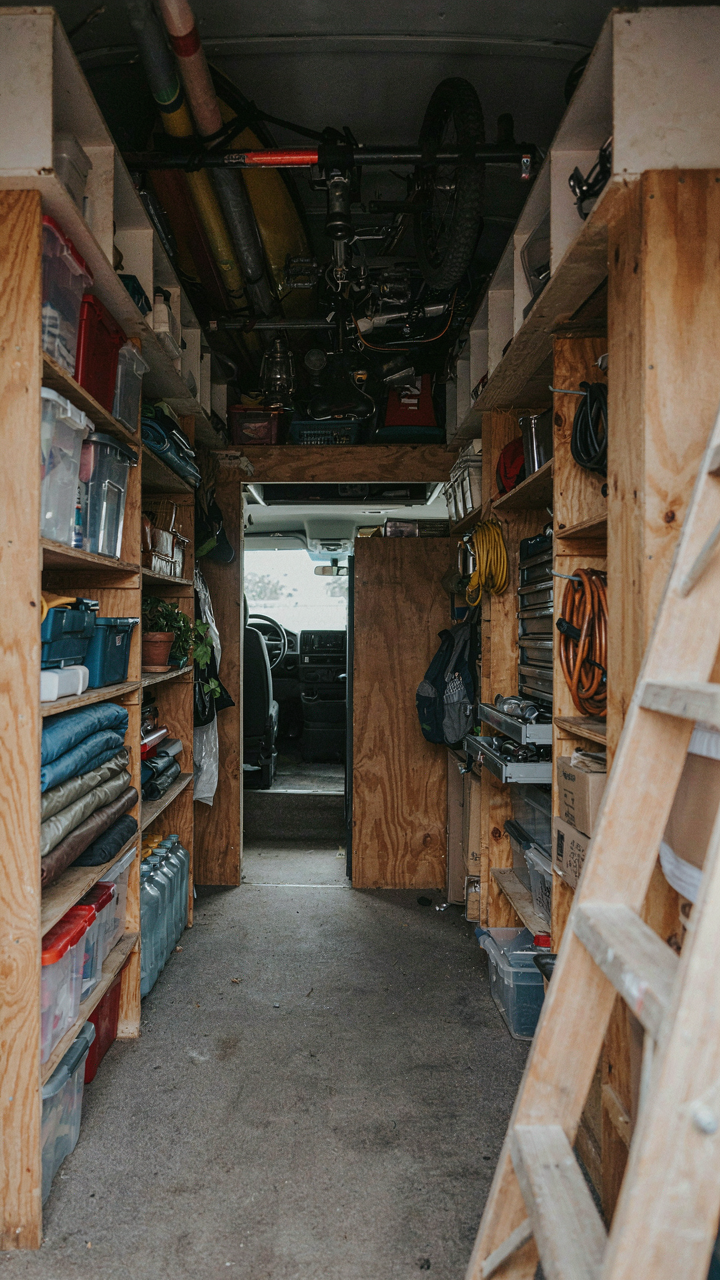
When More Cabinets Become Dead Weight

You want to feel prepared. That’s why you’re reading about storage. The mechanism is simple: people build vans like they’re furnishing a house, maximizing every cubic inch because waste feels irresponsible. Then they live in the van and realize 60% of their storage sits empty while the 40% they actually use stays within arm’s reach. Maximum capacity kills usability.
Most van builds fail because they treat storage as a permanent installation problem instead of a dynamic living problem. You nail down cabinets, shelves, and drawers based on theoretical need, not actual behavior. The build happens once. Your life changes constantly. By month three, you’ve reorganized twice and still can’t access what matters.
Design For The Life You Actually Live
Your life in a van operates on constraint, not abundance. In economics, this principle is called “scarcity economics”—value emerges from limitation, not maximization. Apply this to your build: design storage for 70% of what you think you’ll need, then leave 30% of your interior unfinished. The finished space forces intention. The unfinished space adapts.
The common advice says “measure twice, build once.” That’s incomplete. The real protocol is measure your actual behavior for two weeks before you build anything. Track what you use daily, weekly, and never. Build only for the daily and weekly categories. Leave the rest as open floor space. Flexibility costs nothing upfront but saves everything later when your needs shift.
Daily Rituals For Van Life Organization Mastery

The Five Minute Reset

You want organization to feel effortless so people think you’re naturally disciplined. That’s not how it works. Organization is a habit loop, borrowed from behavioral psychology where “cue, routine, reward” creates automatic behavior. Your cue is morning coffee or engine startup. Your routine is five minutes moving items back to their designated zones. Your reward is the absence of friction for the rest of the day.
Most people skip this because five minutes feels too small to matter. It’s the opposite. Five minutes daily prevents the compounding chaos that forces you into a three hour purge weekly. You move three items per day back to their homes. Fourteen items per week. The van never crosses the threshold into disorder. Set a phone timer. When it goes off, you stop. Consistency beats duration every time.
Mental Clarity Through Consistent Order
Order is not aesthetic. Order is a load management system for your attention. When everything has a location, you stop using mental RAM to remember where things are. You stop opening the same cabinet three times searching for the same item. Neuroscience calls this “cognitive load reduction.” In a van, this is the difference between functional and dysfunctional living.
Inconsistent organization creates decision fatigue disguised as chaos. You place things in different spots based on mood or convenience. Your brain spends energy on micro choices that should be automated. The ritual fixes this. Same time, same places, every day. Consistent order turns your van from a problem you manage into infrastructure you forget about. Your attention goes to work, relationships, movement. Not to where your utensils ended up.
The Unspoken Truth About Van Organization Ideas

Organization Happens Before You Buy Anything

You want a system that makes you look competent. That’s the real driver here. The truth is simpler: organization isn’t a collection of products or clever storage hacks. It’s a filter you apply before items enter your van. Most people organize after they’ve already accumulated too much. You’re trying to manage the problem instead of preventing it. That’s backwards.
The mechanism is straightforward. Every object you bring into a van must pass a utility test before purchase. Not “could this be useful someday.” Ask: does this solve a current problem, or create a recurring task? Van space is the constraint that forces honest answers. In a house, you hide poor decisions behind square footage. In a van, everything compounds. Your organization system fails not because the shelves are wrong, but because you’re storing items that shouldn’t be there.
Find What Actually Triggers Your Clutter Spiral
The common advice blames disorganization itself. That’s incomplete diagnosis. Your clutter has a root cause, usually one of three: you’re keeping backup items you never use, you’re storing things for hypothetical scenarios, or you’re holding onto items from your old life. Identify which one dominates your van. That’s where the real work begins.
Once you name the pattern, you interrupt it at the decision point, not the storage point. If you hoard backups, you create a rule: one functioning version only, plus one backup maximum. If you store for hypotheticals, you set a timeline: use it within three months or remove it. Organizations systems don’t fix the root cause. They just hide it. The actual mechanism is a decision rule applied consistently at the entry point, not a reorganization project applied after the damage is done.
The Only Truly Organized Van Is An Empty One. Get Real


You don’t have an organization problem. You have an ownership problem. Every system you build will fail if you keep stuffing more garbage into your space. Stop buying organizational tools and start removing items instead. Today, pull everything out of one cabinet and donate half of it. You’ll realize most van life organization advice exists to help you keep things you never needed in the first place. The real skill isn’t arranging your stuff. It’s refusing to own it.