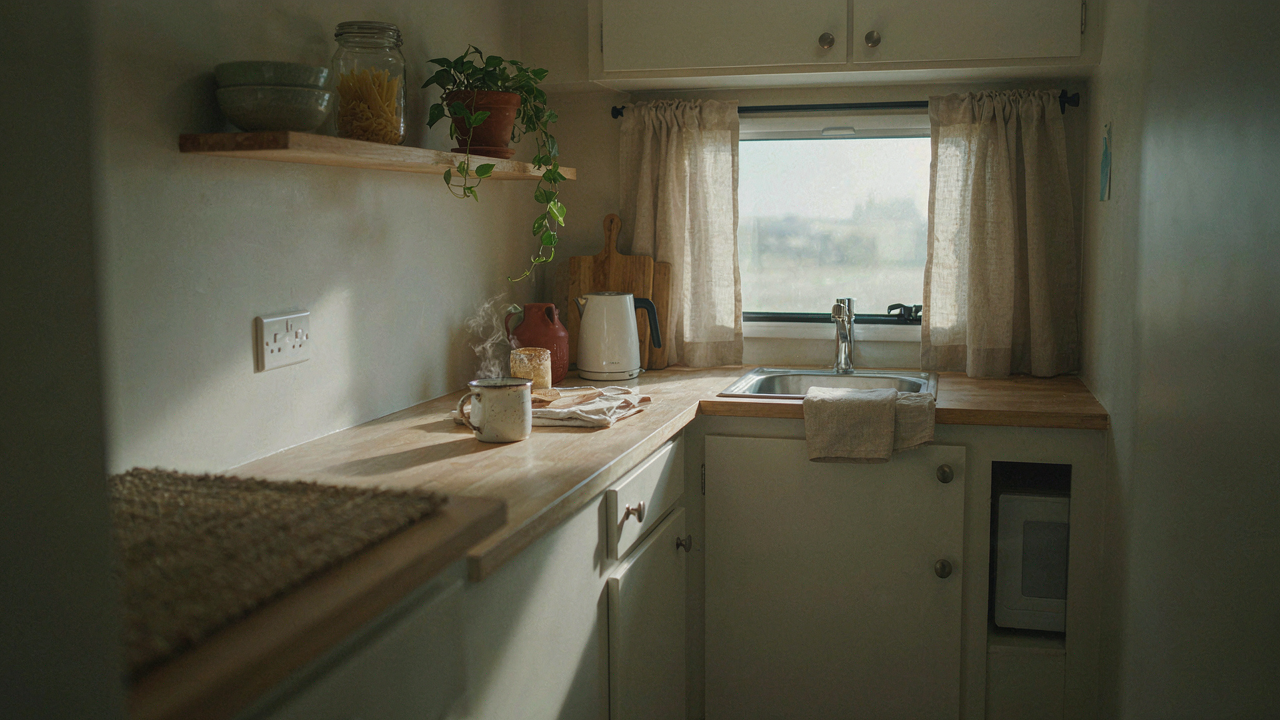
The Minimalism Mandate: Why Less Is Always More In An RV Kitchen

Single Use Items Belong In Storage Units
You want your RV kitchen to feel spacious because a cramped galley triggers real anxiety about being trapped. The mechanism is simple: every item that does one job only consumes cubic footage without earning its keep. A garlic press, avocado slicer, egg separator, or specialized measuring spoon each occupy prime real estate. In a 40-square-foot kitchen, that’s not quaint. It’s theft.
Pull every tool that exists for a single task and move it to external storage or donate it. If you use it once yearly, it stays outside the galley. The knife handles most cutting jobs. A basic can opener beats a dedicated citrus peeler. Your hands and basic utensils replace 80 percent of single-purpose gadgets. This isn’t deprivation. It’s structural efficiency.
Multi Functional Tools Replace Redundancy
Borrowed from systems thinking in engineering, the principle of functional density means each component must serve multiple roles to justify its existence. A good 8-inch chef’s knife slices vegetables, breaks down proteins, minces herbs, and crushes garlic under its flat side. A small cutting board becomes a prep surface, serving platter, and lid for leftover containers. A metal spatula flips, scrapes, spreads, and stirs.
One quality multi-tool beats five single-purpose gadgets. A measuring cup with marked graduations handles wet and dry measuring. Nested bowls replace ten separate containers. Stainless steel cookware pieces with lids nest inside each other and do double duty as mixing bowls and storage. The galley stays functional and uncluttered because every item earns its footprint through multiple applications. Store the rest.
The “One In, One Out” Protocol For Small RV Kitchens

Decision Before Purchase

You want to believe you’ll use everything you buy, so you rationalize keeping it. The mechanism is simple: RV kitchens have fixed volume. Every item you add displaces something else or reduces prep space. This isn’t about minimalism. It’s about physics. Before any new tool, gadget, or container enters the galley, decide what leaves. No exceptions, no storage loopholes.
Most RV owners skip this step entirely. They add items incrementally, telling themselves they’ll reorganize later. By then, the kitchen functions at reduced efficiency because nothing has a clear home. The decision rule works because it forces accountability at the moment of acquisition, not months later when you’re frustrated looking for a spatula buried under three other things you forgot you owned.
Regular Inventory Audits
Inventory control comes from operations management, and RV kitchens need the same discipline as a restaurant line. You can’t manage what you don’t see. Schedule a quarterly audit where you physically remove every item from cabinets and drawers, then decide if it returns. Track what you actually use versus what you theoretically might use. Most RV cooks find they use 60 percent of their tools regularly and 40 percent collects dust or takes up critical space.
The audit isn’t punishment. It’s data collection. You’ll notice patterns: certain appliances never leave their drawer, specific utensils you reach for constantly, containers that warp or crack after three months on the road. Use these patterns to inform what stays and what doesn’t make the cut. After each audit, document what you kept and what left. This prevents the same unused items from creeping back in during your next camping trip.
Gravity Is Not Your Friend: Securing RV Kitchen Contents
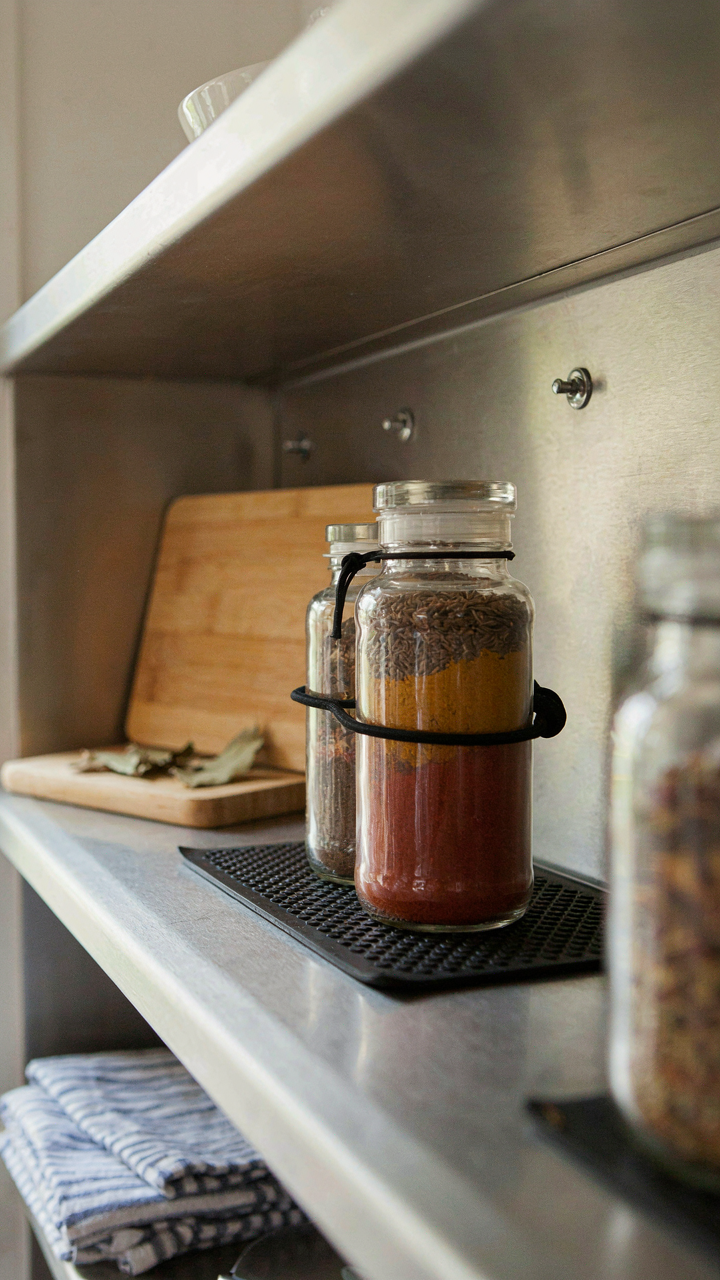
Stop Everything From Moving During Turns

You’re worried about arriving somewhere and finding your kitchen destroyed, which means you’re finally taking RV travel seriously instead of treating it like a parked apartment. Here’s the mechanism: gravity doesn’t pull straight down in an RV. It pulls in the direction of momentum. When you brake hard, decelerate, or turn, every object in your galley experiences lateral force equal to the vehicle’s deceleration rate. Most people secure cabinets but ignore the contents inside, which is backwards.
Non-slip mats and cabinet tension bars work because they create friction and mechanical resistance against that lateral force. Mats go on every shelf. Bars brace the cabinet doors and prevent them from swinging open under deceleration. This isn’t optional if you’re moving regularly.
- Rubberized non-slip shelf liners: Cut to size and layer them on every shelf. They grip items and absorb movement energy during stops and turns without damaging surfaces.
- Tension rods or cabinet bars: Install horizontally across cabinet openings. Adjust them snug so nothing falls forward during hard braking or downhill stops.
- Heavy items low, light items high: Place cast iron, canned goods, and dense items on lower shelves. Lightweight containers go up high to minimize damage risk and center of gravity problems.
- Bungee cords for open shelving: Strap down bottles and jars on open shelves. Use heavy-duty cords rated for repeated use, not cheap ones that degrade.
- Drawer dividers with stops: Install dividers that prevent utensils and small items from sliding during movement. Dividers create compartments that contain motion instead of amplifying it.
Cabinet tension bars alone reduce movement by roughly 70 percent. Combine them with non-slip mats and you’ve eliminated most breakage. Install bars first, then test your setup on a short drive before loading your entire pantry.
Stack Smart, Not Tall
Conventional advice says maximize vertical space. Wrong. Vertical stacking in a moving galley creates instability. Physics calls this center of gravity management. In RV terms, it means you’re deciding whether your items stay put or become projectiles during cornering.
When you stack items vertically, each item above the first one transfers its entire weight through a smaller contact point. Stack plates eight high and the bottom plates support all that force. A sudden turn multiplies this pressure and creates tipping. Instead, distribute weight across multiple shelves horizontally. Use narrow, shallow containers that won’t tip and won’t slide far if they do move. Glass jars lose to plastic. Narrow bottles beat wide ones. The mechanism is simple: lower stacks fail less often.

The Behavioral Economics Of RV Dish Storage
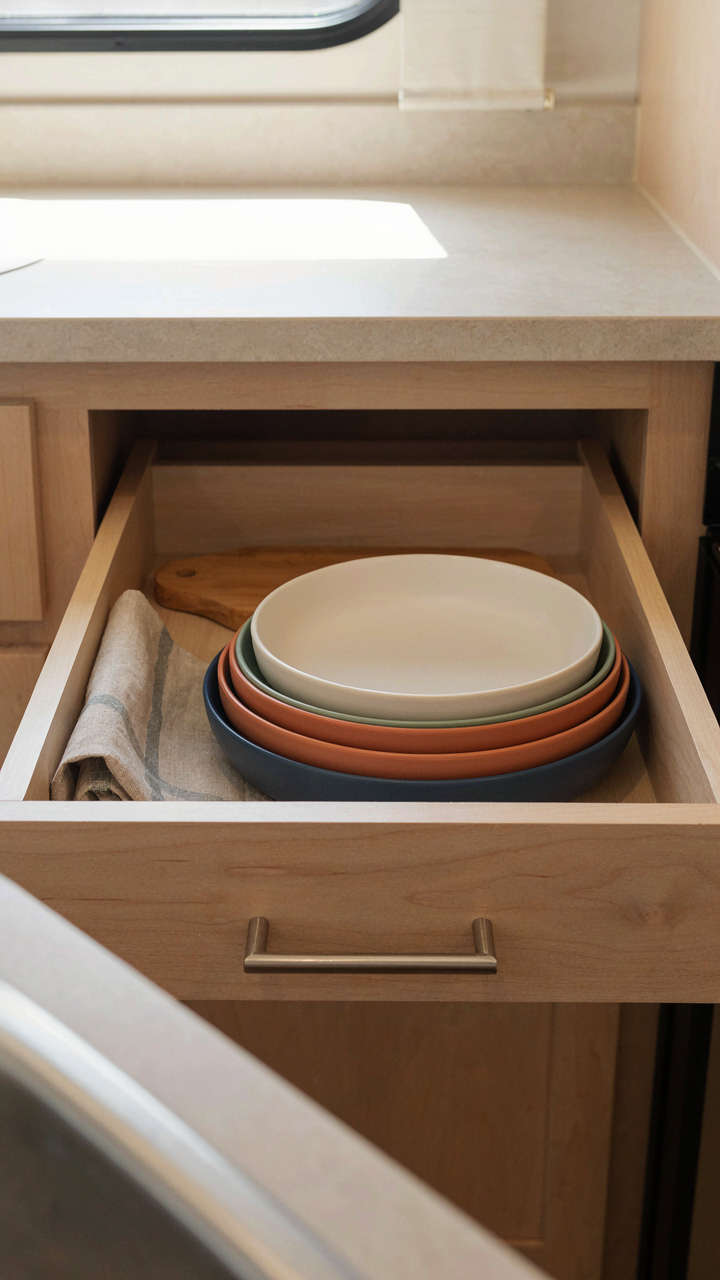
Design Your Default Choice First
You want your RV kitchen to feel effortless because chaos signals you’re not in control. Behavioral economics calls this “choice architecture”—the idea that how you arrange options determines what people actually do. In an RV galley, your default is the path of least resistance. If dishes have one obvious home, they go there. If they have three, they scatter.
Most RV owners treat dish storage as a space problem. It’s not. It’s a friction problem. Measure the vertical and horizontal distance from your sink to where dishes currently live. Then measure the distance to where they should live based on your workflow. The shorter path wins, regardless of logic. Stack plates where your hand naturally moves after drying, not where you think they “should” go aesthetically or organizationally.
Make Staying Organized The Lazy Choice
Everyone says organize your RV kitchen better. Nobody says make disorganization harder than organization. That’s the real lever. In a galley, create physical barriers that make the wrong choice actually inconvenient. A nested stack of plates takes up less space than plates scattered in a cabinet. A pull-out drawer divider takes thirty seconds to use. A cabinet with no divider takes three seconds to throw things in.
Your goal: eliminate the gap between effort required to put something away correctly and effort required to put it away wrong. Use vertical dividers that force plates into one orientation. Use drawer organizers with designated zones that fill up predictably. Use hooks that hold exactly what you need—no more, no less. The moment putting dishes away becomes easier than leaving them out, compliance becomes automatic.
Small RV Kitchen: Designing For Workflow, Not Just Storage
The Three Zones Approach
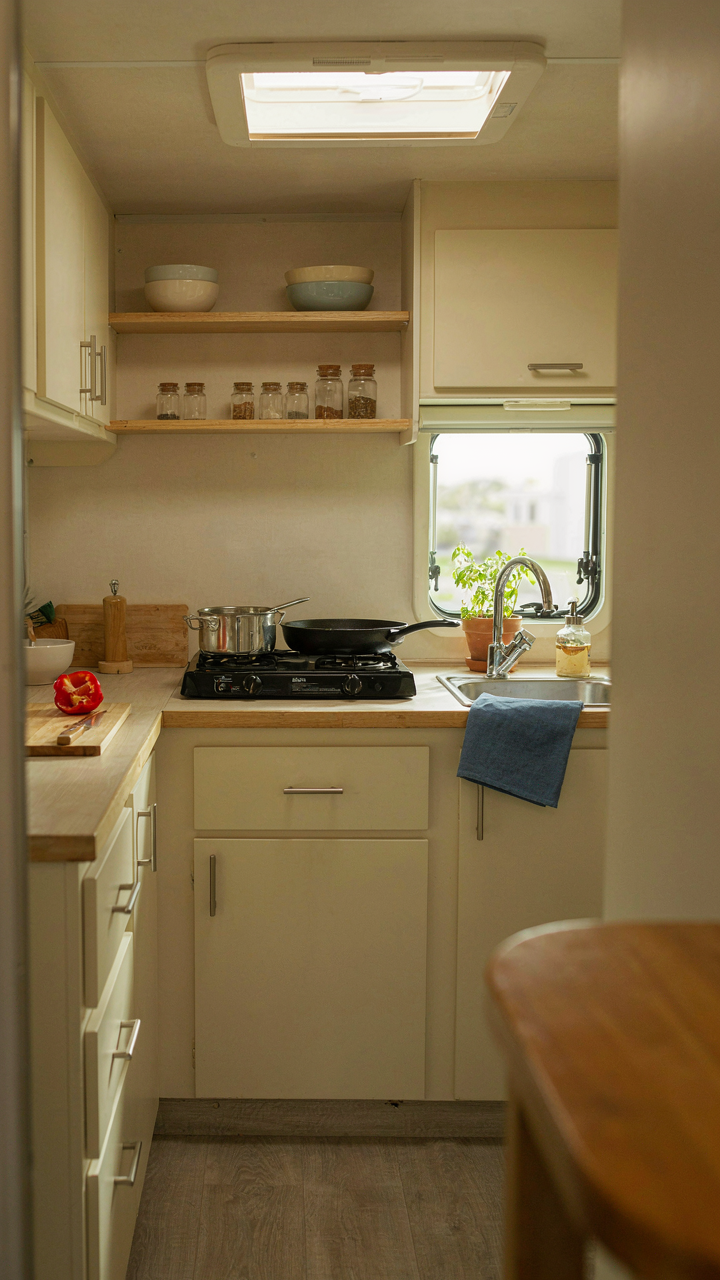
You want your RV kitchen to feel bigger than it is. That’s the real pull here. The mechanism is borrowed from restaurant kitchen design: work stations. A galley kitchen needs three distinct zones operating independently, not bleeding into each other. Prep happens in one spot. Cooking happens in another. Cleaning happens in a third. When these overlap spatially, you lose movement efficiency and create bottlenecks that make a 70-square-foot kitchen feel like a closet.
Start by mapping your actual counter space. Most RV galleys have 8 to 12 linear feet split between sink and stovetop. The gap between them is your prep zone. Stock it with cutting boards, knives, and produce storage within arm’s reach. Keep the cooking zone clear except for what’s actively needed: burner access, pot storage, cooking utensils. The cleaning zone lives around the sink, with dish soap, towels, and drain supplies contained in one cabinet. Separation prevents decision fatigue when you’re hungry and tired after travel.
Access Velocity Beats Decoration
Everything you use weekly should live at eye level or between shoulder and hip height. Everything you use monthly can go above or below. Everything you use once a year shouldn’t be in your kitchen at all. The common advice says organize by category. That’s wrong. Organize by frequency and reach. Your coffee maker, cooking oil, and everyday plates should take three seconds to grab. Your specialty baking pans should take thirty. This isn’t arbitrary. It’s the difference between cooking happening and cooking not happening because the friction is too high to bother.
Mount a magnetic strip above the stovetop for knives instead of using a drawer. Install a pull-out spice rack on the inside of cabinet doors instead of stacking bottles. Use drawer dividers to keep utensils visible and sortable instead of tangled in a pile. Every second you don’t spend hunting for something is a second you spend actually eating.

The False Promise Of RV Kitchen Storage Ideas
Why Storage Solutions Fail Before You Buy Them
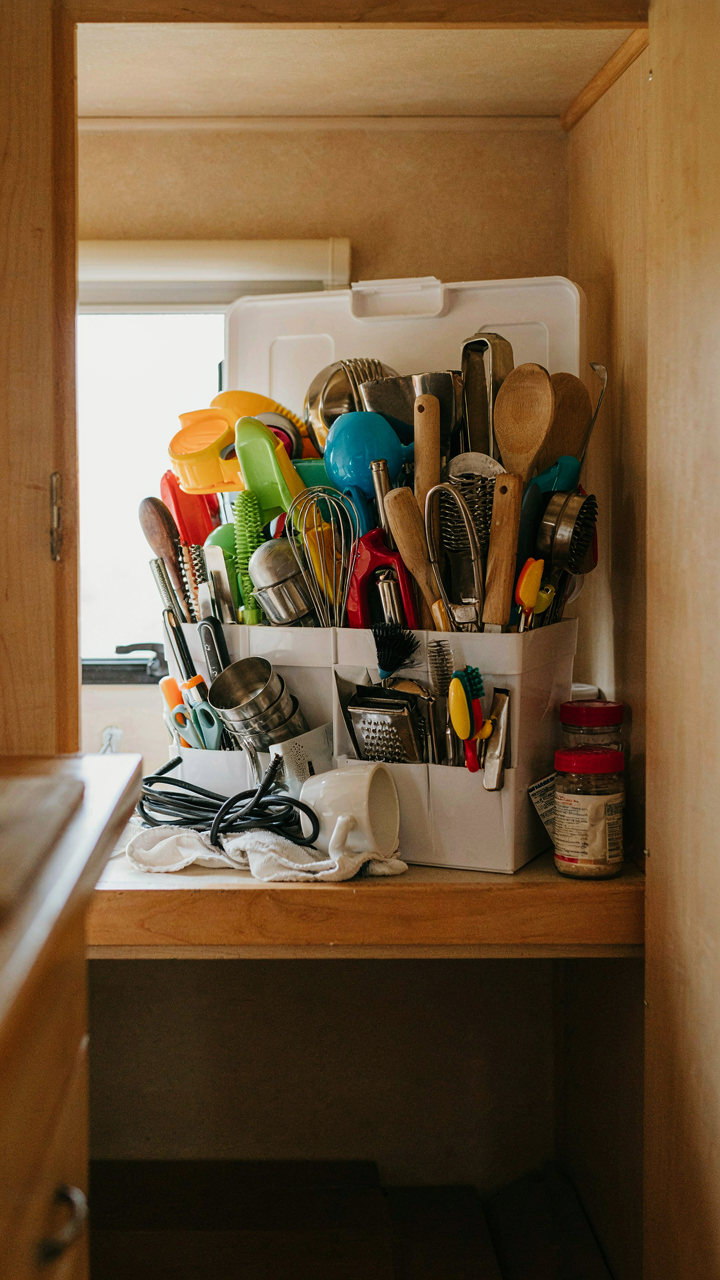
You want to believe a $40 organizer will fix your galley problem because admitting you have too much stuff feels like failure. Here’s the mechanism: storage solutions don’t create space, they compress existing clutter into smaller footprints. You’re playing Tetris with objects you don’t need. Every vertical organizer, pull-out drawer, or hanging rack you install is just rearranging the problem, not solving it. The RV galley has fixed dimensions. Adding containers doesn’t expand those dimensions.
Most RV storage advice treats the galley like a traditional kitchen where you can absorb inefficiency. You can’t. An RV kitchen operates on constraint economics: every cubic inch has conversion cost. You either store something or you don’t. Hanging organizers over cabinets, under-sink racks, and door-mounted solutions all work only if you’ve already eliminated what doesn’t belong. Without that first step, you’re throwing money at density instead of addressing abundance.
Strip Before You Organize
The hard truth: most RV kitchens contain 60% items the owner never uses. Spice collections from previous homes, backup appliances, serving dishes for a dinner party that won’t happen in a 200-square-foot space. Decluttering isn’t pleasant, so every storage article glosses over it and jumps to organizational tactics. That’s backwards. Organization amplifies problems when the wrong items stay. You organize less frequently used items into your prime real estate, then genuine cooking tools compete for space they shouldn’t have to fight for.
Start with removal, not arrangement. Pull every single item from your galley and touch it. If you haven’t used it in three months, or if you own a duplicate, it goes. This sounds extreme because it is, but an RV galley demands ruthlessness. Once you’ve cut inventory by half, you’ll notice organization problems solve themselves through sheer breathing room. The remaining items fit logically because they actually belong there.

Camper Kitchen Organization: The Frictionless Cooking System

Pre Portion Everything Before You Leave
You want this because you’re afraid of wasting food and time in a space where both feel scarce. The real mechanism is constraint-based efficiency: when ingredients are already measured and staged, you eliminate decision fatigue and the cooking friction that kills consistency in tight quarters.
Portion proteins, grains, and vegetables into clear containers or vacuum bags before departure. Label each with the dish it’s meant for and the cooking date. This collapses prep time from fifteen minutes to three. Your stove doesn’t run longer because of poor organization, but poor organization makes you cook less, which means eating worse food and spending more on grab-and-go options.
Wash As You Cook, Not After
The common advice about “do dishes after” is incomplete. In an RV, your sink is undersized, your water is finite, and your gray tank fills fast. Washing one pan while the next ingredient heats takes forty seconds and prevents a backlog that derails future meals.
Fill a small basin with hot water while your burner runs. Wipe plates and utensils immediately after use. Drain the basin, refill with fresh water, and do a final rinse. This keeps your counter clear, your sink functional, and your system moving. The mechanism is velocity: small actions distributed across cooking time beat one large action after it ends.

RV Storage And Organization Ideas That Actually Work
Magazine Racks Hold More Than Magazines
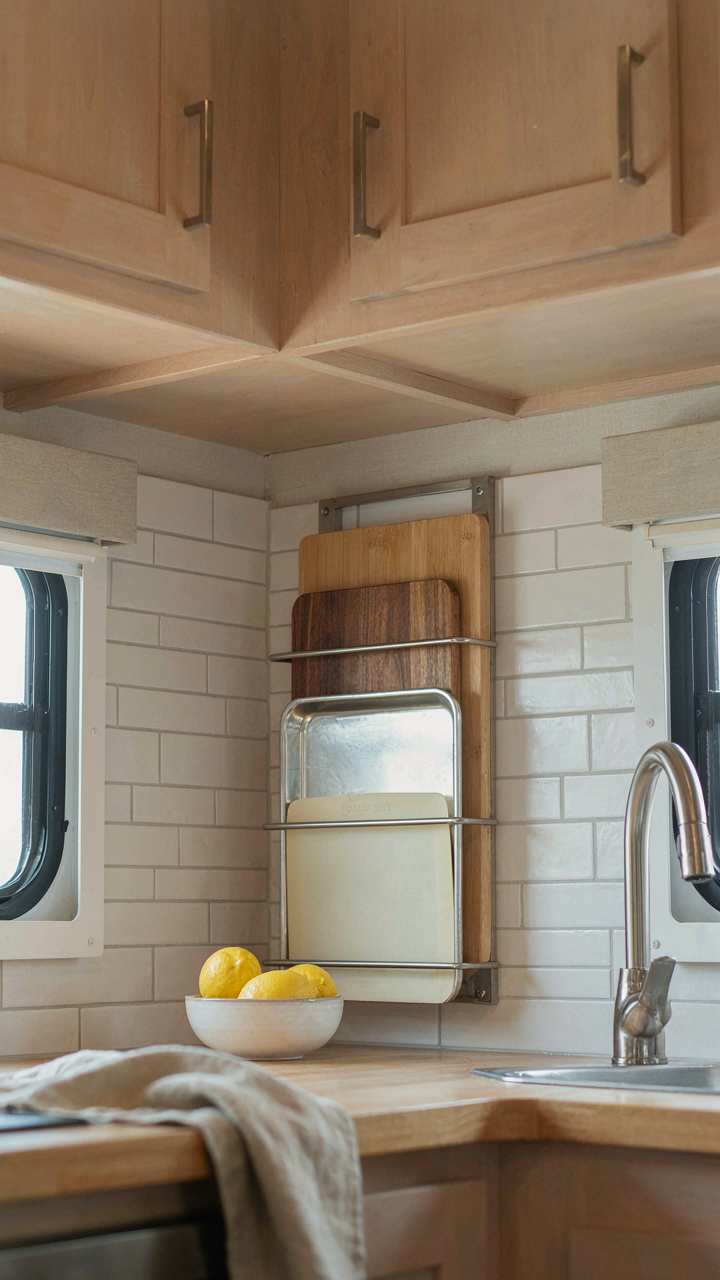
You want your galley to look intentional because a messy RV kitchen makes you feel like you’re failing at freedom. The real mechanism here is vertical stacking without depth. Magazine racks solve the problem most people don’t name: cutting boards and pan lids need to stay accessible but they dominate horizontal space and topple in cabinets during movement. Racks let you store them upright in dead wall space, the same principle used in commercial kitchens where every inch counts.
Install magazine racks inside cabinet doors or on galley sidewalls using screws or adhesive strips rated for RV vibration. Stack cutting boards vertically with the largest at the back. Lids slot between the boards without shifting. This approach transforms wasted vertical space into functional storage while keeping items grab-and-go. Most standard magazine racks fit RV cabinet openings without modification.
Command Hooks Anchor Daily Tools
Most people waste cabinet real estate hanging spatulas and tongs inside doors where they jam the hinges or fall into other items. The real solution is proximity storage: tools live where you use them, not where they fit. Command hooks mounted on galley sidewalls or cabinet interiors hold your five most-used utensils at arm’s reach while cooking, reducing motion and cutting prep time.
Place hooks at elbow height on the wall closest to your prep zone. Space them four inches apart for dense packing without snagging. Weight-rated hooks support ladles, measuring spoons, and wooden spoons without failure during RV movement. Rotate seasonal tools monthly so you’re never hunting for what you actually use. The mechanism is simple: eliminate the reach, eliminate the friction.

RV Kitchen: The Path To True Culinary Freedom
Stop Cooking Like You’re At Home
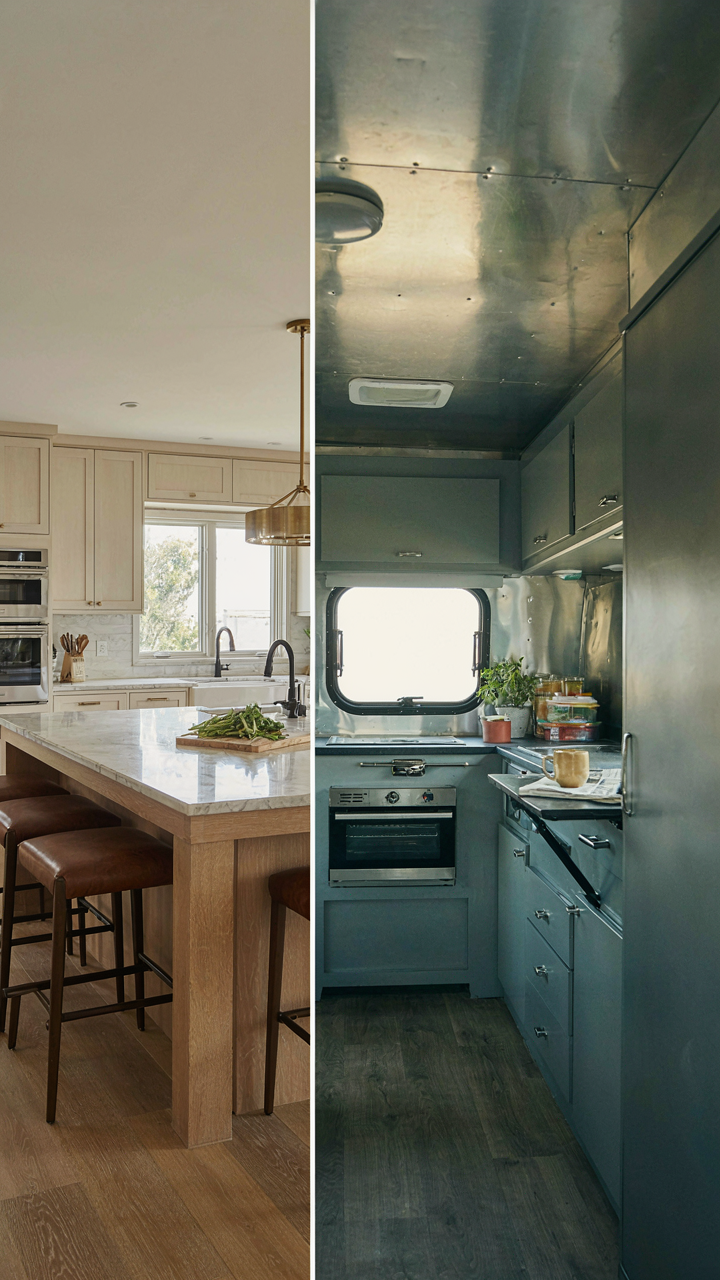
You want to believe your RV kitchen can replicate your home kitchen. It can’t, and pretending it does wastes money, time, and sanity. The mechanism is simple: a home kitchen was designed around unlimited utilities and space. An RV kitchen was designed around constraints. Cooking habits built for abundance fail in scarcity. You don’t need better storage hacks. You need a different cooking system entirely.
The shift required here borrows from systems design in manufacturing: constraint-driven production. Your RV’s galley isn’t a smaller kitchen. It’s a different kitchen with different inputs. You can’t simmer stocks for hours without depleting propane. You can’t keep fifty ingredients accessible without blocking movement. You can’t prep six dishes simultaneously on two burners. Accept this first. Everything else follows from acceptance, not from buying organizers.
Luxury Means Fewer Things, Not Better Ones
Common advice tells you to maximize every cubic inch with clever storage. Wrong. The actual luxury in an RV kitchen is absence. Absence of decisions. Absence of searching for the one thing you need. Absence of waste. This flips the status game most people play with organization porn. You don’t win by having a perfect system. You win by having almost nothing to organize.
The mechanism is reduction. Keep one good knife instead of a block of ten. Keep two pans instead of a nested stack of six. Keep salt and oil and acid and heat instead of thirty specialty items. This isn’t deprivation. It’s clarity. When you own three spoons, you know where they are. When you own thirty, you search. The reduction phase takes two weeks of real cooking to identify what actually gets used. After that, organize what remains. Most RV kitchen problems disappear when the inventory shrinks below the space available.
The Only Thing Cluttering Your RV Kitchen Is Your Attachment To Hypothetical Needs
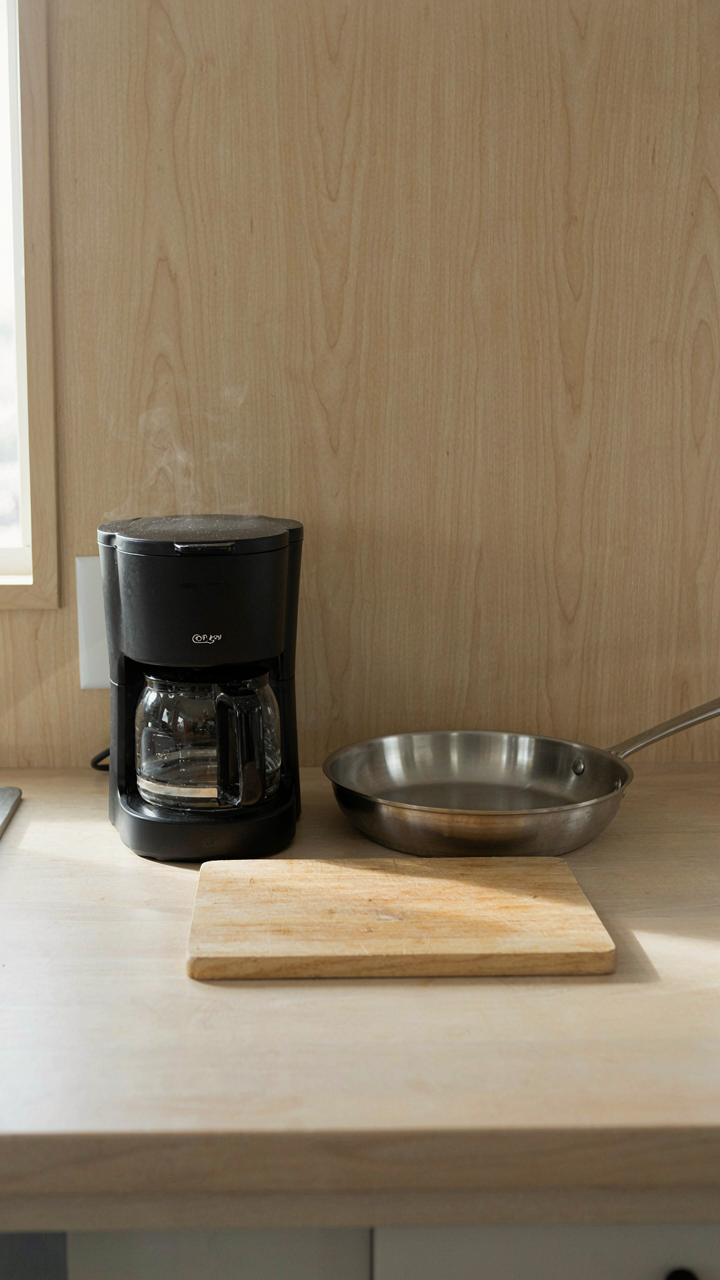
You keep that extra spatula because you might need it. You hoard containers for meals you’ll never cook. You store gadgets for camping trips that exist only in your head. Stop. Pull everything out of your galley today and ask one question: have I used this in the last month? If no, it leaves. RV kitchen organization isn’t about systems or hacks. It’s about eliminating the weight of decisions you haven’t made yet. Your space expands the moment you stop planning for a version of yourself that doesn’t exist.