
Why “RV Storage Hacks Space Saving” Is A Lie
The Myth Of More Space Through Clever Products
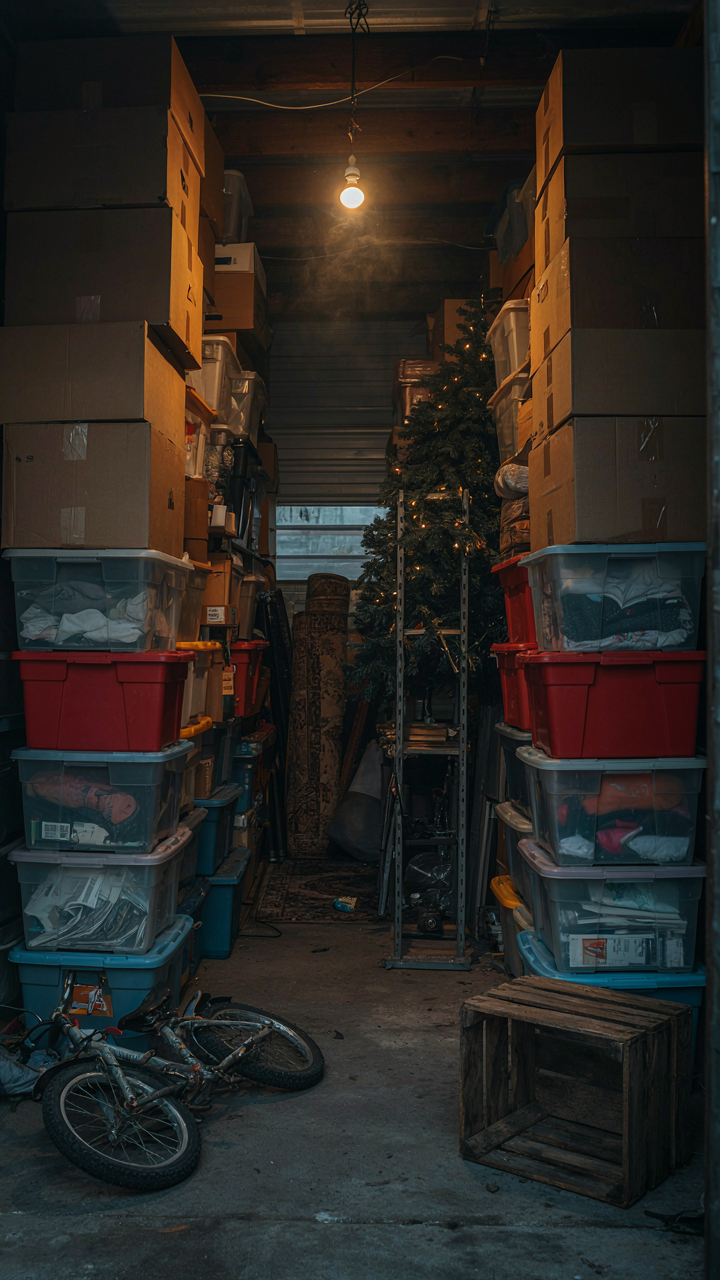
You want to believe a better organizer will solve the problem because admitting you own too much feels like failure. Here’s the mechanism: storage products don’t create space, they compress visibility. Economics calls this the substitution effect. You buy a hanging organizer and suddenly the wall looks organized, but you’ve simply hidden the fact that you’re storing items you rarely use. The RV didn’t gain capacity. You gained the ability to ignore what you own.
Most people approach this wrong. They think organization means buying containers that stack tighter or hang higher. The real move is recognizing that every organizational product is a physical lie you tell yourself. It makes clutter feel intentional. It makes excess feel systematic. The organizer isn’t solving a space problem. It’s solving a guilt problem.
The Real Cost Of Accumulating Space Saving Junk
Every organization product you buy adds weight, takes up installation time, and occupies the mental real estate you’re trying to free up. You now own a hanging shoe organizer, three drawer dividers, two nesting bins, magnetic strips, and adhesive hooks. That’s not organization. That’s a second layer of stuff that requires maintenance. The cost isn’t the thirty dollars per item. It’s the compounding cognitive load of managing systems designed to manage other systems.
The mechanism works like this: you solve one storage problem with a product, creating a new problem of where to store the product itself. You install a cabinet organizer to fit more plates. Now you need to remember how to remove it to access the cabinet. Now you need to spend five minutes extracting a plate instead of thirty seconds. Organization products often make daily life slower by adding friction to the retrieval process. Stop buying solutions and start removing what doesn’t earn its space.
The Minimalism Protocol For Camper Trailer Storage

One In, Two Out

You want to feel in control of your space without admitting you brought too much stuff. The mechanism is simple: RV storage operates like a closed system in thermodynamics. Energy (space) is fixed. Adding without removing creates pressure. Most people organize first, which just prettifies the problem. You need a subtraction rule before a filing system.
The one-in-two-out protocol forces a decision every time you acquire something. New camping chair arrives? Two items leave the trailer. This isn’t deprivation. It’s calibration. Your trailer has a real storage capacity. Organization hacks don’t expand it. They only redistribute what’s already there. You’re not fighting against clutter. You’re fighting against the lie that you can keep everything.
Eliminate Duplicates Before You Organize
Most storage advice skips this step entirely, jumping straight to containers and labels. That’s wrong. Duplicates are invisible waste taking up prime real estate. You own two coffee makers. Three sets of bedding for a bed that exists once. Four flashlights in different compartments. Remove duplicates first. This single move often creates 20-30 percent more usable space without buying anything.
Audit every category in your trailer methodically. Kitchen tools, bedding, clothing, lighting, first aid supplies. Count each item type. Keep one of each essential item. One backup for things that fail (flashlight, knife). Everything else goes. The act of elimination is faster than organizing clutter into smaller boxes. You finish auditing, remove the duplicates, then organize what remains.
Small Travel Trailer Storage Ideas: Gravity And Adhesion
Vertical Space Exploitation With Command Hooks

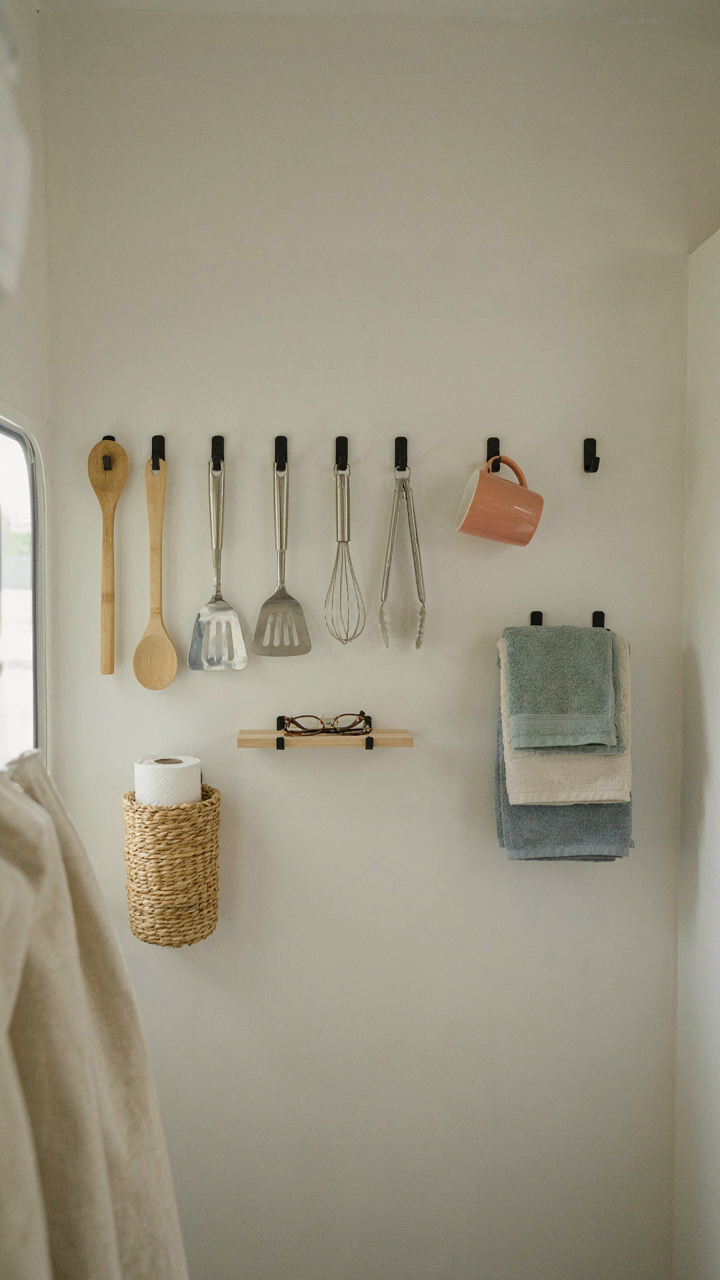
You want to feel like you’ve optimized something without actually sacrificing comfort or accessibility. The real mechanism here is physics: Command Hooks operate on adhesion rather than penetration, which means they work on any clean surface without drilling into walls you don’t own. This matters in an RV because every hole becomes a potential leak point and a liability.
Command Hooks come in weight ratings. The standard removable hook holds 1 pound. Medium holds 5 pounds. Large holds 7.5 pounds. The trick people miss is that you can stack them vertically in pairs or clusters on the same surface, multiplying capacity without multiplying damage. Install them on the interior cabinet faces, the back of cabinet doors, the sidewalls of closets, and along the upper edge of windows where wind and vibration matter less.
- Hanging shoe organizers on interior cabinet doors: Lightweight fabric organizers create instant compartments for electronics, medications, spices, and small tools without consuming cabinet floor space.
- Adhesive hooks on bathroom walls above the toilet: Creates dedicated zones for toiletries, hair tools, and towels without cabinet sacrifice or permanent installation.
- Stacked hooks on bedroom headboard backing: Holds lightweight gear bags, travel pillows, and charging cables in the dead space directly behind where you sleep.
- Double hooks along kitchen backsplash: Suspends lightweight cast iron, measuring tools, and cooking utensils from the vertical plane between countertop and upper cabinets.
- Vertical hook chains in closets: Thread carabiners or S-hooks through a chain mounted vertically, creating adjustable hanging levels for multiple items without adding bracket weight.
The failure mode is moisture and temperature. Command Hooks use a synthetic adhesive that weakens in high heat and high humidity. If your RV spends summers in the Southwest or winters in damp coastal areas, check adhesive integrity every two months and replace preventively in spring before heat season arrives.
Under Cabinet Baskets And Magnetic Strips
Stop treating under-cabinet space like dead zone. It’s actually prime real estate because gravity pulls your heaviest items down anyway, so you’re working with physics instead of against it. Magnetic strips eliminate the need for adhesive or fastening and can hold ferrous metal tools, knives, and small cast iron items without any installation footprint.
Under-cabinet baskets work best when you choose a depth that doesn’t interfere with knee clearance when seated at tables. Most RV dinettes have about 15 inches of clearance. A 6-inch-deep basket mounted under the kitchen cabinets leaves 9 inches of leg room. Fill baskets with items you access infrequently during travel but frequently enough that you don’t want them buried in storage bins. Spice bottles, backup medications, and small repair supplies work well here. Magnetic strips should hold only items that travel with you frequently enough to stay magnetic-strip accessible, not items you’re storing as backup. The moment you treat magnetic strips as general storage, they become clutter attractors.

Beyond “RV Hacks”: The Systems Thinking Approach

The Feedback Loop That Stops Clutter Before It Starts
You want a trick that fixes your mess without you having to change anything. That’s the real ask. But clutter isn’t the problem—the lack of a feedback mechanism is. Cybernetics, the field that studies control systems in machines and organisms, teaches us that without feedback, entropy always wins. In an RV, your feedback loop is the lag between bringing something in and noticing it has nowhere to go. That lag is where clutter breeds.
Most people organize after the damage is done. They cram, label, stack. What they miss is that clutter signals a broken input system, not a storage problem. Create a decision point at entry. Every item that boards your RV answers one question before it stays: “Where does this live, and can I access it in under 20 seconds?” If you can’t answer both parts, it doesn’t stay. This isn’t organization. It’s a gate that prevents the mess from forming.
Where Your Gear Lives Determines How You Move
Workflow optimization is borrowed from manufacturing. In a factory, production speed depends on tool placement relative to the worker’s movement pattern. Your RV layout works the same way. Gear placement isn’t about fitting things in spaces—it’s about minimizing the distance between where you stand and what you need. Shoes by the door. Coffee setup on the counter, not in a cabinet. Cooking tools in the galley in the exact sequence you use them.
Map your typical day movement through the RV. Trace the path from bed to kitchen to outside. Note every repeated reach, crouch, or step. The gear you touch most lives on that path. Everything else lives in deep storage. This isn’t intuitive, which is why most RVers fail at it. They organize by category instead of by movement. Your system works only when it matches how your body actually moves through the space, not how it should move in theory.
Organization For Camper Living: Your “Everything Drawer” Is A Failure

Stop Organizing By Reach, Start Organizing By Task
You want to believe a single drawer works because it feels efficient. The real reason is fear: fear of committing to a system, fear of “wasting” space on categories, fear that you’ll need something and won’t know where it is. This paralysis kills RV organization faster than anything else.
The mechanism is borrowed from manufacturing logistics: you need workflow proximity, not storage convenience. Every item must live near where you use it. Tools live near where repairs happen. Cooking items live near the stove. Medications live near the bathroom. When you chase convenience instead of function, you create decision friction every single time you need something, and in a 200-square-foot space, that friction multiplies fast.
The “everything drawer” works until it doesn’t. Then you spend fifteen minutes finding a Phillips head screwdriver while your water system needs fixing, or you search through a tangled mess for a pain reliever when you’re already uncomfortable. Drawer organization by category—not by the hope that you’ll remember where you threw something—is the only system that scales.
Create Stations, Not Collections
Every zone in an RV serves one primary function. Your galley cooks. Your bathroom manages hygiene and health. Your bed holds sleep and storage. Your entrance manages entry and exit. Each zone owns its own tools and supplies. This is the opposite of what most people do: dump related items in one central location and hope for the best.

A cooking station contains your utensils, oils, spices, and prep tools in a contained footprint near heat and counter space. A bathroom station holds medications, first aid, toiletries, and cleaning supplies within arm’s reach of the sink and shower. A mechanics station—even if it’s a single cabinet—stores fasteners, tools, and lubricants near your entry or garage. Distributed systems reduce search time and eliminate the “where did I put it” loop entirely.
When you assign ownership of items to zones, restocking becomes automatic. You notice when supplies run low because you’re physically in that space using them. You buy replacements naturally. The system maintains itself because the friction points vanish. Your only job is respecting the zone boundaries you created.
RV Organizers: The Built In Vs. The Bolt On
When Permanent Modifications Make Sense
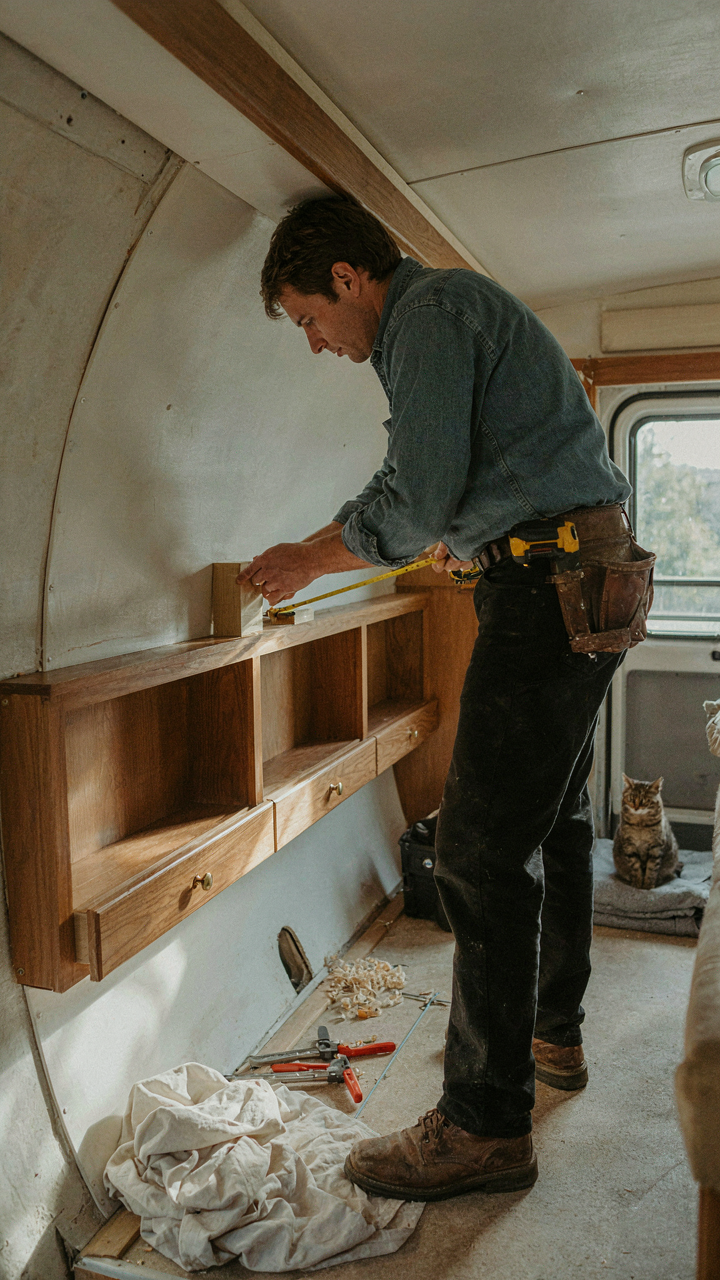
You want the built-in solution because it feels like you’ve solved something forever, and because admitting that RV living requires ongoing maintenance feels like failure. Here’s the mechanism: permanent modifications work only when the problem they solve is genuinely static. RVs aren’t static. Your weight distribution changes. Your route changes. Your needs change. Built-ins make sense only for problems that don’t move.
Cabinets, drawers, and shelving bolted into cabinetry work when they organize things you’ll never touch during travel. Spice racks, tool holders, and battery storage behind walls fit this category. They’re worthwhile because installation happens once and removal costs more than the benefit. But don’t retrofit permanent storage for things you access mid-journey or swap seasonally. The sunk cost fallacy will trap you with a kitchen drawer that made sense in winter but blocks your propane access in summer.
The Real Cost Of Temporary Everything

Everyone says temporary solutions are “flexible,” which is corporate speak for “you’ll buy this three times because it keeps failing.” Velcro bins shift during braking. Tension rods collapse under weight you misjudged. Adhesive strips peel after one heat cycle. The hidden pitfall isn’t that temporary systems fail. It’s that each failure costs you time and money while creating a cognitive load of uncertainty that undermines the whole reason you organized in the first place.
Temporary solutions work only when you’re genuinely rotating through configurations month to month. If you’re running the same route, carrying the same gear, and following the same rhythm for six months or longer, the math flips. Buy the fasteners. Drill the holes. Accept the permanence. The moment you stop treating temporary tools as shortcuts and start treating them as placeholders for decisions you haven’t made yet, you’ll organize better and buy less.
Motorhome Organization Ideas: The Art Of The Purge

Scheduled Decluttering A Non Negotiable Routine
You want to believe one purge solves the problem. It doesn’t. The mechanism at work here is entropy: disorder accelerates once you stop actively resisting it. RVs compress this law into months instead of years because limited space forces rapid accumulation.
Set a purge window every three months, not when you notice chaos. Mark it on your calendar like a tank maintenance schedule. During this window, you touch every category you own, not just obvious junk. This prevents the slow creep of items that seemed useful once but never get used.

The common advice stops at “get rid of stuff.” That’s incomplete. You need to establish what stays and why before the next accumulation cycle starts. Without a documented reason for keeping something, it becomes invisible clutter within weeks. Your purge isn’t about feeling lighter—it’s about resetting the baseline so entropy has less material to work with.
Document what you remove and why. This reveals patterns: items you thought you’d use but didn’t, duplicates you forgot existed, things that belong in a house, not a moving box. These patterns become your filter for future purchases and storage decisions.
Emotional Attachment Versus Functional Necessity
This isn’t about letting go of memories. It’s about separating the object from the feeling it creates. You keep something because it belonged to your grandmother or because you paid for it—not because it moves your life forward in your RV. That distinction kills your organization system faster than anything else.
Ask one question: does this object work in my current life or the life I’m actually living? Not the life you plan to live. Not the hobby you might restart. The actual present. Items fail this test immediately: the bread maker, the elaborate camping gear you haven’t touched, the books you already read. These are anchors disguised as possessions.
Functional necessity means the item solves a real problem you face regularly. A hammer solves problems. A decorative item that takes up a shelf does not. Your RV has finite surfaces and volume. Every square inch carries a cost—in weight, in movement, in cognitive load. Emotional items can stay, but only if they serve a purpose beyond memory. A photo doesn’t need three boxes of memorabilia surrounding it.

The decision matrix is simple: use or utility. If an item does neither, the emotional attachment is the reason you’re keeping it, and that’s the reason it’s consuming space. Move the memory into documentation—photos, notes—and move the object out.
RV Storage Ideas 5th Wheels: Maximizing Exterior Space
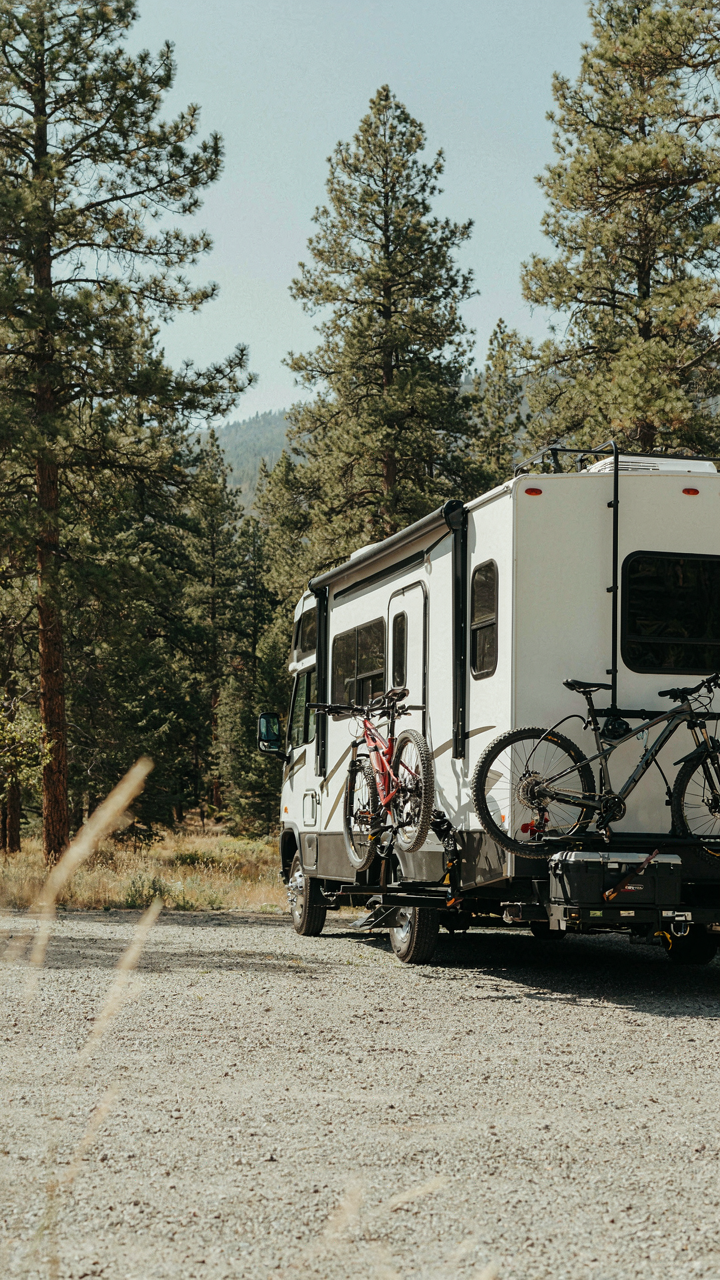
Under Belly Compartments And Cargo
You want exterior storage because you’ve run out of interior space and you’re tired of feeling cramped, not because it’s trendy. The real mechanism here is load distribution—borrow from structural engineering: weight placement matters more than volume. Under-belly compartments on 5th wheels sit low and centered, which keeps your rig’s center of gravity stable during towing. This isn’t aesthetic. It’s physics.
Most RV owners ignore under-belly storage because they assume it’s only for waste tanks. It’s not. These compartments handle gear rotation, seasonal equipment, and heavy items that would otherwise consume living space. Access them frequently during setup to avoid the trap of “out of sight, out of mind” storage that becomes dead weight. Cargo carriers mounted to the frame add capacity without affecting interior livability, but they require proper weight distribution calculations based on your 5th wheel’s specific tongue weight rating.
Weather Sealing Determines Longevity
Weatherproofing external storage isn’t optional. Water infiltration destroys gear faster than anything else, and RVs move through temperature swings that accelerate corrosion. The mechanism is simple: moisture plus metal plus temperature variance equals rust and rot. Your exterior compartments fail because of gaps, not because of rain intensity.
Seal every seam with marine-grade silicone before your first trip. Check gaskets on compartment doors twice yearly and replace them when they harden. Apply protective coatings to metal cargo carriers annually. Use waterproof storage containers inside compartments to create a second barrier—this prevents direct contact between gear and metal surfaces. The protocol is inspection, seal maintenance, and layered barriers. Skip any step and you’re replacing corroded equipment within two seasons.
RV Camper Organization Ideas: The Habit Loop Advantage

Trigger Action Reward For Tidiness
You want organization to feel automatic so you stop thinking about it. That’s the real motive here. Behavioral psychology calls this the habit loop: trigger, action, reward. A trigger is the cue that starts behavior. In an RV, your trigger is the moment you finish using something. The action is putting it back in its designated spot immediately. The reward is the mental clarity of knowing where everything lives.
Most people fail here because they create systems without anchoring them to existing routines. You don’t build discipline by willpower. You build it by making the desired action easier than the alternative. Park your coffee maker next to the cup cabinet. Keep your navigation chart on the dash bracket. Every time you reach for something, the storage location is already visible. The trigger fires automatically because it’s already part of your hand’s path.
Automate Small Organizational Tasks
The common advice says “label everything and organize by category.” That’s incomplete. Labeling only works if you’ve already engineered your containers to eliminate decision-making. Automation in this context means removing the choice altogether. Bathroom items don’t go in a general storage cabinet where you hunt for them. They live in a hanging organizer mounted inside the bathroom door. You walk in, grab what you need, done. Zero friction.
Create zones that enforce behavior through physical design, not willpower. Mount a magnetic strip for utensils on the galley wall instead of throwing them in a drawer. Use clear over-the-door organizers for medications and toiletries so you see inventory without opening anything. Store your trash in a pull-out bin under the sink that slides out and slides back automatically. These systems work because the container itself makes the correct action obvious and fast.
The Only Storage Hack You Need Is A Trash Can
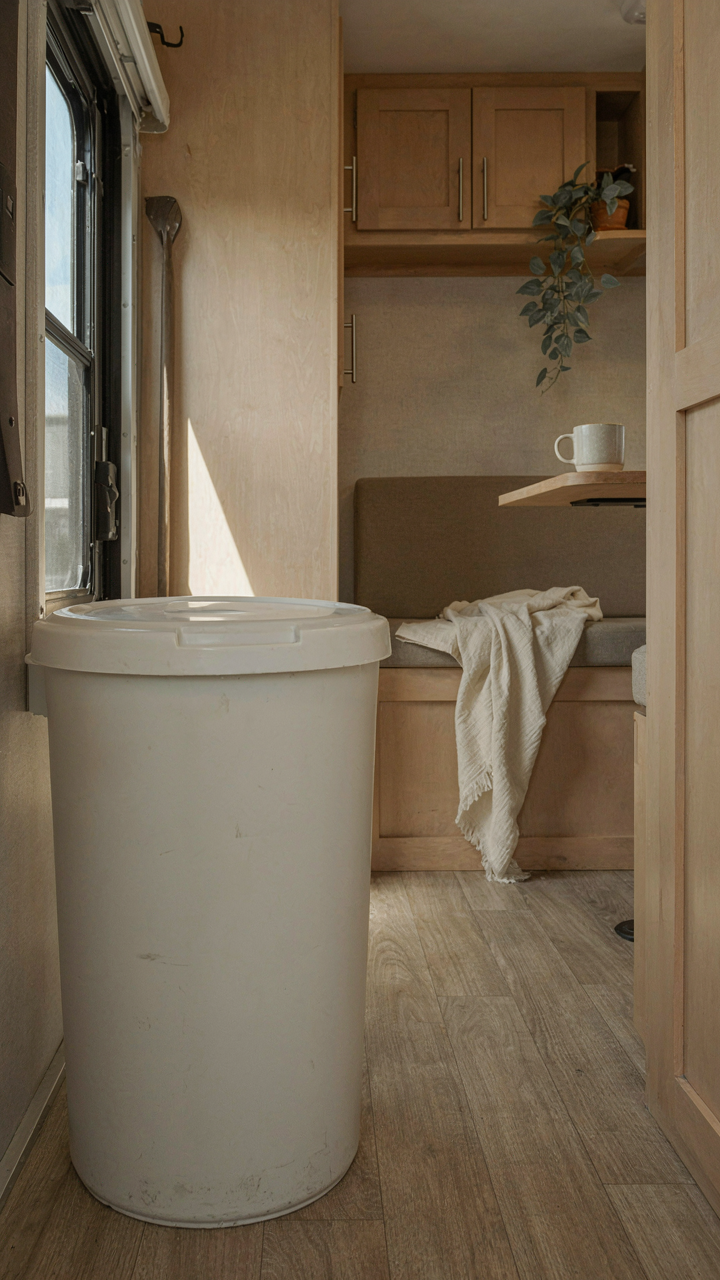
You don’t have a storage problem. You have a keeping problem. Every RV organization system fails because you refuse to throw things away. Stop buying containers and start buying courage. Pull everything out of your rig today and decide: does this item earn its weight in square footage? If not, it goes. The RV doesn’t need better storage. It needs you to stop treating it like a mobile storage unit.