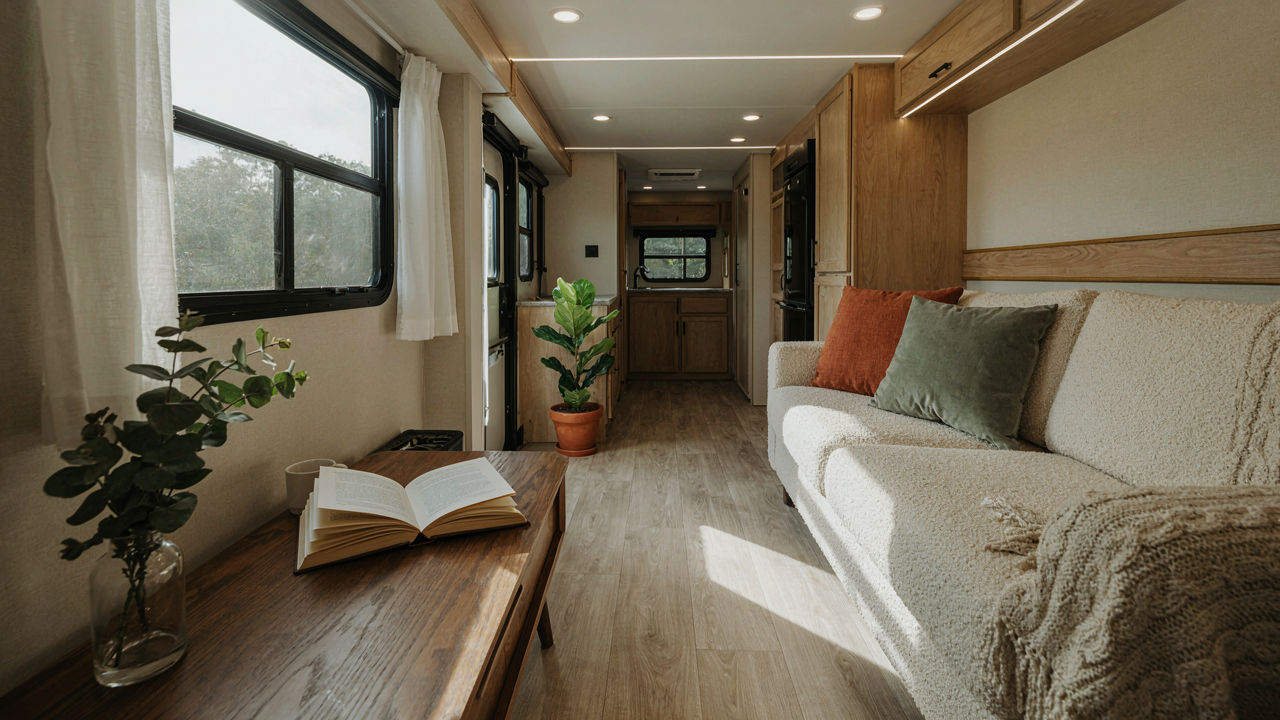
Beyond Fabric: The Structural Imperative Of An RV Couch Makeover
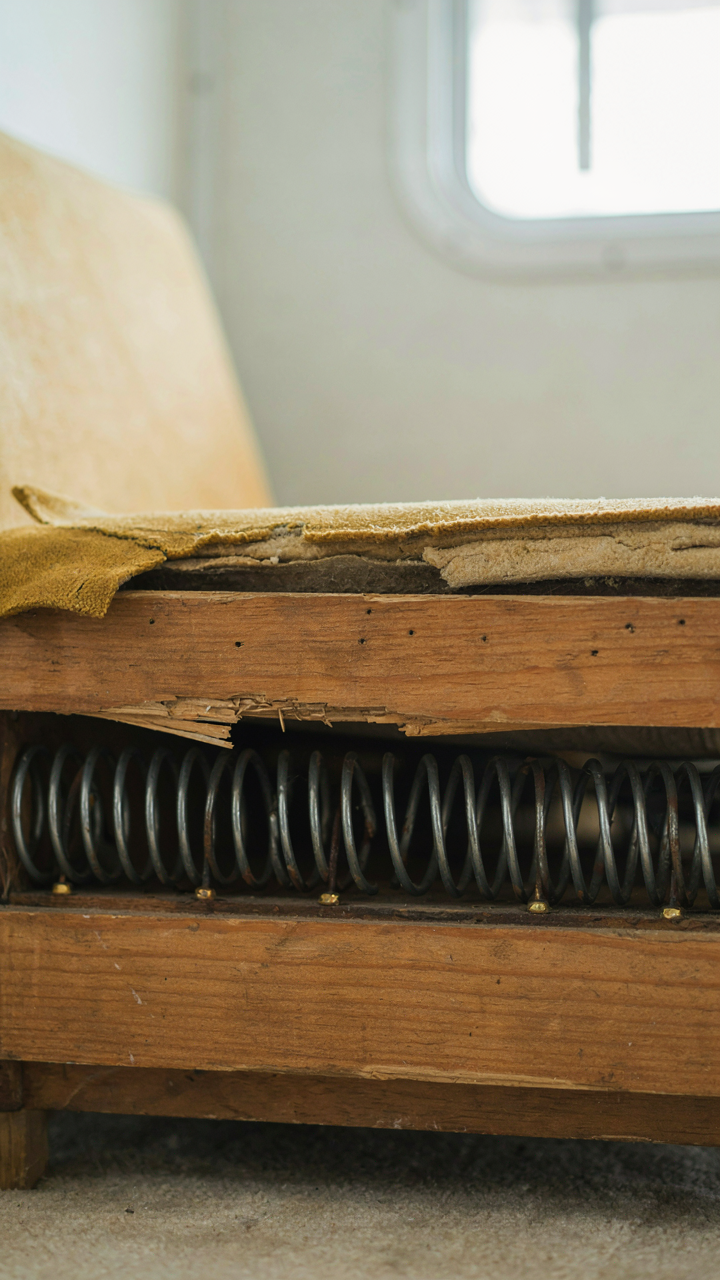
Check The Frame Before You Touch The Fabric
You want the makeover to look good because you’re selling the RV or hosting people, but the real reason you’re reading this is fear that you’ll sink money into cosmetics while the skeleton rots underneath. Here’s the mechanism: RV couch frames fail from repeated compression cycles, moisture intrusion, and the constant micro-movement caused by road vibration. These three forces work together. A frame that looks intact can have internal structural compromise you won’t see until the fabric is gone.
Start by removing cushions and inspecting the wooden frame directly. Press hard on all joints and the perimeter with your thumb and knuckles. Soft spots, cracks, or play in the joints mean rot or delamination has already started. Check under the couch for water stains or discoloration on the underside. RV couches sit low, and they collect condensation and spill water that migrates downward. If you find compromise, reinforce the frame with additional blocking or replace the frame section entirely before applying new fabric.
Where Couches Break And How To Fortify Them
RV couches fail predictably at three locations, and the common advice to just reupholster over bad structure is incomplete because it guarantees the same failure will repeat. The first failure point is the front edge where people sit repeatedly. The second is where the frame connects to the RV wall or floor—bolts loosen, welds crack, or fasteners corrode. The third is the center seam where two frame sections meet or where the backrest hinges.
For the sitting edge, add a steel reinforcement plate underneath the front rail, bolted through the existing frame. For the connection points, replace all corroded fasteners with stainless steel hardware and use threadlocker on bolts to prevent vibration loosening. For center seams, inject two-part epoxy resin into the joint if it’s glued wood, or add steel brackets across the seam on both the top and bottom surfaces. Do structural work before fabric work, or you’ll be doing this again in two years.
The Ergonomics Of Expedition: Why Comfort Is A System, Not A Feeling

Foam Density Determines Your Couch’s Actual Lifespan

You care about this because a broken couch in a moving vehicle isn’t just uncomfortable—it’s a sunk cost you can’t easily fix on the road. Foam density is measured in pounds per cubic foot, and it’s the load-bearing mechanism that separates a couch that lasts two years from one that lasts eight. Higher density foam (3.5 to 5 pounds per cubic foot) resists compression better under repeated weight cycles. Lower density foam (1.5 to 2.5 pounds per cubic foot) compresses faster, creating that sagging middle seat within months of regular use.
RV couches absorb constant micro-movements from driving and temperature shifts. Medium-density foam (2.8 to 3.5 pounds per cubic foot) is the practical sweet spot for most builds—it handles daily use without premature breakdown and costs less than premium options. When replacing cushions, specify the exact density to your supplier rather than saying “firm” or “soft.” The difference between 3.0 and 2.5 pounds per cubic foot determines whether your couch feels solid in year three or collapses into itself. Request samples and compress them manually for thirty seconds to feel how they recover.
Cushion Layout Shapes Which Activities Actually Work
Cushion placement isn’t aesthetic—it’s functional allocation. Where you position firmness determines which positions your body can actually hold for hours without pain. Engines use load distribution to prevent point failure; couches use the same principle. A single centered cushion under high-stress zones creates collapse faster than distributed support across multiple smaller sections.
Sleeping, working at a laptop, and lounging demand different support geometries. Sleeping requires a flat, consistent surface that spans the full depth. Working requires a backrest at a specific angle plus arm support at elbow height. Lounging tolerates slope but needs lateral containment. Match your actual usage to cushion thickness and placement—don’t assume one configuration handles all three. If your RV couch must absorb multiple uses daily, use modular cushions you can rearrange rather than a monolithic design.
The Material Science Of Mobility: Choosing Upholstery For Endurance
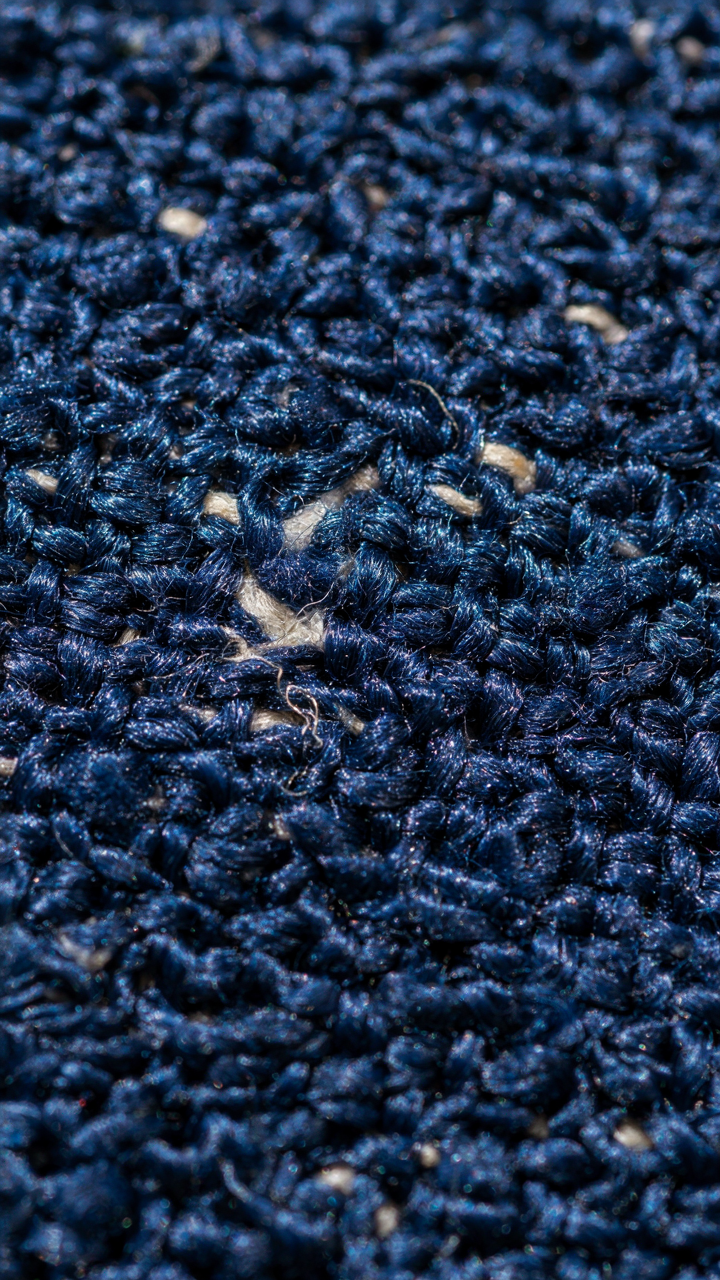
Abrasion Resistance And Stain Defense

You want the couch to still look acceptable in year three because replacing it costs money and effort you’d rather pretend doesn’t exist. The mechanism is simple: RV upholstery fails in two ways—surface fibers break down from friction, and liquids penetrate the weave. Abrasion resistance measures how many cycles a fabric survives before visible pilling or thinning occurs. Martindaleabrasion testing quantifies this by rubbing fabric against itself until failure shows. Most RV-grade fabrics should withstand 15,000 to 30,000 cycles minimum. Anything below 10,000 cycles will look trashed within eighteen months of actual use.
Stain repellency isn’t about magic coatings. It’s chemistry. Performance fabrics use fluorocarbon treatments that make liquid bead on the surface rather than absorb into fibers. This buys you time to blot before permanent setting. Solution-dyed synthetic fibers like solution-dyed polyester or acrylic hold color throughout their depth, so light staining rarely becomes permanent. The real advantage: solution-dyed fabrics resist fading from UV exposure during storage and daytime parked use. Request fabric specs that list both abrasion rating and whether the dye is solution-applied or surface-applied before committing to any remake.
Temperature And Airflow Through Fabric Density
RV couches trap heat and moisture because nobody thinks about microclimate engineering when picking upholstery. Physics applies here: fabric density determines how freely air moves through the weave structure. Tight, thick fabrics insulate trapped body heat, making the couch feel clammy in summer and cold in winter. Looser weaves allow convective air movement, which keeps the surface temperature closer to ambient conditions. Ventilation also controls moisture accumulation from humidity and spills. Synthetic microfiber sounds luxurious but often sacrifices breathability for softness. Natural fibers like linen or cotton blends move air faster but demand more stain maintenance.
For RV living, pick fabrics rated for moisture permeability or ask manufacturers directly how their material performs in humid, poorly ventilated spaces. Blend weight matters too: lighter fabrics (under 12 ounces per yard) breathe better than heavy upholstery designed for stationary furniture. Test samples by pressing your hand against the material for sixty seconds, then checking if moisture beads on your skin. That tells you airflow capacity in real conditions. The couch that stays dry outlasts one that holds moisture and promotes mold growth in the cavity beneath.
The RV Sofa Bed Ideas Protocol: Maximizing Space With Minimal Compromise
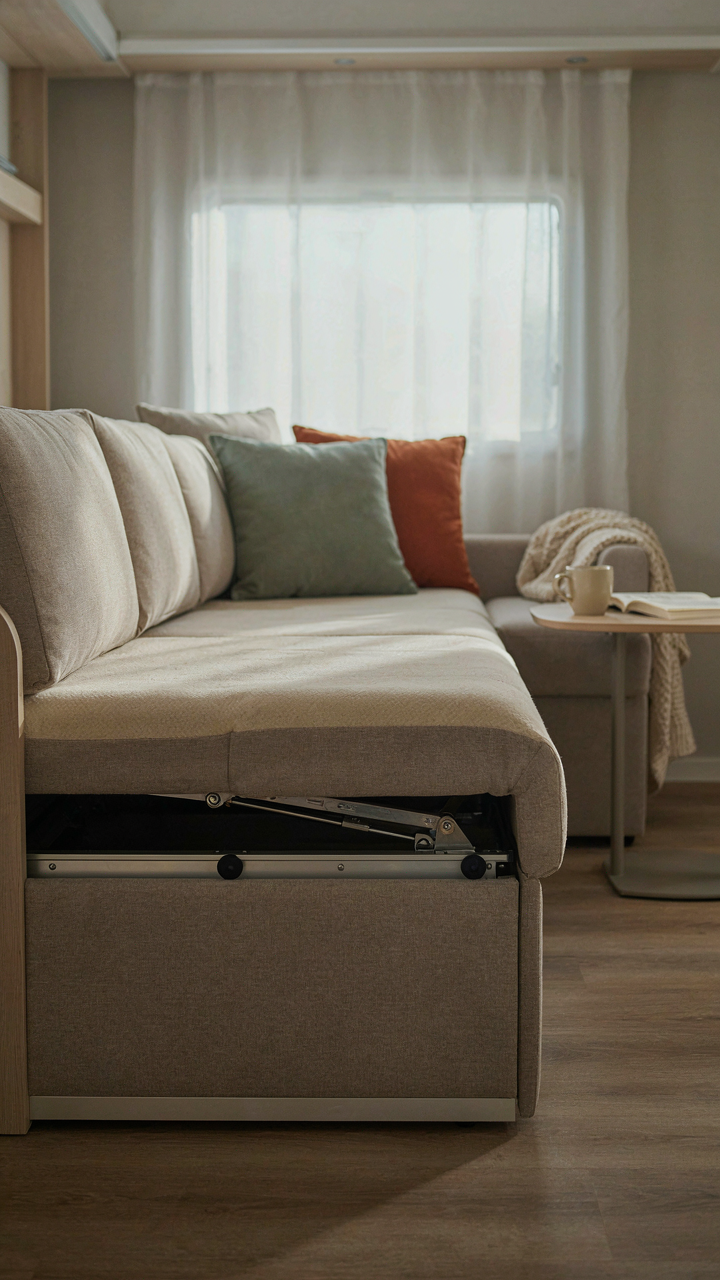
Conversion Mechanisms That Actually Work

You want a sofa bed that doesn’t feel like a betrayal when you actually use it. The real problem: most RV conversions prioritize compactness over the one thing you’ll use daily—sitting comfortably. Borrowing from mechanical engineering, every conversion system trades load capacity for deployment speed. A quality mechanism distributes weight across multiple pivot points rather than concentrating stress on hinges or frames. This determines whether your couch fails in year two or holds for a decade.
Flip mechanisms, pull-outs, and transformer-style recliners each solve different problems and create different ones. Flip mechanisms save horizontal space but demand perfect weight distribution or they bind. Pull-outs work reliably but steal usable floor depth when extended. Recliners give you the most forgiving sit but monopolize your social area. The mechanism you choose depends on whether you value sleeping comfort or daily living comfort more—not both equally.
Storage Integration Without Creating Dead Zones
RV couches fail not because they convert poorly but because people place them where traffic naturally flows. You need a couch that lets air and movement exist around it, not against it. Measure your actual walkway width first. Most people guess and waste eighteen inches of potential storage or leg room. A sofa bed positioned perpendicular to your entrance creates a navigation bottleneck that no conversion quality fixes.
Under-seat storage keeps your conversion footprint honest—if drawers pull smoothly when the seat is deployed, you’ve won. If they jam or require unfolding everything to access, you’ve built a trap. Test the mechanism fully extended and partially extended before committing. Confirm cabinet doors still open. Check that pull-out components don’t block water tanks or electrical access panels. Your couch makeover succeeds when it moves through three states—seated, reclined, and fully stored—without touching anything else.
Replacing Rv Couch: When To Repair, When To Ruthlessly Replace
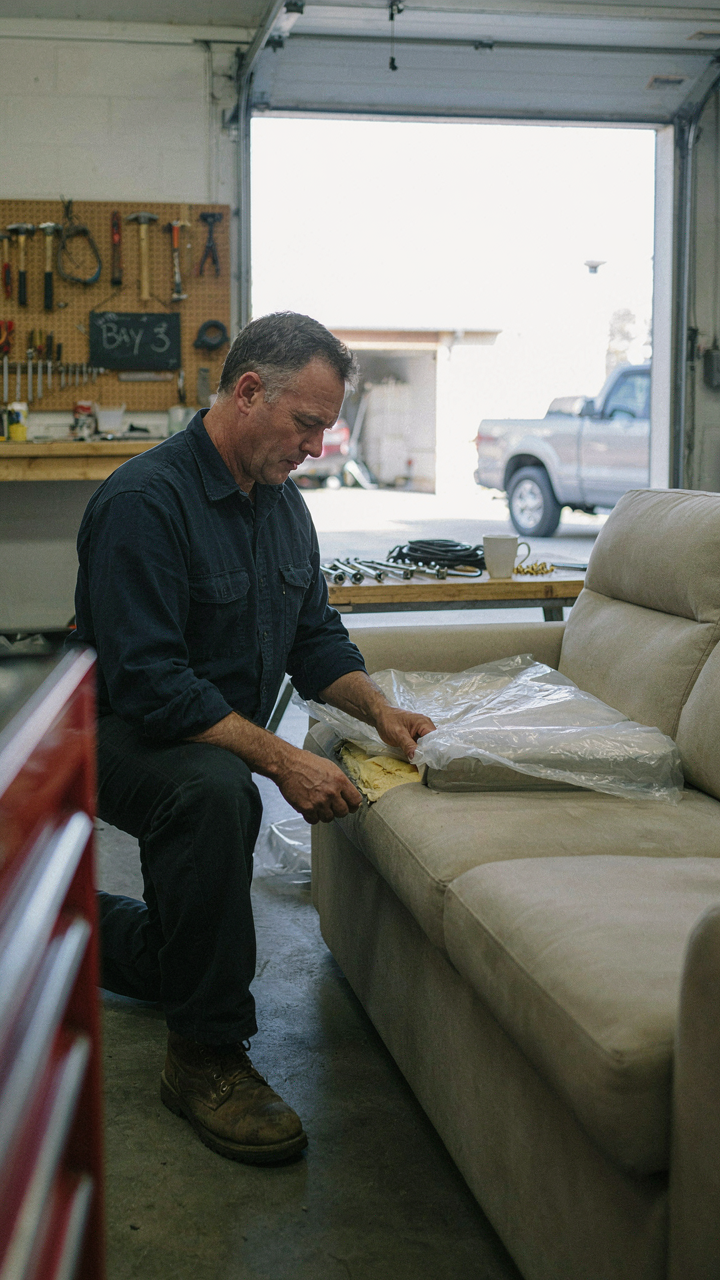
The Math Behind Keeping A Broken Couch
You’re hoping the repair will work because replacing it feels like admitting you made a bad purchase decision. Here’s the mechanism: repair economics is borrowed from maintenance theory in operations management. When applied to RV furniture, you’re tracking two variables: remaining structural integrity and cumulative repair cost relative to replacement price. A frame held together by staples and hope has already failed the first test. Most RV couches cost between 800 and 2000 dollars new. If you’ve spent more than 400 dollars on repairs in the past two years, replacement math flips in your favor immediately.
The mistake everyone makes is treating each repair as isolated. They’re not. A sagging cushion means the frame is compromised. A frame repair means the seams will pop next. You’re not fixing a couch. You’re temporarily delaying total failure while spending money that compounds. Calculate total repair spending year-over-year. If that number exceeds 30 percent of a new unit’s cost, order the replacement now and stop the bleeding.
When The Frame Tells You It’s Dead
Structural fatigue in RV couches follows a predictable pattern: wood frames absorb road vibration, moisture, and weight cycling until the joints fail. You can’t glue wood that’s already splintered at the mortise. The fatigue point isn’t when the couch sags. It’s when you push on it and feel movement in multiple directions. If pressing the armrest moves the back cushion, the frame joints have separated. This isn’t repairable with standard furniture repair techniques because RV couches endure forces that stationary furniture never encounters.
Check for irreversible damage by applying pressure to each section independently. The frame should resist. If any part flexes or creaks when you apply weight to another part, the structure is compromised. Water damage sealed inside the frame creates rot that spreads through the wood grain and stays hidden until failure. Look along the underside for soft spots or discoloration. When you find structural failure, replacement is the only logical choice because repair attempts will fail again within months.
The “Camper Furniture Ideas” Blueprint: Beyond The Couch
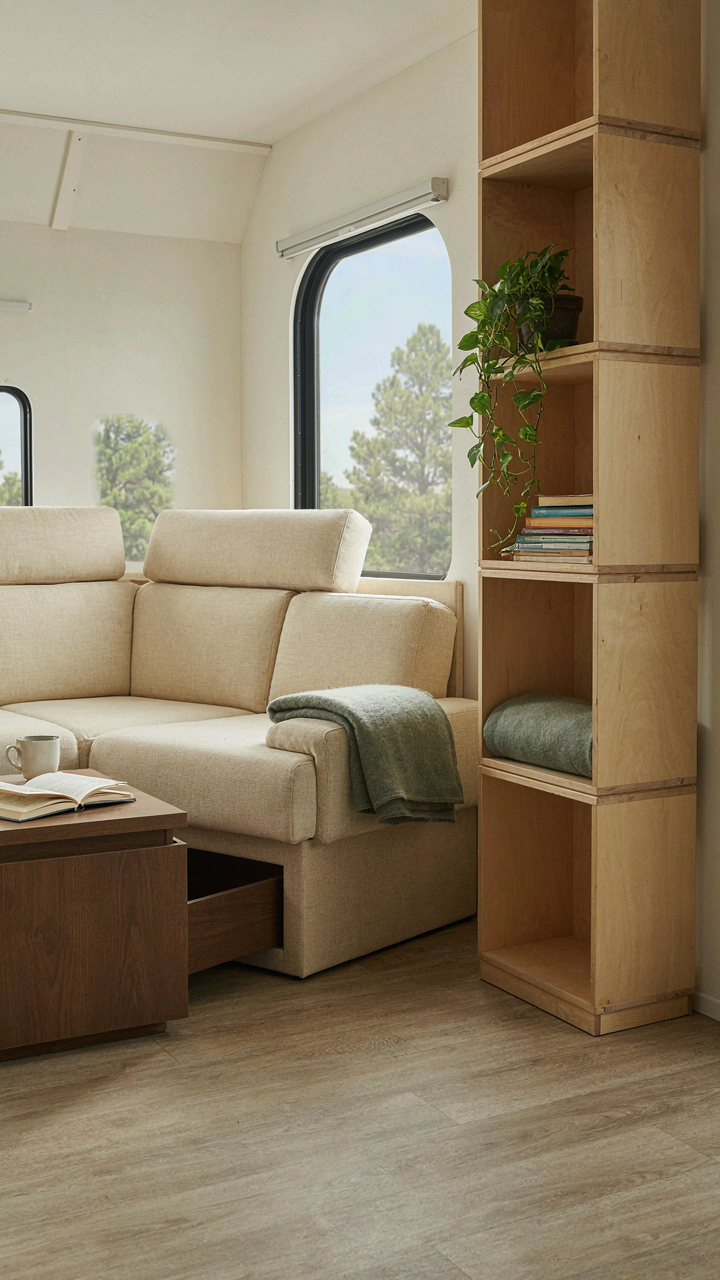
Modular Pieces That Actually Work

You want your RV to feel intentional, not like you’re making do. The truth is that most people buy furniture that looks good in photos but locks them into one layout forever. Modular components solve this by treating your space like a variable instead of a fixed asset. Each piece serves multiple configurations, which means your couch makeover becomes a system, not a one-time purchase.
- Ottomans with hidden storage: Double as seating, footrests, or extra bed bases. Prioritize models with removable lids to maximize utility across different layouts and seasons.
- Nesting tables: Stack vertically when space shrinks, spread horizontally when you need surface area. Lighter materials like aluminum or engineered wood reduce weight without sacrificing stability.
- Sectional components: Buy individual pieces that clip or bolt together rather than one fixed L-shape. You can reconfigure around plumbing, storage, or door swings as needed.
- Skirted bases or legs: Modular skirts attach to couch frames, letting you swap aesthetics without replacing the entire piece. This cuts replacement costs when you want a visual refresh.
- Removable cushion covers: Zipped or velcro-backed covers change color and texture instantly. They protect the base upholstery while giving you seasonal or mood-based flexibility.
The mechanism here is constraint removal. When your furniture adapts to multiple uses, you stop optimizing for one scenario and start living in the space instead of around it. Test each piece’s reconfiguration before buying. If it doesn’t move easily or snap into at least two distinct setups, it’s just regular furniture wearing a modular label.
The 80/20 Math Of What Actually Matters
Economics calls this the Pareto Principle: 80 percent of your comfort comes from 20 percent of your furniture choices. In RV terms, this means your couch frame, cushion quality, and fabric durability generate almost all the value. Everything else is negotiable. Most people waste money on accent chairs, side tables, and storage ottomans that sit unused while their primary seating deteriorates.
Identify what you actually use daily in your specific rig. If you’re stationary most of the year, invest heavily in seating comfort and frame construction. If you’re moving weekly, prioritize lightweight materials and quick-setup configurations over visual details. The Pareto trap is spending equally on all furniture pieces when concentration of resources on the high-impact 20 percent delivers disproportionate returns. Stop treating every item as equally important. Build the couch system first, fund everything else with what remains in your budget.
DIY Vs. Professional: The Real Cost Of RV Couch Replacement DIY
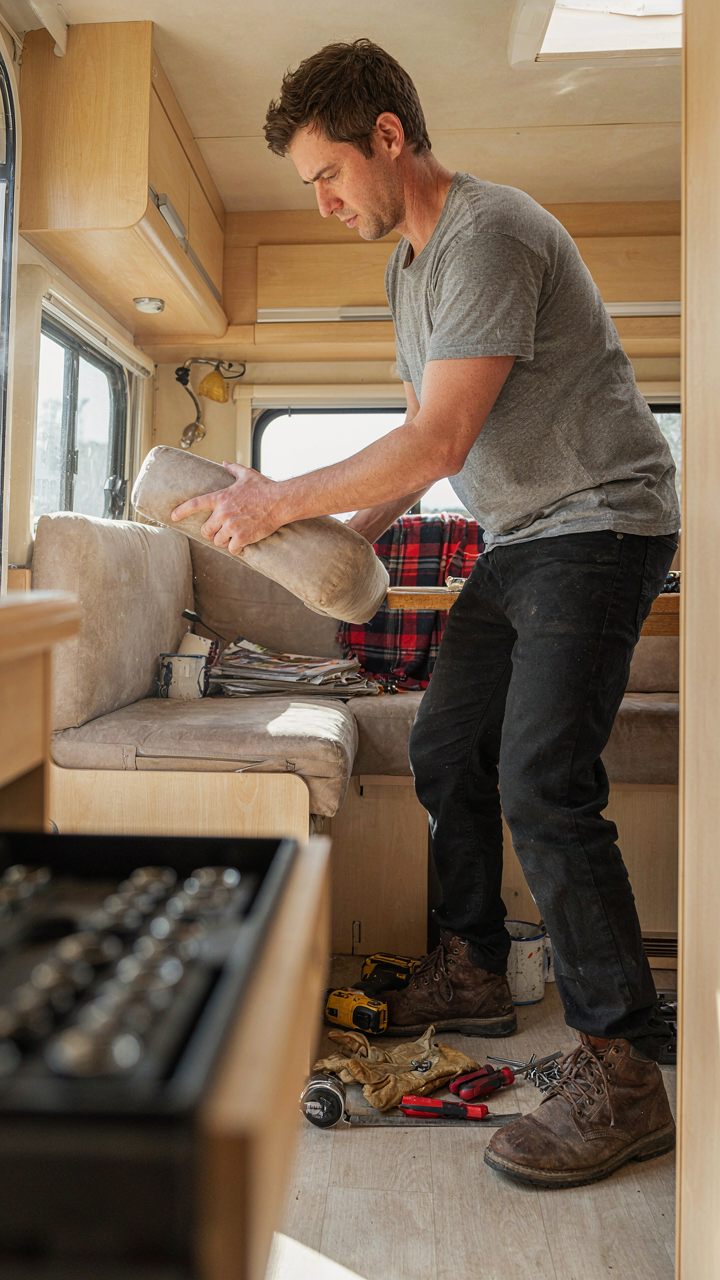
Know Your Actual Skill Level

You’re considering DIY because you want to prove you can handle it yourself. Here’s the mechanism: RV couches sit in tight spaces with fixed dimensions, bolt-down requirements, and gas strut systems that demand precision. Guessing your skill level kills projects faster than bad tools. Most people overestimate their ability to measure twice, cut once, and work in confined spaces while maintaining quality.
An RV couch isn’t forgiving like home furniture. One miscalculation on frame depth means the door won’t close or cushions won’t fit the frame properly. You need a circular saw, upholstery stapler, pneumatic nailer, drill, measuring tools, and knowledge of how gas struts function before you start. If you’ve never reupholstered anything, you’re not ready for this job alone.
The Time Trap That Bleeds Money
Common advice says DIY saves cash. Wrong. The real expense is time sitting unrealized while your RV stays parked and unusable. Pulling out the old couch takes two hours if you rush. Measuring, ordering materials, waiting for delivery, cutting frame components, upholstering, installing new hardware, and testing function stretches to 20-40 hours of actual work spread across weeks. Your RV generates zero value during this period.
Calculate your hourly rate. If you earn fifty dollars per hour and spend thirty hours on this project, you’ve burned fifteen hundred dollars in opportunity cost. The materials alone cost four hundred to eight hundred dollars depending on fabric and frame quality. A professional charges twelve hundred to two thousand dollars total and finishes in one to two days, leaving your RV operational and revenue-generating sooner. The math doesn’t favor DIY unless your time has zero market value.
The Longevity Loop: Maintaining Your Rv Sofa For Decades, Not Seasons
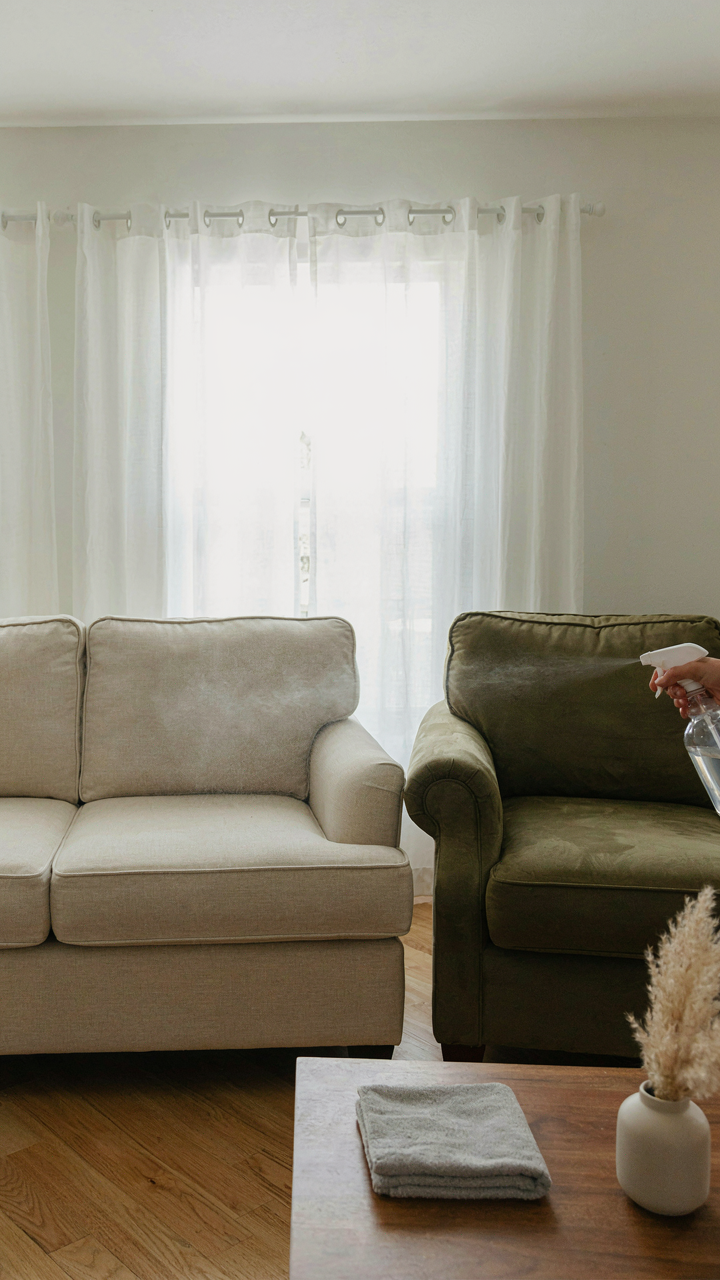
Clean Before Damage Sets In

You want to believe your RV couch will last forever if you just buy the right one. It won’t. The mechanism is simple: dirt and oils embed into fabric fibers, break down material bonds, and accelerate wear. Prevention beats replacement. Vacuum weekly with a handheld unit designed for upholstery. Target crevices where crumbs and dust accumulate. This removes abrasive particles before they grind against fibers during normal use and vibration.
Fabric protectant applied after cleaning creates a barrier between spills and material. Apply every six months in an RV where the couch takes constant low-level abuse. Most protectants use silicone or fluorocarbon compounds that repel liquids without changing the feel of the fabric. Skip this step and a single coffee spill becomes a permanent stain that spreads into the cushion core. Spot clean immediately when spills happen, but the barrier prevents panic situations entirely.
Shield Against The Physical Environment
UV damage works through photodegradation, a process where sunlight breaks chemical bonds in fabric dyes and fibers. RVs don’t move like houses. Your couch sits in direct sun for hours while parked, then travels at highway speeds where vibration stresses seams and cushion attachment points. These are three separate threats that compound each other. Use thermal or reflective window coverings whenever the RV is stationary. This cuts UV exposure by sixty to eighty percent depending on the covering material and window angle.
Humidity and vibration require different tactics. Store the RV in covered parking when possible to limit moisture exposure that weakens cushion cores and promotes mildew. For vibration, inspect and tighten all frame bolts and seam stitching every twelve months. Tighten before you see damage, not after. Vibration damage is irreversible once it splits seams or loosens cushion attachment points. The couch fails suddenly after months of micro-damage nobody sees.
Unconventional RV Couch Ideas: Breaking Free From Mass Market Mediocrity
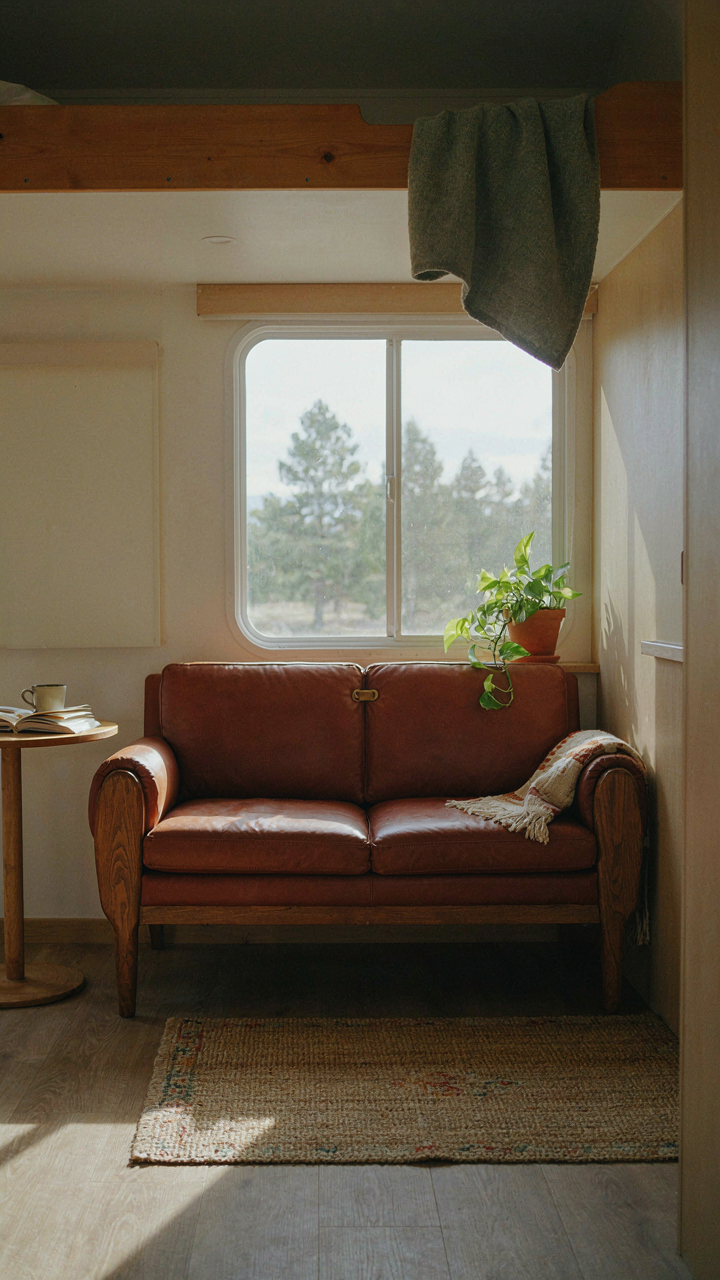
Custom Builds And Unconventional Materials

You want people to see your RV interior and think you made intentional choices, not that you settled. That’s the real driver here. The mechanism is simple: mass-market RV couches exist because factories optimize for volume and liability, not for how you actually live in 200 square feet. Custom builds flip this. You design for your specific weight distribution, your specific storage needs, your specific climate. A plywood frame with high-density foam, wrapped in solution-dyed fabric or marine-grade leather, outlasts OEM couches because you control the material stack. You’re not fighting a design built for a committee of accountants.
The path is ruthless: measure your actual seating depth and length first, not what the manual says your RV accommodates. Source a local upholsterer who’s worked with marine applications—they understand moisture, UV exposure, and vibration better than furniture makers. Steel-tube frames cost more upfront but eliminate the wood rot that destroys RV interiors. Your build time compresses to two weeks max if you source materials before you start. The real cost isn’t the labor—it’s the decision to stop treating your couch like an appliance you inherited.
Repurposing Commercial Furniture For RV Constraints
The standard advice says buy RV-specific furniture because standard pieces won’t fit. That’s partially true and largely backwards. Commercial logistics applies here: constraint forces innovation. A restaurant booth frame, stripped and reupholstered, gives you a couch that handles movement better than residential furniture because it was engineered for movement. A medical-grade waiting room chair holds up to humidity because it was built for high-traffic environments. The trick is identifying pieces engineered for the actual stressors your RV creates, then adapting them.
Start with dimensions, not aesthetics. Measure your alcove, then hunt for commercial pieces that fit within those bounds or come close enough to modify. Office cubicle seating, airline crew rest couches, and boat salon furniture all contain mechanisms RV designers borrowed anyway. Your upholsterer can compress or extend these frames by six inches in most cases. The real win: these pieces already solve for durability in hostile conditions. Your build adapts the solution instead of reinventing it from IKEA particleboard.
The Real Failure Isn’t A Worn Couch; It’s Ignoring The Underlying System That Caused The Wear

You can slap new fabric on that couch today, but it’ll look trashed again in six months if you don’t fix how you live in your RV. Most people blame wear. The real culprit is friction. Friction between your space and your habits. Before you buy anything, spend one day documenting exactly how your couch gets destroyed. Spills? Dust? Constant friction from bodies? Once you know the enemy, you pick materials that win. Your RV couch makeover fails because you redesign the problem, not prevent it.