
The Illusion Of More: Why “Storage Solutions” Fail
You’re Buying Your Way Out Of A Decision Problem
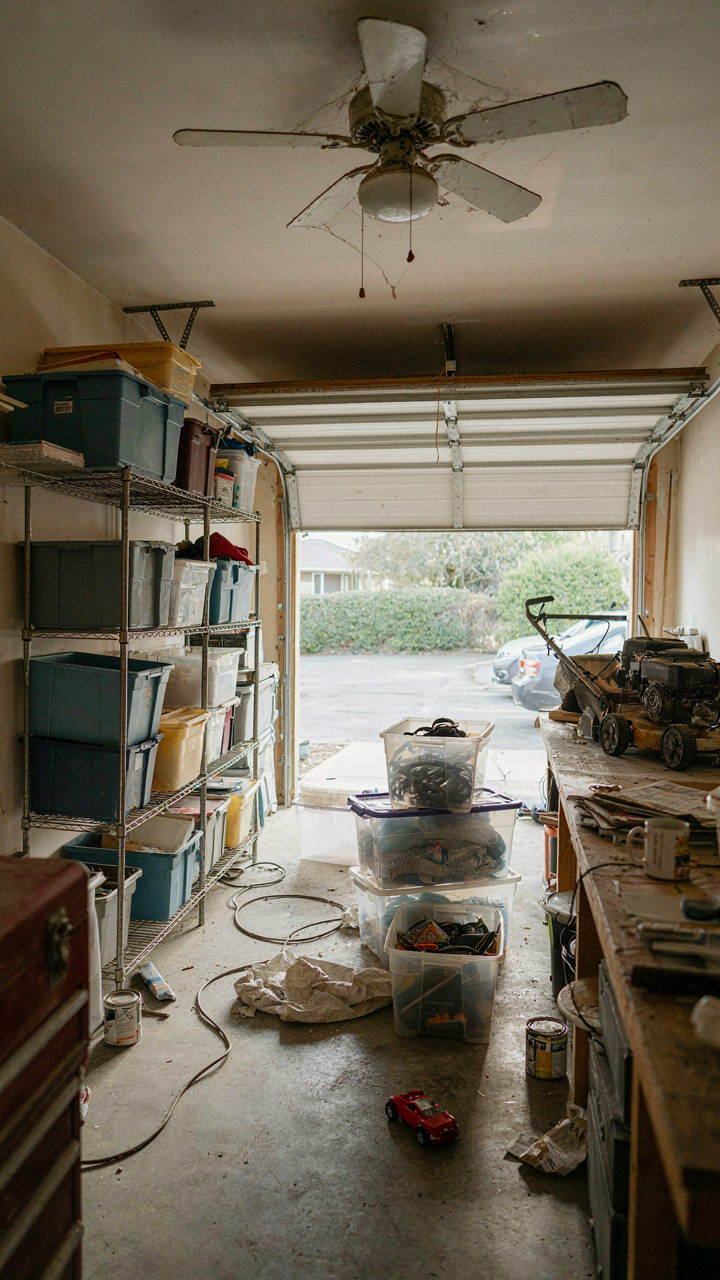
You want to feel like you’ve solved the problem without actually solving it. The mechanism at work here is the same one that fills suburban garages: storage products feel like action. You buy an under-bed organizer, a hanging caddy, stackable bins. You’ve done something. You haven’t. The RV bedroom doesn’t have a storage shortage. It has a stuff surplus. Every dollar spent on containers is a dollar spent avoiding the real choice: what stays and what goes. Most people know this and buy anyway because a new product is easier than a hard inventory decision.
The trap deepens because storage containers themselves take up space. A bin system that promises efficiency occupies cubic feet. Hanging organizers add weight and reduce headroom perception in an already tight cabin. Vertical storage racks consume wall real estate that could stay open. You’re trading your floor space problem for a ceiling or wall problem, then calling it solved. The RV bedroom doesn’t need more places to put things. It needs fewer things to put anywhere.
Accumulation Compounds In Confined Geometry
Storage solutions don’t prevent accumulation—they enable it. This is a physics principle: systems expand to fill available capacity. An RV bedroom with new storage gets filled. New storage was supposed to free floor space; instead it legitimizes keeping more items. You now have “proper places” for things, so those things multiply. The organizational infrastructure becomes permission to own more. Six months later, the bedroom feels equally cramped, just organized differently. The containers are full. The floor is still gone.
What actually happens in small RV spaces is that each storage solution becomes the seed for purchase behavior. Once you install hanging organizers, you buy more clothes to fill them. Install under-bed drawers, and suddenly seasonal items migrate from the storage bay into the bedroom. The problem isn’t that you can’t fit your belongings. It’s that you keep acquiring new ones because the system makes room. The only mechanism that works is ruthless subtraction before any new storage infrastructure exists.
The Spartan Method: Ruthless Prioritization For Small RV Living

What Actually Counts As Essential

You’re hoping that calling something “essential” will let you keep it without guilt. Here’s the mechanism: your brain conflates emotional attachment with necessity. In economics, this is called the endowment effect—you overvalue what you own simply because you own it. For RV storage, essential means one of three things: it keeps you alive, it generates income, or it serves your primary activity in the RV. Everything else is cargo.
Most people misdefine essential as “might be useful someday.” That’s not essential. That’s insurance against boredom or imagined scenarios. Essential in a 70-square-foot bedroom means: sleep system, work gear if applicable, seasonal clothing in rotation, hygiene items, and nothing more. The gap between what you think you need and what you actually use expands the moment you stop moving. Track what you touch for 30 days. What remains gets drawer space.
Strip Down Before You Organize
The common advice tells you to buy better storage containers. That’s backwards. Containers enable hoarding. You need friction first, then systems.
- Remove everything from the bedroom: Pull every item from cabinets, under the bed, closets. Pile it on the dinette. See the actual weight of your life.
- Touch-test every single item: Hold it. Ask: have I used this in 60 days? Will I use it in the next 60? If no to both, it leaves today.
- Sell or donate immediately: Don’t create a “maybe” pile. Decision fatigue kills momentum. Use Facebook Marketplace or donate to a local shelter same day.
- Measure your actual storage: Write down cubic feet available in drawers, cabinets, under-bed space. Know the number. It’s your constraint.
- Keep a one-touch rule: When an item enters the bedroom, it has one designated spot. No secondary piles. No “I’ll organize this later.”
Once you’ve eliminated 40 to 60 percent of what you brought, the remaining items take up half the space. Then storage becomes simple. You’re not organizing clutter anymore—you’re maintaining a system with breathing room built in.
Vertical Victory: Leveraging Unused Camper Bedroom Storage

Wall Mounted And Overhead Options

You want floor space back because you’re tired of feeling boxed in, and vertical storage is the only honest answer. Most RV owners ignore their walls entirely, treating them like decoration instead of real estate. Wall-mounted shelving, hanging organizers, and overhead cabinets transform dead space into working storage. The ceiling above your bed is the most wasted zone in any camper bedroom. Aluminum rail systems and tension rods mount securely without permanent damage to fiberglass or composite walls.
Overhead storage bags and net systems work best for items you access seasonally. Install them perpendicular to the bed so they don’t create a claustrophobic feeling directly overhead. Shelving mounted at eye level keeps daily items accessible without cluttering nightstands. Corner shelves solve the problem of wasted triangular spaces that run the length of most RV walls. The mechanism is simple: you’re converting cubic footage that costs nothing into functional square footage that costs money to replace with floor space.
The Leverage Principle In Tight Quarters
Physics teaches leverage through applied force at distance, and RV storage works the same way. You maximize limited vertical space by distributing weight across multiple points rather than loading one shelf to capacity. Lightweight materials matter here because gravity compounds every ounce over time in a moving vehicle. Wall anchors rated for the vertical load prevent catastrophic failure during transit or sudden stops. Install shelving at intervals that match your belongings, not at arbitrary heights that leave gaps below heavier items.
Heavy items belong lower. Light items belong higher. Never reverse this order. Your storage system fails when you ignore weight distribution and expect adhesive strips or light-duty brackets to hold concentrated loads. The protocol is straightforward: calculate total item weight, verify bracket ratings exceed that weight by 50 percent, then anchor into studs or use backing plates that span multiple ribs in the RV frame. Execute this step correctly and your storage survives five years of road vibration without sagging.
Under Bed Ops: Covert RV Clothes Storage Ideas

The Real Problem With Under Bed Space

You want under-bed storage to work because you’re tired of clothes dominating your bedroom footprint. The mechanism is simple: RVs ship with beds that float 18-24 inches above the floor, but most owners treat that void as unusable dead space. That’s a design failure on your part, not the RV’s. The gap exists because manufacturers needed structural clearance for plumbing, electrical, and subfloor components. Recognize what’s actually beneath the bed before you cram it full. Most RVs have lateral runs of fresh water and waste lines, plus heating ducts. You can’t penetrate these randomly. Measure the depth, test for obstructions with a flashlight and probe rod, then map out what’s safe to occupy.
The real storage lives in the perimeter zones where nothing runs. RV beds typically sit on a frame bolted to the floor rails, leaving pockets along the long sides and foot end. These zones stay clear on purpose. Sliding containers into them costs you nothing in installation but forces you to commit to a rotation system. If you slide winter coats under in June and forget them until August, you’ve just created a moisture trap. Containers without ventilation breed mildew in the damp RV environment. Use breathable fabric bins or rigid boxes with drain holes drilled into the bottom corners.
Strategic Placement Under The Bed Frame
Military logistics calls this “load plan optimization”—arranging resources so the most-needed items reach you fastest. Apply it here: items you access weekly stay at bed foot or within arm’s reach of the side. Off-season gear lives deeper under the head, where you rarely disturb it. Most RV beds are accessible from one or two sides only, so traffic flow matters. If your bed backs against a window wall, you’ve got a natural dead zone there that takes five seconds to reach versus thirty seconds if you’re digging from the foot. Map your movement pattern first. Pull the bedding off and live with the empty frame for one night. You’ll see immediately where you naturally reach.
The containers themselves determine usability. Shallow, wide bins stack better than tall narrow ones and slide easier on the bed frame’s undercarriage. Measure the exact clearance between your mattress and the floor substructure. Most RV beds have 16-20 inches, but water heaters, furnaces, or structural cross-beams can steal six inches in specific spots. Use this measurement as your container height ceiling, then back off two inches to prevent jamming. Label every bin on the long edge and the front face—not the top. You’ll thank yourself when you’re lying in bed and need to remember what’s stored where without pulling the whole setup out. Sliding a container under the bed takes thirty seconds; you need the label visible from your pillow.
Modular Mastery: Adaptive Camper Closet Ideas
Build Systems That Reconfigure, Not Accumulate

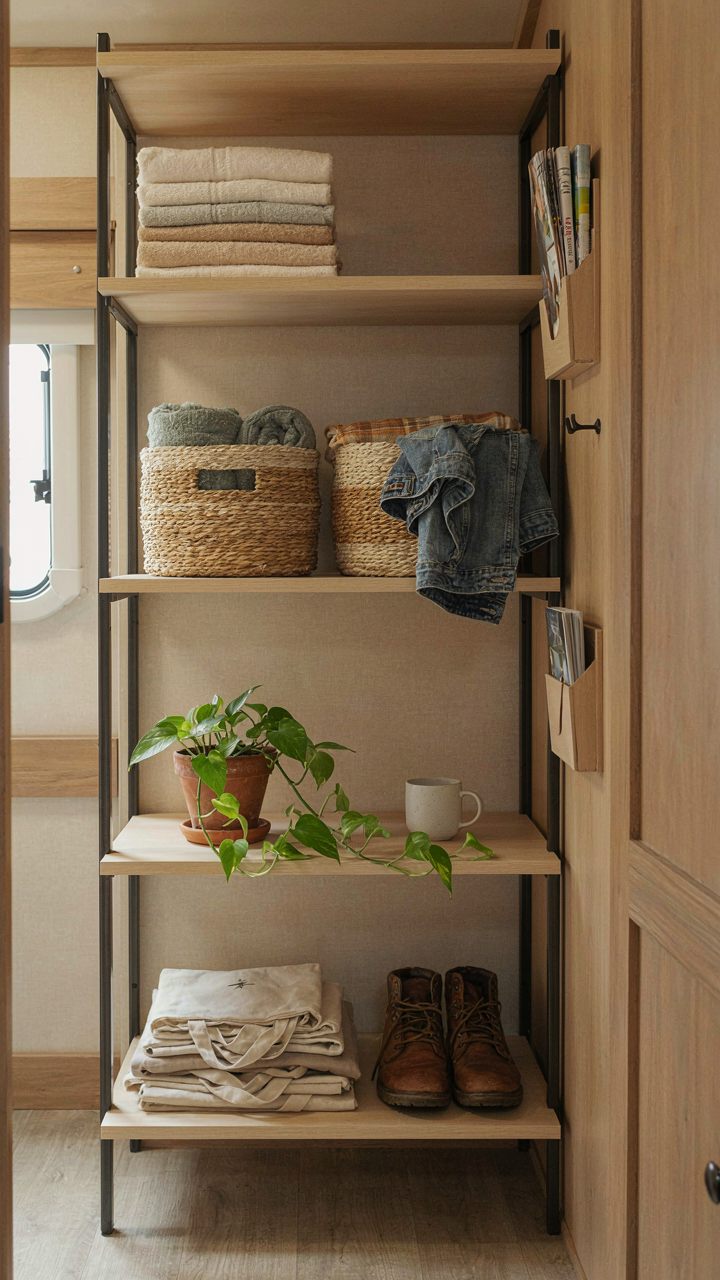
You want modular storage because you’re tired of feeling trapped by your own stuff. The real mechanism is constraint-based design: RV bedrooms force you to choose between fixed layouts and adaptive ones. Fixed layouts lock you into one configuration forever. Adaptive systems let you reconfigure storage based on what you actually need that month, then pivot without ripping out walls or replacing hardware.
Customizable rail systems, adjustable shelving, and removable bins solve this by treating your closet like construction, not decoration. Use aluminum track mounted to studs so you can slide brackets up, down, or sideways. Mount shelves on adjustable standards rather than permanent fasteners. The cost difference is negligible but the flexibility compounds over years of use. You stop fighting your space and start using it.
Flexibility Compounds When You Eliminate Fixed Points
Most RV closet advice treats storage like a permanent installation. That’s wrong. The constraint you’re actually solving isn’t storage capacity, it’s your inability to adapt when your needs change. Think like a logistics operation: flexibility is the buffer that absorbs unpredictability. When you travel three months versus six months, when you shift from winter to summer gear, when you add a passenger, your storage demands shift. Rigid systems fail under that pressure.
Removable dividers, stackable containers with uniform dimensions, and hooks that swap between walls and doors let you rearrange in minutes rather than hours. This isn’t luxury. This is operational efficiency applied to 90 cubic feet. The protocol: measure your bedroom dimensions, identify weight-bearing surfaces, install one primary rail system, then build everything else around that anchor point. Everything else slots in or out as needed.
The Multi Purpose Mandate: Every Item Earns Its Space

Identifying Dual Function Items For RV Bedroom Storage

You want more floor space without admitting you brought too much. The real mechanism here is opportunity cost. In economics, every square foot of your RV bedroom either stores one thing or enables movement. You can’t have both with single-use items. Dual-function furniture collapses that tradeoff. A storage ottoman becomes a seat, a footrest, and a containment box. An under-bed drawer system with a hinged top surface doubles as a workspace. These aren’t clever hacks. They’re the only rational use of finite cubic space.
The mistake people make is treating storage and furniture as separate problems. They’re not. A bed frame with integrated drawers doesn’t add storage to the room. It replaces the storage you already need elsewhere. Same footprint, doubled utility. Vertical wall-mounted shelving with a fold-down desk does the same work. Look for items that serve two distinct functions simultaneously, not items that theoretically could serve multiple purposes if you rearrange them. The distinction matters because it determines whether you actually save space or just shuffle clutter around.
Eliminating Single Use Clutter In Camper Bedroom
The conventional advice says “only bring what you need.” It’s incomplete. The real problem isn’t quantity. It’s specificity. You need clothes, toiletries, and bedding. You don’t need a hair dryer that works at exactly 1800 watts, or four throw pillows that match your aesthetic but serve no thermal or ergonomic function. Single-use items exist because you made a decision about margin, not necessity. Margin in an RV bedroom is zero. Everything you can’t justify in two ways gets eliminated.
Start with your nightstand. If it holds only a lamp and a water glass, it’s a space tax. Replace it with a wall sconce and a small magnetic shelf. The lamp function moves to the wall. Storage appears under it. Your phone charger lives on that shelf instead of taking drawer space. Work through every surface and container this way. If an item serves only one purpose and that purpose could integrate into something else, it doesn’t stay. This isn’t minimalism as philosophy. It’s mathematics.
Digital Declutter: Reducing Physical Media In The RV

From Paper To Screens

You want to feel like you’re not sacrificing comfort just because your bedroom is eight feet long. That’s the real motive. Here’s the mechanism: physical media takes up cubic inches that you cannot reclaim. A single bookshelf in a stationary home costs nothing. In an RV, it costs weight, space, and the ability to move. Books, DVDs, and printed documents occupy shelf real estate that could hold clothing, tools, or just air. The math is brutal. One cubic foot of books weighs thirty to forty pounds and consumes storage that serves zero other function once you digitize the content.
Most people think the barrier to going digital is attachment to physical objects. That’s incomplete. The real barrier is friction during the transition. You need a system before you shed the books. Start by photographing documents and using OCR software to make them searchable. For books, use Kindle, Apple Books, or Scribd depending on your library size and reading habits. For movies, a streaming subscription costs less per year than the shelf space a DVD collection demands. The shift isn’t about nostalgia versus progress. It’s about reclaiming square footage you’re literally paying to haul around.
Space Multiplication And Real Accessibility
Every pound stored in your RV bedroom affects fuel efficiency, payload capacity, and how the vehicle handles on the road. Think in terms of weight density, the engineering concept that measures output per unit input. Physical media has negative weight density in mobile living: high mass relative to utility gained. A hundred-page printed manual takes up a full shelf. The same manual in digital form takes up one megabyte and sits on a device you’re already carrying. The accessibility paradox cuts deeper. You cannot quickly reference a specific passage in a physical book while driving. You can search a digital document in seconds.
The real advantage emerges in repetition and scale. Ten books equal five pounds and significant shelf footage. Twenty books become impractical. But fifty ebooks fit on a phone that weighs six ounces. Physical media forces you to choose what you keep. Digital storage forces discipline only around what you actually retain and organize. Start the transition by moving your most frequently accessed materials first. Photograph manuals, subscribe to ebook services for leisure reading, and migrate documents to cloud storage. The mechanism that works: digitize before you leave for the road, not after you run out of space.
The Unseen Weight: Mental Clutter’s Impact On Physical Space

Why You Can’t Let Go Of Things

You want to believe your RV bedroom storage problem is about square footage. It’s not. You’re afraid that throwing something away means admitting you made a bad purchase decision, wasted money, or won’t become the person who uses it. The mechanism is simple: emotional attachment to objects prevents rational assessment of their utility, so items accumulate not because they fit, but because releasing them feels like losing a version of yourself you’re still defending.
This is loss aversion from behavioral economics applied directly to RVs. Your brain weighs a potential loss twice as heavy as an equivalent gain. You kept that camping stove for three years without using it because losing it felt worse than the cost of storing it. That’s not laziness. That’s a documented cognitive bias working against your floor space. The clutter isn’t the problem. The mental story attached to each item is.
Permission To Release What Doesn’t Work
The common advice here is garbage: “only keep what sparks joy” or “would you buy it again.” These feel therapeutic but ignore the actual friction. You need a different filter. In an RV bedroom, every object competes for limited cubic space. Ask one question: Does this item serve my actual life in this RV, or does it serve an imaginary version of my life I’m not living? The distinction is binary and removes emotional debate.
Once you answer honestly, the release becomes mechanical. You’re not discarding a bad decision. You’re reclaiming the space your past self borrowed from your present self. Create a remove list for items that fail the test. Don’t negotiate. Box them, store off-site, or sell them within two weeks. The faster you move items out, the less mental weight they carry and the more cubic footage your bedroom suddenly has.
The Real Constraint Isn’t Space; It’s Your Attachment To Excess


You don’t have an RV storage problem. You have a decision problem. Every inch of wasted space in your bedroom represents something you never use but refuse to discard. The hacks work, but only if you do the harder work first: eliminate what doesn’t serve your life on the road. Pull everything out of your bedroom today. Touch each item. Ask if it earns its weight. What remains goes vertical. Everything else leaves. Your floor space expands the moment you accept that less is the real luxury.