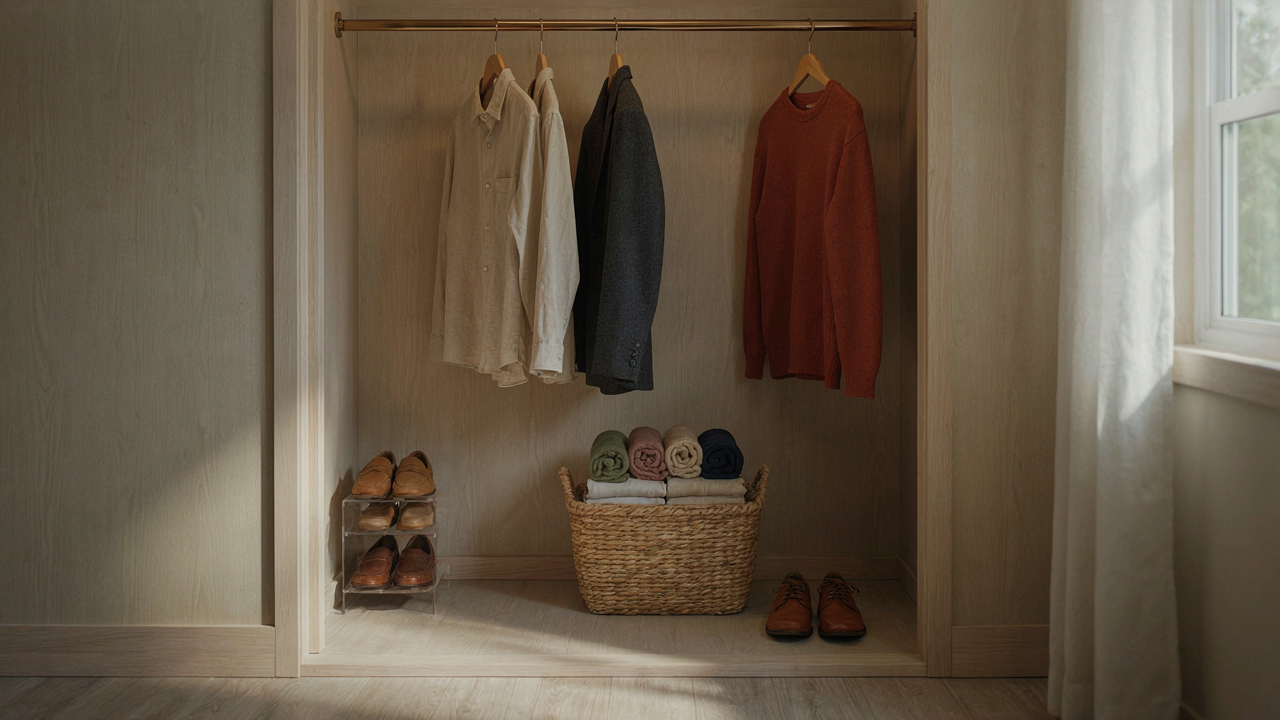
The Myth Of More: Why “Maximizing” Is A Trap For Camper Organization

The Organizer Accumulation Spiral
You want to feel like you have control. That’s why you keep buying organizers. The RV closet hack industry profits off a basic human fear: that one more product will finally solve the problem. But here’s the mechanism nobody states plainly. Every organizer you add takes up space and requires maintenance. You’re not gaining capacity. You’re trading usable volume for the illusion of order. The closet didn’t shrink because you bought a hanging shoe caddy. It shrunk because the caddy now occupies real inches of rod space and depth. Most people miss this because they focus on “slots” or “pockets” instead of the actual cubic footage consumed by the container itself.
The psychology here mirrors inflation in economics. You start with one shelf divider to stack sweaters. Then you add drawer organizers. Then hanging cubbies. Then vacuum bags. Each purchase promises to unlock hidden space that doesn’t exist. What actually happens is you’ve converted open air into structured storage that now demands the exact items it was designed to hold. You’ve created artificial demand instead of solving the real constraint. The real constraint is the RV closet’s dimensions. Those don’t change when you buy more stuff to organize the stuff you already bought.
The False Promise Of Added Capacity
The common advice here is garbage. Storage blogs tell you that organizing creates space. It doesn’t. Organizing redistributes what you already have into a visible arrangement. You feel less chaotic but you own the same total volume of items. This is why people get home after their RV trip and the closet still feels packed. They organized better, not smarter. The real mechanism at work is called constraint management, borrowed from operations and manufacturing. In that field, you don’t solve a bottleneck by painting it a different color. You solve it by eliminating the bottleneck itself. In an RV closet, the bottleneck is hanging rod length and depth. Adding organizers doesn’t extend either one. It consumes both.
Here’s what actually happens. You fill organizers because they’re there. It’s called the Ikea effect meets empty space horror. Once you install a hanging caddy with ten pockets, you feel obligated to use those pockets. You find items to fill them. The closet doesn’t function better. You’ve just shifted from disorganized chaos to organized chaos while losing inches of hanging space for actual clothes. The solution isn’t more organizers. It’s deciding what stays in the RV and what doesn’t. Ruthless inventory control beats any hack.
Radical Curation: The First Rule Of RV Clothing Storage Ideas
The One In Two Out Principle

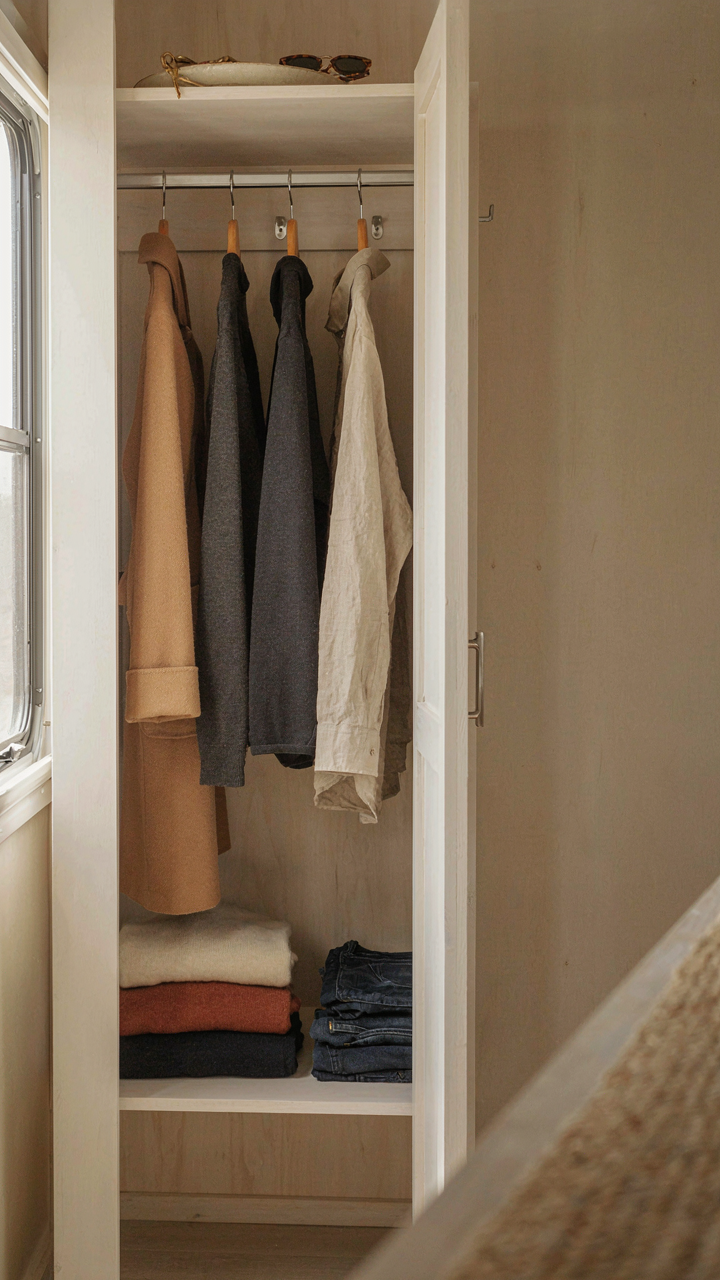
You want to feel like you have options without admitting you’re afraid to commit to a smaller wardrobe. Here’s the mechanism: RV closet space isn’t infinite, so every garment competes for real estate. The one in, two out rule forces a decision cost. When you add something, you must remove two items. This isn’t punishment. It’s math. The constraint kills the fantasy that you’ll wear everything.
Most RV dwellers ignore this because they think downsizing means sacrifice. It doesn’t. It means removing the items you haven’t worn since the last trip, plus one more. Start with the back row. Items pushed to the rear are already telling you something. Pull them out. If you haven’t reached for them in two months, they’re dead weight taking up cubic inches you need for actual rotation pieces.
Essential Versus Convenient Distinctions
Inventory economics teaches us to separate SKUs by velocity and demand. Apply that to your RV wardrobe. Essential items are what you wear in your specific climate within your travel window. Convenient items are what you might wear under ideal conditions that rarely occur. The separation isn’t obvious, which is why people keep both categories crammed into the same closet.
Work through your hanging space and tag each piece. Essential: base layers, weather-appropriate outerwear, daily wear. Convenient: special occasion pieces, seasonal items you’re “probably” going to need, backup versions of things you already own. Convenient items get culled first or stored in under-bed bins. Essential items get prime real estate at eye level and arm’s reach. This priority sequencing is the actual mechanism that stops you from digging through dead space.
The RV Garment Flow Protocol: Beyond Static RV Storage
Where Your Clothes Actually Live

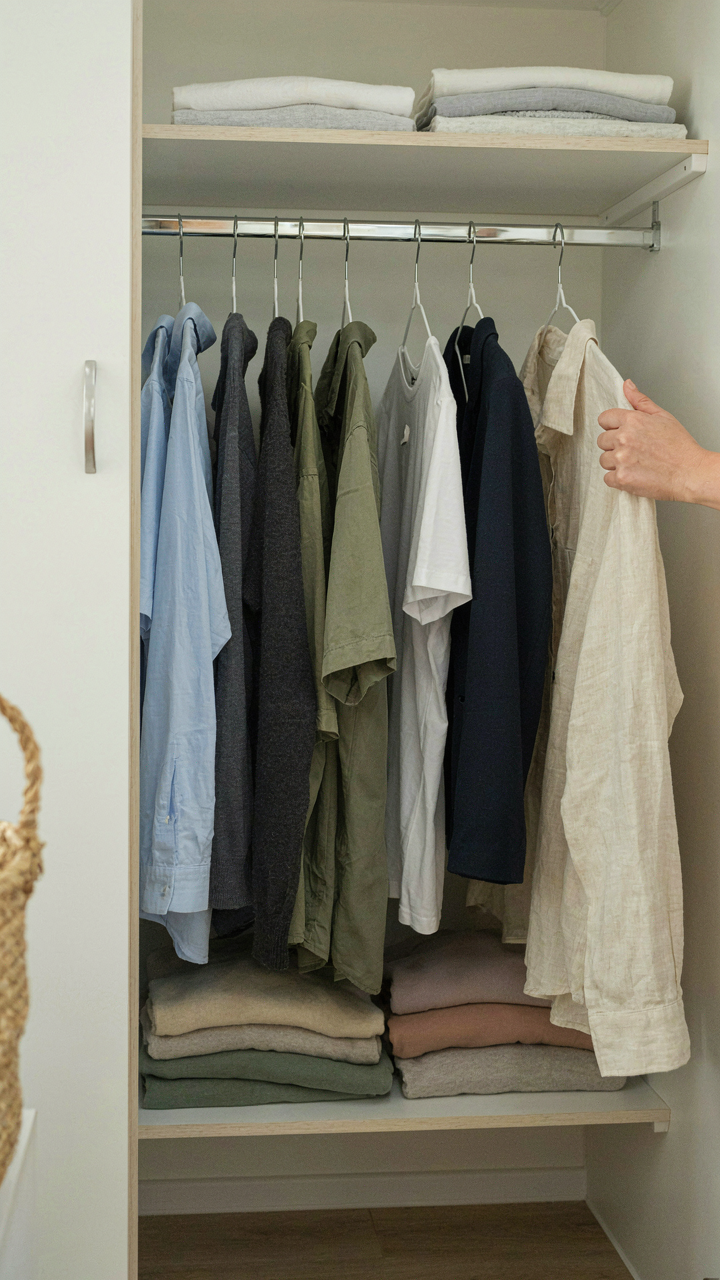
You want this section because you’re tired of digging through a closet that fights you every time you need a shirt. The real mechanism is this: most RV dwellers treat closets like static storage units instead of circulation systems. Clothes enter, pile up, and exit rarely. Borrow from logistics here. In supply chain management, inventory that doesn’t move is dead weight. Your RV garments are the same. They need a defined path from dirty to clean to hung to worn, with zero friction at each stage.
The lifecycle isn’t complicated, but you have to build it deliberately. A shirt enters the RV in your travel bag. You wear it. It goes dirty. It gets washed. It needs re-hanging. Most RV closets break at the re-hanging stage because the system wasn’t designed for repeated cycling. You end up throwing clean clothes on a bunk or shoving them into a drawer. The closet stops being useful. Map this cycle before you buy a single hook.
Frictionless Movement Over Dead Storage
Static hooks and rods store clothes. Frictionless systems move them. This is the difference between a closet that works and one you resent. The common advice here is wrong: people say organize by color or category. That’s inventory thinking. What actually matters is making the path from washer to hanging to wearing take zero mental effort. One step of friction at any point and you’ll default to the floor or a chair.
Design the closet around this: the distance from your washer to the rod should be minimal. The hanging space should have immediate visual access. Clothes you wear weekly hang at eye level, not buried behind seasonal items. Use tension rods or cascading hangers to multiply vertical space without adding depth. The goal is to make re-hanging a three second action, not a puzzle. When friction disappears, the system maintains itself.
Gravity As Your Enemy: Overcoming Camper Closet Storage Ideas Limitations
Folding Beats Hanging In Tight Quarters

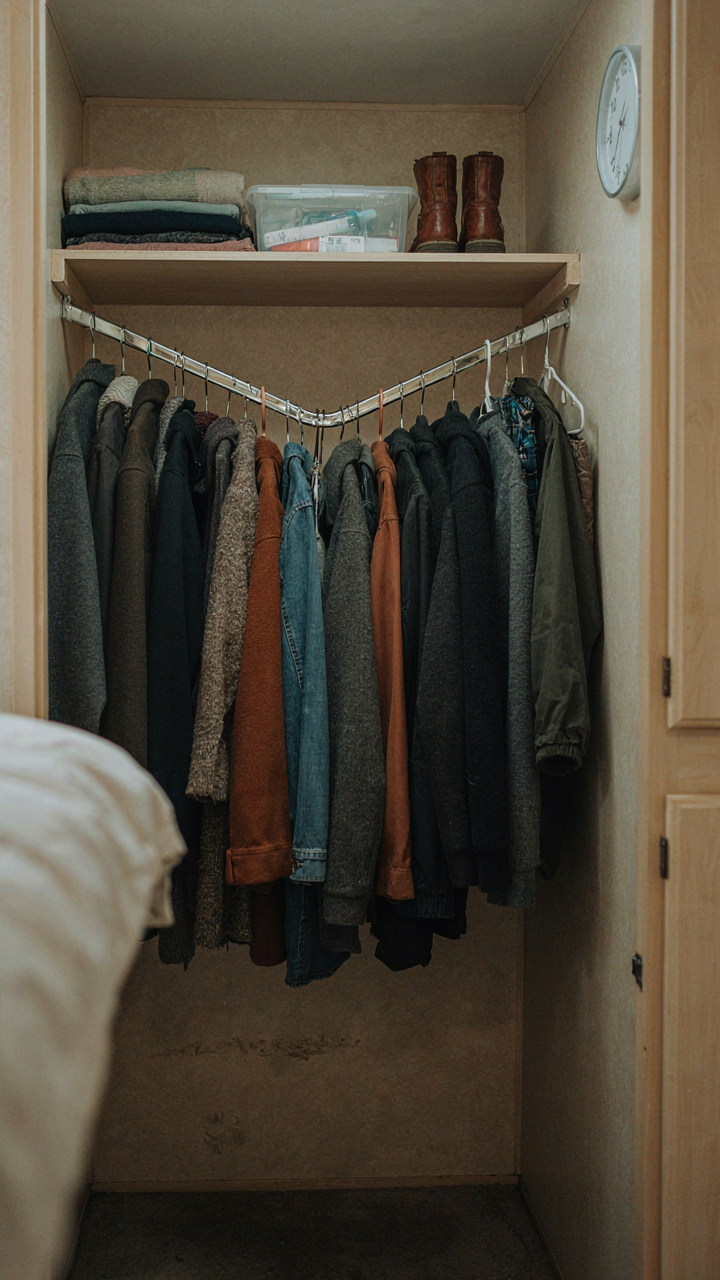
You want hanging space because it feels like you’re doing storage right. That’s the trap. In an RV closet, gravity works against you the moment you load a rod. The physics principle at play here is load distribution: hanging items concentrate weight on a single point, while folded items distribute it across shelf surface area. RVs move. Every bump translates into stress on that rod and the frame holding it.
The real efficiency gain comes from understanding volume per cubic inch. A folded shirt takes up roughly the same footprint as a hanging one but costs you zero structural liability. Hanging should be reserved for items that genuinely wrinkle in transit or items you access daily. Everything else folds. Use tension rods if you must hang, but keep the load under five pounds per rod. Most people hang everything by default, then wonder why their closet hardware fails at mile 200.
Compression For Storage, Not Rotation
Compression bags serve a single purpose: seasonal bulk that stays packed. Do not use them for clothes you cycle through weekly. That defeats the mechanism entirely.
- Winter Clothing Sets: Pack heavy coats, thermal layers, and snow gear in compression bags when moving south. Access once or twice yearly, not daily.
- Off-Season Bedding: Extra blankets and heavy comforters compress to a quarter of their volume. Store above the closet or under bunks when not in use.
- Special Occasion Wear: Formal clothes worn for rare events compress flat and stay protected from movement damage during travel.
- Archived Documents and Records: Tax files, registration paperwork, and manuals compress into organized bags. Seal them and label by year for quick identification.
- Spare Textiles: Extra towels, cleaning rags, and linens take up dead space. Compression cuts that waste without affecting your daily access patterns.
Compression bags create a false economy if you unseal them constantly. The real value is removing seasonal dead weight from your active closet footprint. Calculate what you actually wear in the current season, then compress everything else. This is the protocol that separates functional RV storage from chaos dressed as organization.
The Cybernetic Closet: Feedback Loops For RV Closet Organization Ideas
Track What Actually Gets Worn

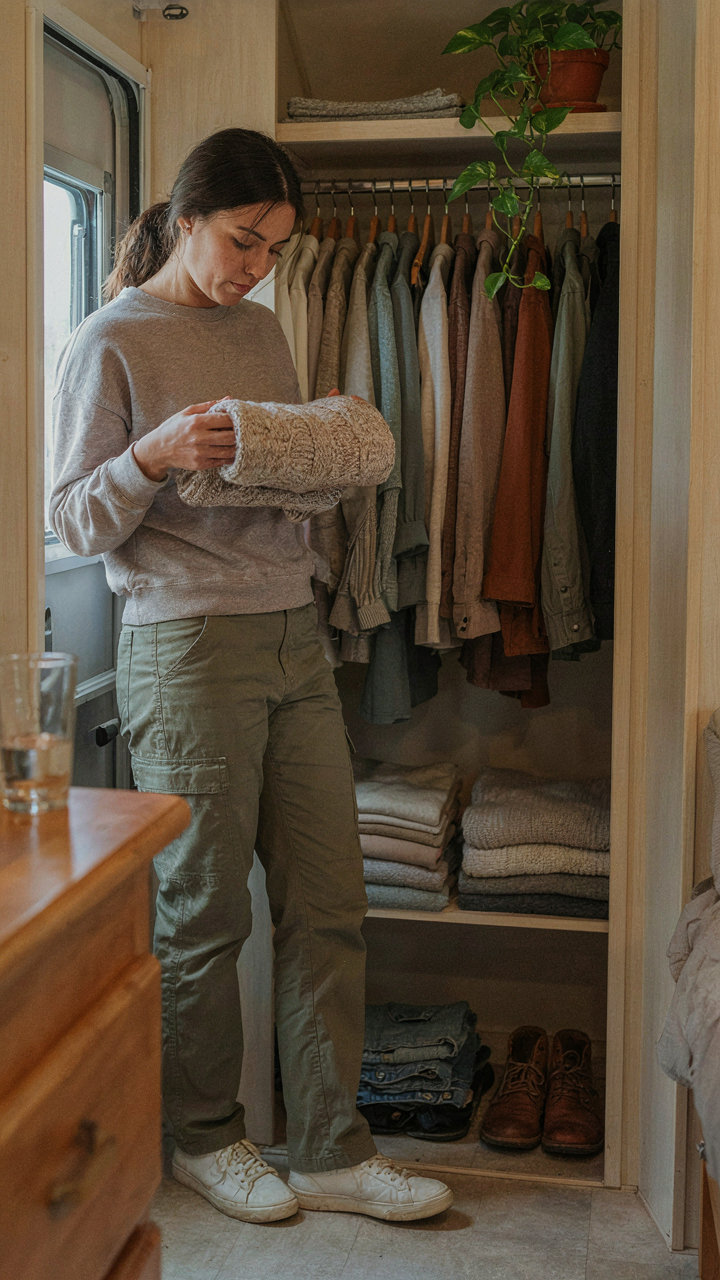
You want to believe your RV closet is efficient, but you’re probably storing dead weight that makes you feel resourceful instead of admitting you don’t need it. Cybernetics, the study of systems that self-correct through feedback, applies directly here: measure input against output. For two weeks, mark every item you actually wear with a piece of tape or mental note. This reveals the gap between what you think you wear and what you actually wear. Most RV dwellers discover they cycle through 40 percent of their hanging space.
The metric that matters is days between wears. If a shirt hangs for thirty days untouched, it’s occupying real estate in a confined space. RV closets don’t reward sentiment. They reward density and access speed. Document which items you touch daily, weekly, and never. This data becomes your closet’s operating system. Without it, you’re organizing blind.
Monthly Reset And Recalibration
People skip this step because it feels like busywork, but recurring evaluation is where the system actually works. Set a calendar reminder for the first Sunday of each month and spend fifteen minutes doing a complete visual inventory. Look at what moved versus what stayed static. Did seasonal shifts change your wearing patterns? Did you buy new items that displaced old ones? The feedback loop closes when you act on the data, not just collect it.
Each cycle, remove one item that didn’t move the previous month and consolidate the remainder tighter. This creates compounding efficiency gains. Your RV closet becomes a living system instead of a static storage box. After three months of monthly resets, you’ll own the exact wardrobe you actually wear and nothing else.
Verticality Deconstructed: Smart RV Closet Storage Solutions
Not All Height Is Usable Height

You want to believe every inch of wall space is real estate. It isn’t. The real problem is that RV closets have dead zones—spaces that look vertical but don’t function that way because of door swing, frame obstruction, or simple ergonomic reach. You’ll waste money and time installing gear in zones you can’t actually access without contorting yourself or moving other items first.
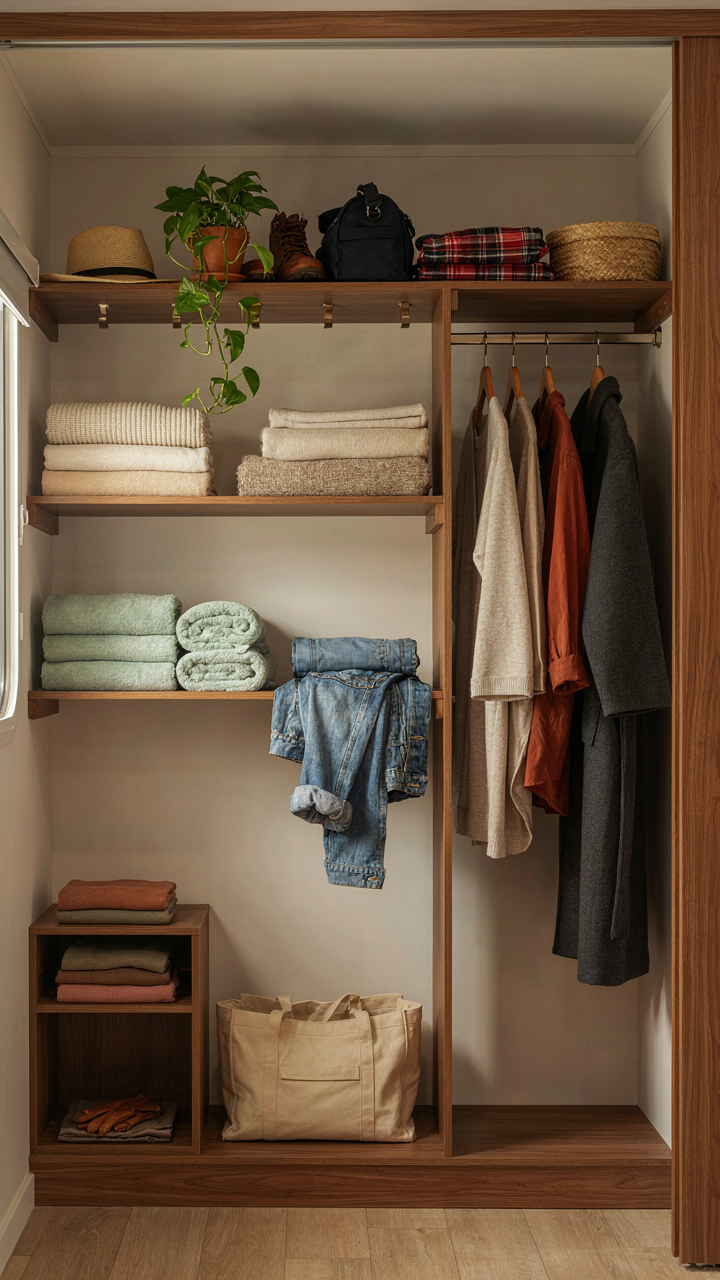
Start by mapping your closet like architects map load-bearing walls. Stand inside. Mark the zone from floor to 18 inches—you’ll bang your shins and lose items here. Mark the zone from 72 inches up—you won’t reach it without a step stool, defeating the point. The real working zone sits between 18 and 72 inches. Door swing takes another 12-18 inches of that zone out of play. What remains is your actual vertical real estate. Only deploy storage systems in zones you can access in under three seconds without moving anything else.
Command Hooks And Tension Rods Work Because They Solve Different Problems
Most RV closet advice lumps these together like they serve the same function. They don’t. Tension rods create a secondary hanging rail—they multiply your hooks per square inch but only if you mount them correctly. Command hooks solve the soft-landing problem: they hold weight without wall penetration, matter in fiberglass RV walls where drilling creates failure points.
Tension rods work when you’re hanging light items—belts, scarves, lightweight jackets. Mount the rod 12-15 inches below your primary hanging rail and secure both ends fully. Command hooks anchor to vertical studs or solid wall sections only, never to curved fiberglass. Test each hook under load before trusting it. Deploy tension rods in the 18-72 inch zone only. Place command hooks where you need quick-grab access—jacket loops, bag straps, daily rotation items. The mechanism is simple: tension rods multiply hanging capacity per unit of space; command hooks multiply access points without wall damage.
The Illusion Of Versatility: Dedicated Zones For RV Organization
Stop Mixing Categories

You want your RV closet to work harder so you don’t have to think about where things go. That’s the real reason this matters. The mechanism is friction: every time you break your own rule about where an item belongs, you create a decision tax. Your brain deploys energy deciding between zones instead of just grabbing what you need.
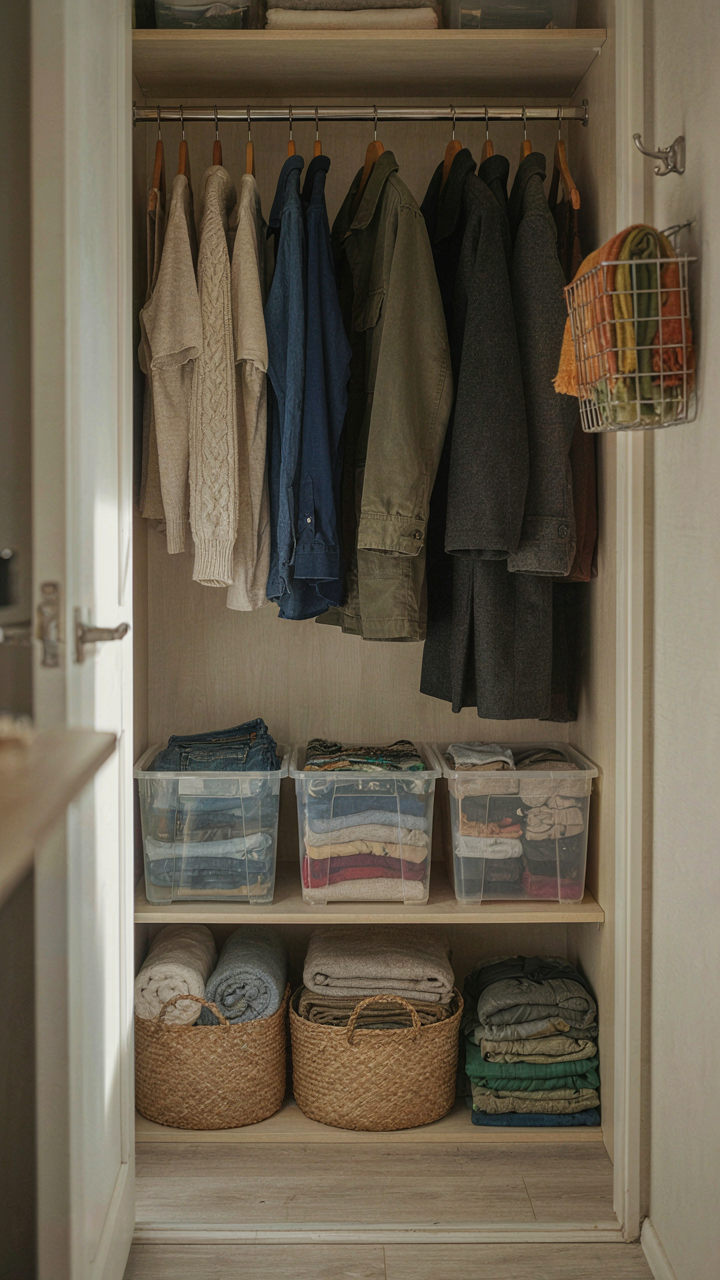
Multi-purpose storage zones sound efficient in theory. They’re not. A shelf that holds both seasonal clothes and camping gear forces you to excavate. You move the camping gear to reach the clothes. You move the clothes to find the gear. What felt flexible becomes a Jenga game. Single-category zones eliminate this entirely. Everything has one home.
Assign Fixed Locations By Function
Think in terms of inventory control from warehouse logistics. Each bin, shelf, or rod section becomes a stock keeping unit. You’re not organizing by color or material. You’re organizing by function, frequency, and retrieval speed. Clothes you wear weekly go at eye level. Off-season items go up high. Rarely-touched gear goes low or in the back corner.
The mistake most RV owners make is treating the closet like a bedroom closet at home. You can’t afford that luxury in 32 square feet. Assign one zone for daily wear. One for layering pieces. One for formal or infrequent items. One for outdoor gear. One for shoes. Stop rotating items between zones. Once you set a zone, it stays that zone. This removes all ambiguity and cuts search time to seconds.
Beyond The Hanger: Unconventional RV Closet Hacks For Volume
Rolling, Stuffing, And Compression Methods

You want more space without admitting you brought too much. Here’s the mechanism: volume reduction beats reorganization every time. Clothing occupies dead air. Remove that air, and you’ve solved the real problem, not just shuffled it around.
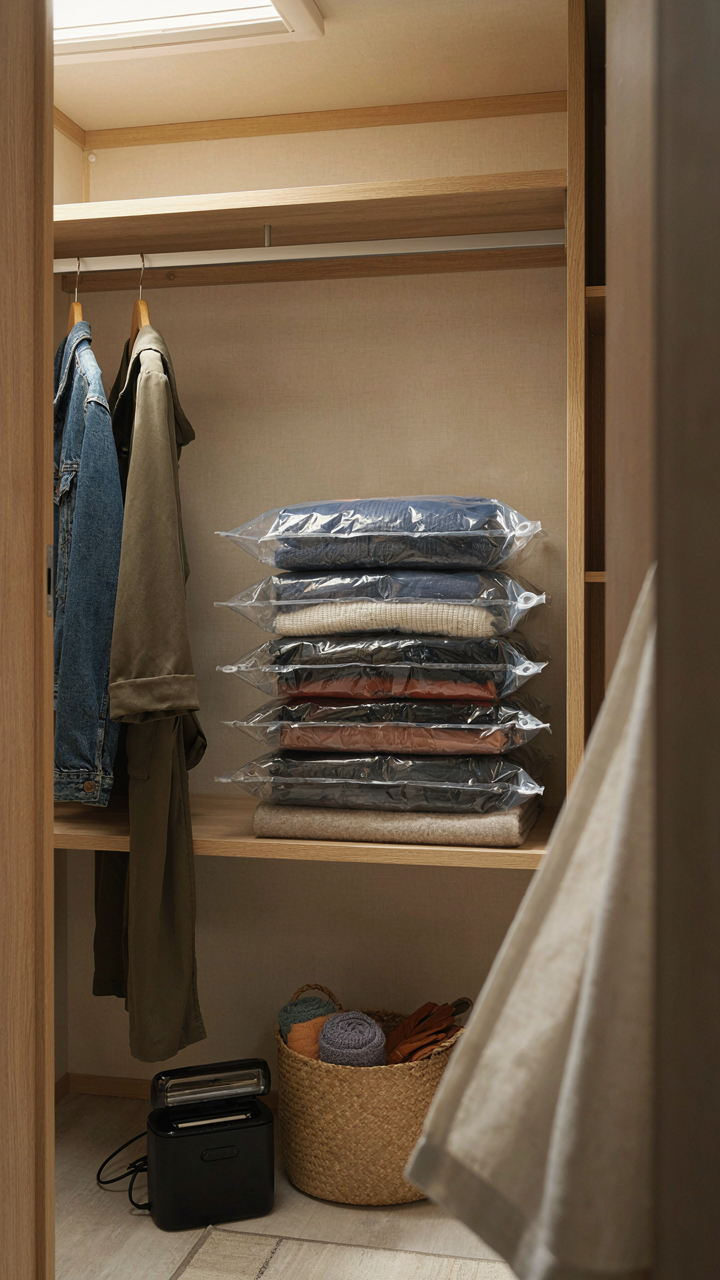
Rolling clothes compresses them vertically and prevents the cascading collapse that happens with folding in tight spaces. Vacuum seal bags work on the same principle as industrial shrink-wrap, removing oxygen to cut volume by 60 to 75 percent. The trade-off is access speed. You trade quick retrieval for density. In an RV, density usually wins because you’re not rotating wardrobes weekly.
Stuffing works differently. Compression bags let you squeeze items into overhead bins or under-seat storage without the vacuum seal commitment. Stuff a jacket into a gallon freezer bag, press out air by hand, and it occupies a quarter of its original space. This method keeps items accessible without equipment. The downside is it’s slower than hangers and takes discipline to maintain organization within the bags themselves.
Extending Into Adjacent Storage Zones
Most RV closet solutions treat the closet as an island. It’s not. Your closet connects to dead zones: under the bed, overhead cabinets, and the space above the door frame. These aren’t extensions. They’re the actual storage system if you design for them.
Under-bed storage slides hold bulky items out of sight but within arm’s reach. Seasonal clothes, extra bedding, and off-rotation shoes live here. The bed itself becomes part of your closet infrastructure. Measure the clearance first. Most RV beds sit eight to ten inches high. Standard storage bins fit, but barely. Custom-fit bags designed for under-bed use take up 30 percent less space than rigid containers.

Overhead cabinets above the closet rod or near the ceiling store lightweight items: empty hangers, out-of-season accessories, backup toiletries. Install pull-down hooks or tension rods to create a second hanging tier. Over-the-door organizers add pockets for socks, underwear, and accessories without consuming floor or wall space. Stack these zones deliberately. The protocol is simple: frequent access items at eye level, seasonal or backup items above, bulk storage below.
Maintenance, Not Miracle: Sustaining Your RV Closet Storage Ideas

The Audit That Actually Works
You want to believe your system will stay organized without effort. It won’t. The real mechanism here comes from inventory management: you must conduct regular purges or your closet reverts to chaos within weeks. This isn’t about motivation. It’s about the math. Every item you add without removing something else compresses the system. Small RV closets hit capacity fast, and once they do, nothing stays where you put it.
Schedule a ruthless audit every four to six weeks. Pull everything out. Touch each piece. Ask one question: have I worn this in the last two months? If no, it leaves the RV. Don’t negotiate with yourself about “someday” or “just in case.” Someday never comes, and just in case costs you usable space right now. The items that stay get hung and folded according to your system. Everything else exits.
The One Move That Stops Backsliding
Most people fail here because they treat storage as a destination, not a behavior. The mechanism is simple: friction kills habits. If putting something away takes more effort than dropping it on the bed, you will drop it on the bed. Every single time. Remove that friction entirely by positioning hangers at eye level and keeping high-traffic items in the easiest-to-reach spots.
Enforce a “don’t put it down, put it away” rule the moment you enter the RV. This takes three weeks to lock in as automatic behavior, not discipline. Hang the jacket before you sit. Fold the shirt before you check your phone. The closet only works if every item has a designated spot and you return it there within seconds of undressing. One exception, one time, and you’ve given yourself permission to make exceptions. The system collapses when you treat it like a suggestion.
The True Cost Of Clutter: Time, Energy, And Mental Space

Daily Friction From Bad Storage
You care about this because you’re losing time you’ll never get back. Here’s the mechanism: every morning in an RV, you make micro-decisions about what to wear. Disorganized hanging space forces you to move items repeatedly to access what you need. That’s decision fatigue before your day starts. One study on decision-making shows that each trivial choice depletes cognitive resources. In an RV where space is finite, a poorly organized closet compounds this drain across every single day.
Most RV owners think the solution is buying more hangers or installing extra rods. Wrong. The real friction isn’t the number of hangers. It’s the time spent searching, the mental load of remembering where things are, and the physical effort of rearranging items you’ve already hung. A well-organized closet reduces daily search time to under two minutes. A cluttered one stretches that to five or ten. Over a year, that’s hours wasted on a task that should be automatic.
Mental Load Depletes Decision Making
Cognitive psychology shows that visual clutter drains working memory. Your brain processes every item in your line of sight, even subconsciously. In an RV closet, this means each poorly organized hanger or tangled stack of fabric pulls mental resources away from actual decisions. You can’t think clearly about navigation, cooking, or planning when your environment is sending conflicting signals about what’s accessible and what isn’t.
The mechanism is simple: reduce visible options to increase mental clarity. When your hanging space shows only the items you’ll actually wear this week, your brain stops processing the rest. This frees bandwidth for tasks that matter. The closet stops being a source of low-level anxiety and becomes a tool. That shift happens when you implement a visible, predictable organization system and maintain it without exception.
The Only Real RV Closet Hack Is To Confront Your Attachment To Excess, Not To Invent Another Storage Gimmick

You don’t need another hanging organizer. You need to stop buying clothes you won’t wear. Every RV closet hack you’ll ever find is just a band-aid on the real problem: you’re carrying too much. Pull everything out today. Try on each piece. If it doesn’t fit or you haven’t worn it in three months, it goes. The best storage system is having less stuff to store in the first place.